Author: boxchilli

Mono-printing our telephone journeys

Southampton-based artist, Joey Walters has been commissioned to run a series of family-friendly art sessions at John Hansard Gallery for our project. We are delighted to be working with Joey, based at Arches Studios, who is devising art activities exploring young people’s telephone use.

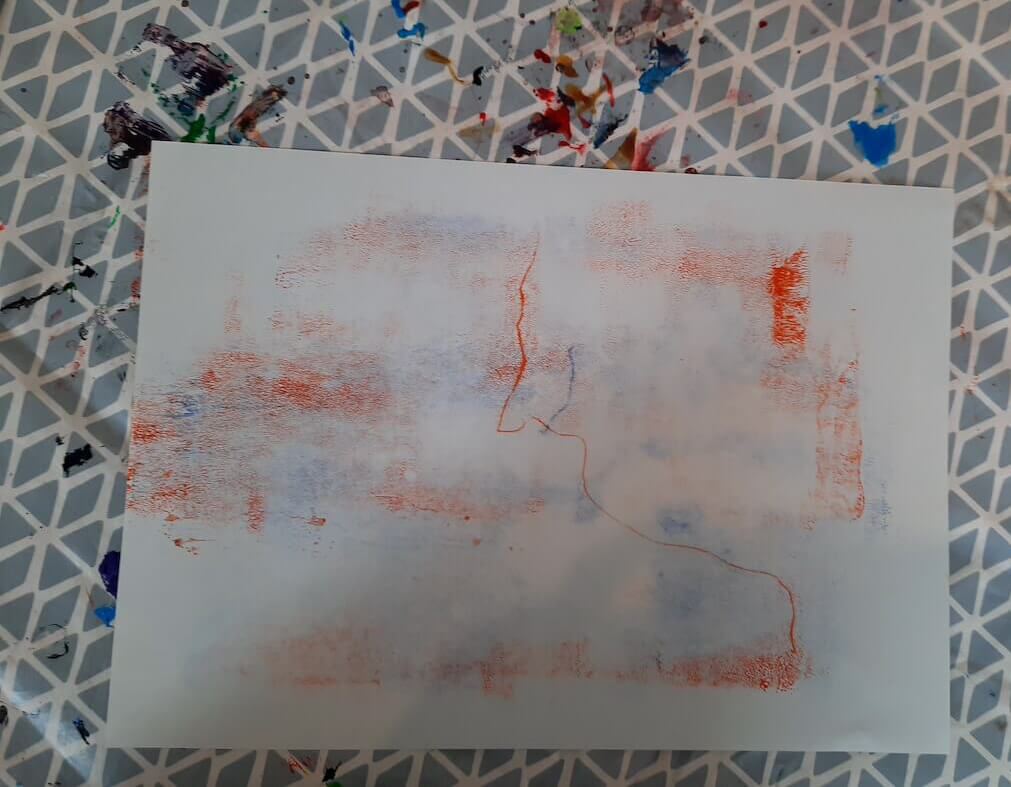
In the first Space to Create! session linked to the project, Joey showed families how to create a mono-print using paint to illustrate the journeys we go on with our phones. The idea was to visualise the way our phones physically travel (in our bag or pocket), and how this connects us to wider networks.

Using maps of Southampton, participants traced lines between points where they had used their phone, and journeys they had taken with their phone. The prints were created using coloured inks to show abstract coloured lines that represented the connections made by phone use.

Spreading the ink with the roller was a particular hit amongst young participants at the sessions! As art galleries have begun to re-open again following the second Covid-19 lockdown, the workshop also offered families a space to come into to spend time together making something.

Creating the mono-prints prompted participants to reflect in different ways about the scales of our phone use today – how a phone can connect people across the extent of a city – and the degree to which we rely on technology, not only for talking to friends and loved ones, but also for navigating our daily lives. Mapping where they travelled with their phone also encouraged participants to think about how they move around Southampton – by bike, on foot, on public transport, or car.

Space to Create! sessions linked to the project are happening at John Hansard Gallery until September 2021; they are free and open to everyone.

Telephonic Youth launches new logo

We are very excited about our new bespoke project logo. Our logo has been designed by Studio 3015, a creative and educational space based within the Winchester School of Art, part of the University of Southampton.

The text for the logo – ‘Telephonic Youth’ – aims to capture the idea of how significant telephones have been in children and teenagers’ lives, and how connected young people were to telephone technologies in the 1980s and 1990s. These are key themes we are exploring on our research project.

Studio 3015’s brief was to create a logo using the phrase, ‘Telephonic Youth’ that embodied a certain era of telephone use in the 1980s and 1990s. The logo has been created from a graphic coil vector. It takes reference from the phone cord on landline phones people used at home, at work and in public phones. Although cordless phone sets were coming to the market in the UK in the 1980s, many phone sets were still designed with a connecting cord into the 1990s. This meant in this era many people’s experience of using telephones was to be rooted in one space, where the telephone was set up.

Back in the archives

As libraries and archives have started re-opening in recent months, so Telephonic Youth has got to work. Over the last few weeks, we have been visiting the British Library and researching in their collections of young children’s storybooks about telephones.

Many of these books have alliterative or rhyming titles. A Telephone Called Tim tells the story of a blue wall-mounted telephone called Tim, and his relocation from a telephone warehouse to his first job, in the home of a doctor and his wife. Telephone Ted traces the story of a teddy who plucks up the courage to answer the phone when it rings when the family is out, but struggles to be understood. Ted moves from feeling sad, to angry to happiness when he finally ‘gets through’ to another teddy friend who lives across the street. Ting-a-ling follows a toddler playing on a telephone and her imagined conversations.