Filter by:

Tiger by the Tail (1984)

Tiger by the Tail (1984)

Public Telephones (1985)
Public Telephones (1985)

Call Across the World (1985)

Call Across the World (1985)

Electricity and Telecommunications [Teaching pack] (1991)
Electricity and Telecommunications [Teaching pack] (1991)

Children at primary school, Sussex (1987)
Children at primary school, Sussex (1987)

999 Teaching resource poster
999 Teaching resource poster

999 Emergency Service (1995)

999 Emergency Service (1995)

Emergency 999 (1988)
Emergency 999 (1988)

Payphone Says…Street Wise Kids Don’t Vandalise! (1987)
Payphone Says…Street Wise Kids Don’t Vandalise! (1987)

Child holding a painting for the competition ‘Protect your payphone’ (1989)
Child holding a painting for the competition ‘Protect your payphone’ (1989)

Pete-payphone (1994)
Pete-payphone (1994)

Sound amplifying watch receiver
Sound amplifying watch receiver

Westminster Children’s Hospital patient
Westminster Children’s Hospital patient

Lyons Coco Brek cereal box
Lyons Coco Brek cereal box

Young people using Tremolo phone
Young people using Tremolo phone

Now! Talkabout
Now! Talkabout

Truly, Madly, Deeply in Love? Tell the World (Not your Mum and Dad) (1992/3)

Truly, Madly, Deeply in Love? Tell the World (Not your Mum and Dad) (1992/3)

Private Payphone (1994)
Private Payphone (1994)

Student Services
Student Services

Phonecard Christmas promotion (1990)
Phonecard Christmas promotion (1990)

BT Phonecard BT63 Student Plus (1992)
BT Phonecard BT63 Student Plus (1992)

BT Phonecard BT227 (1994)
BT Phonecard BT227 (1994)

Is it Fair to Blame Fisher-Price for the Size of your Phone Bill? (1997)

Is it Fair to Blame Fisher-Price for the Size of your Phone Bill? (1997)

Teenager (1999)

Teenager (1999)

The records shown in the exhibition are part of BT Group Archives’ collection. Learn more about BT’s history here.

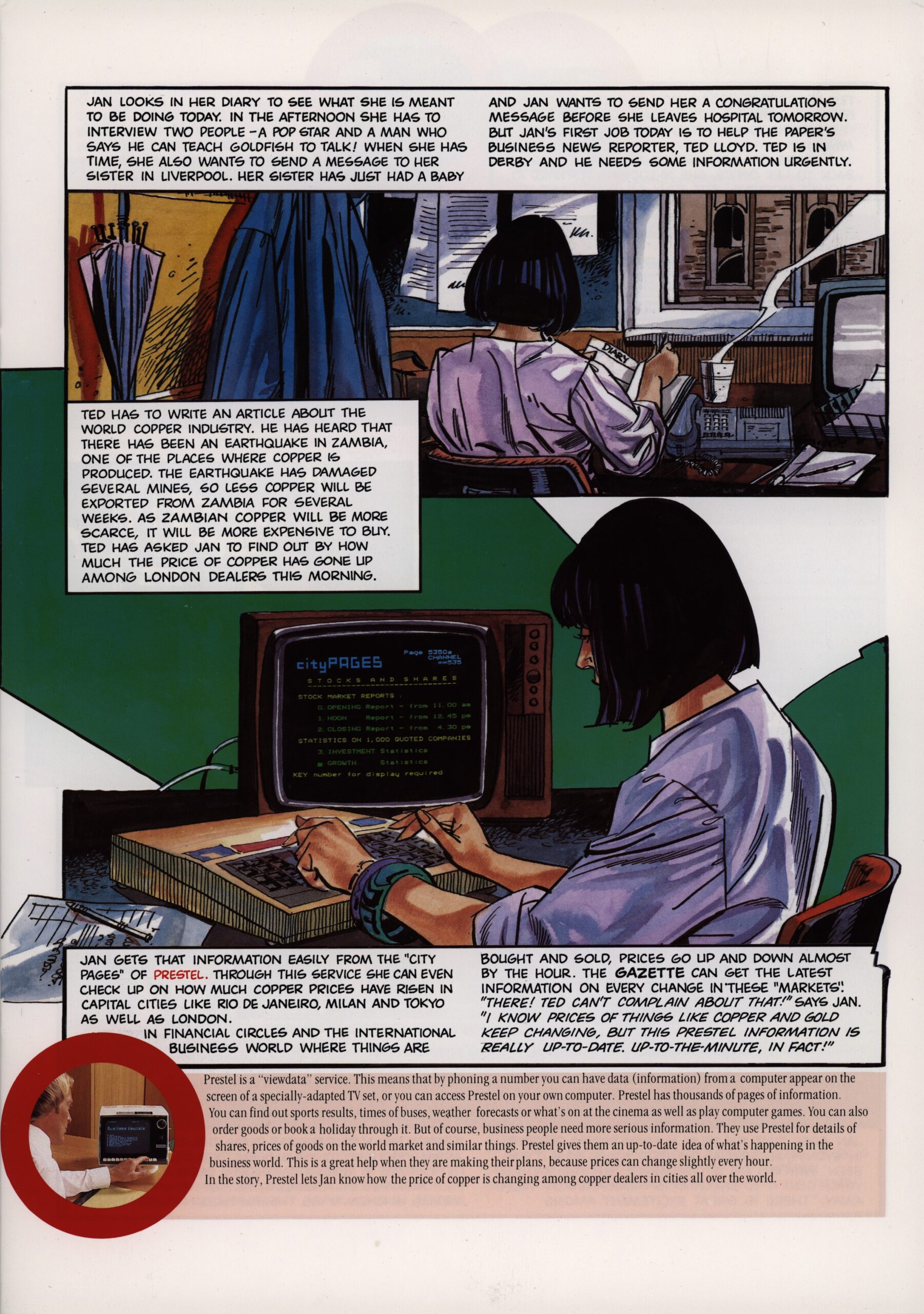
Tiger by the Tail (1984)

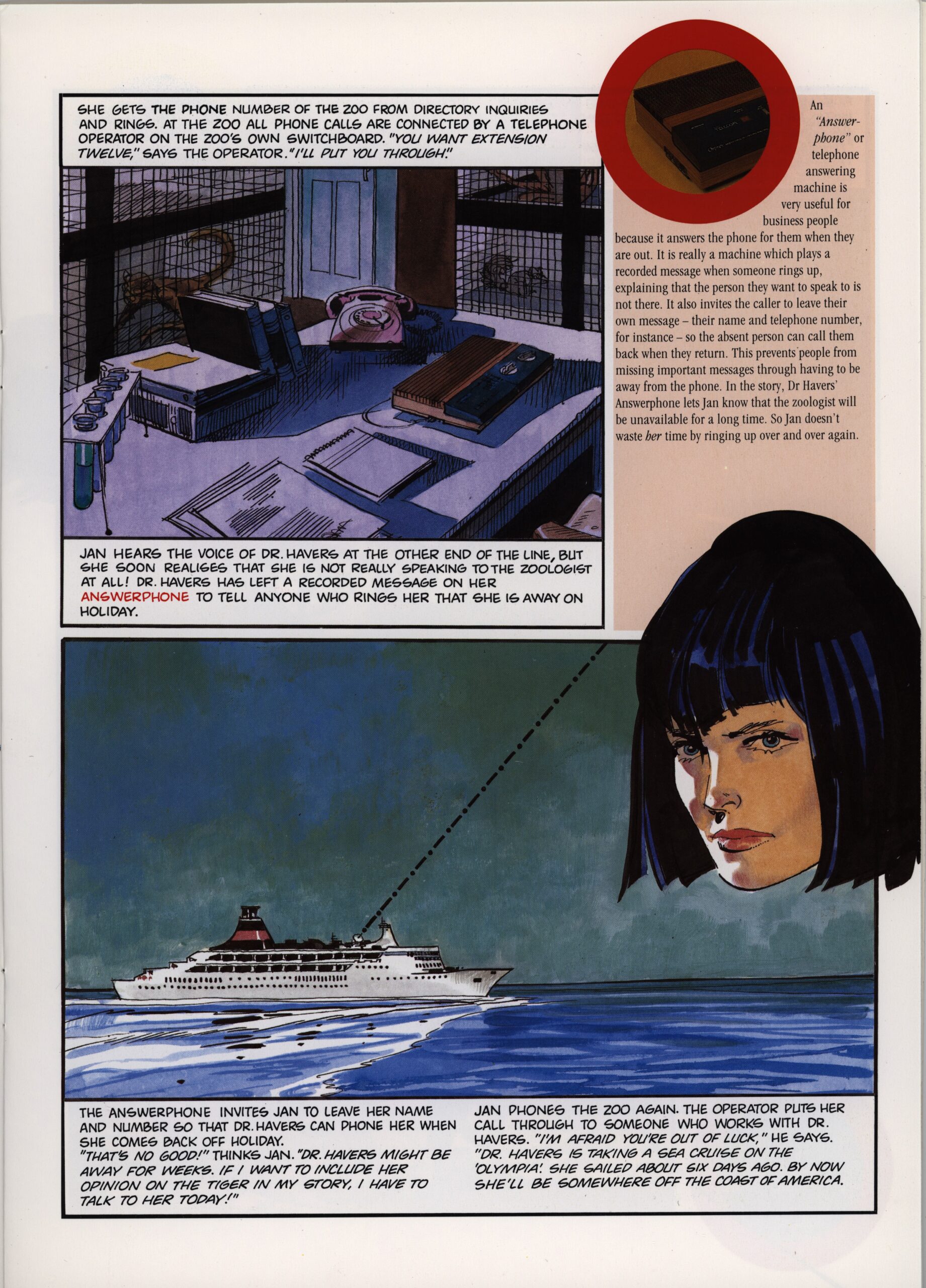
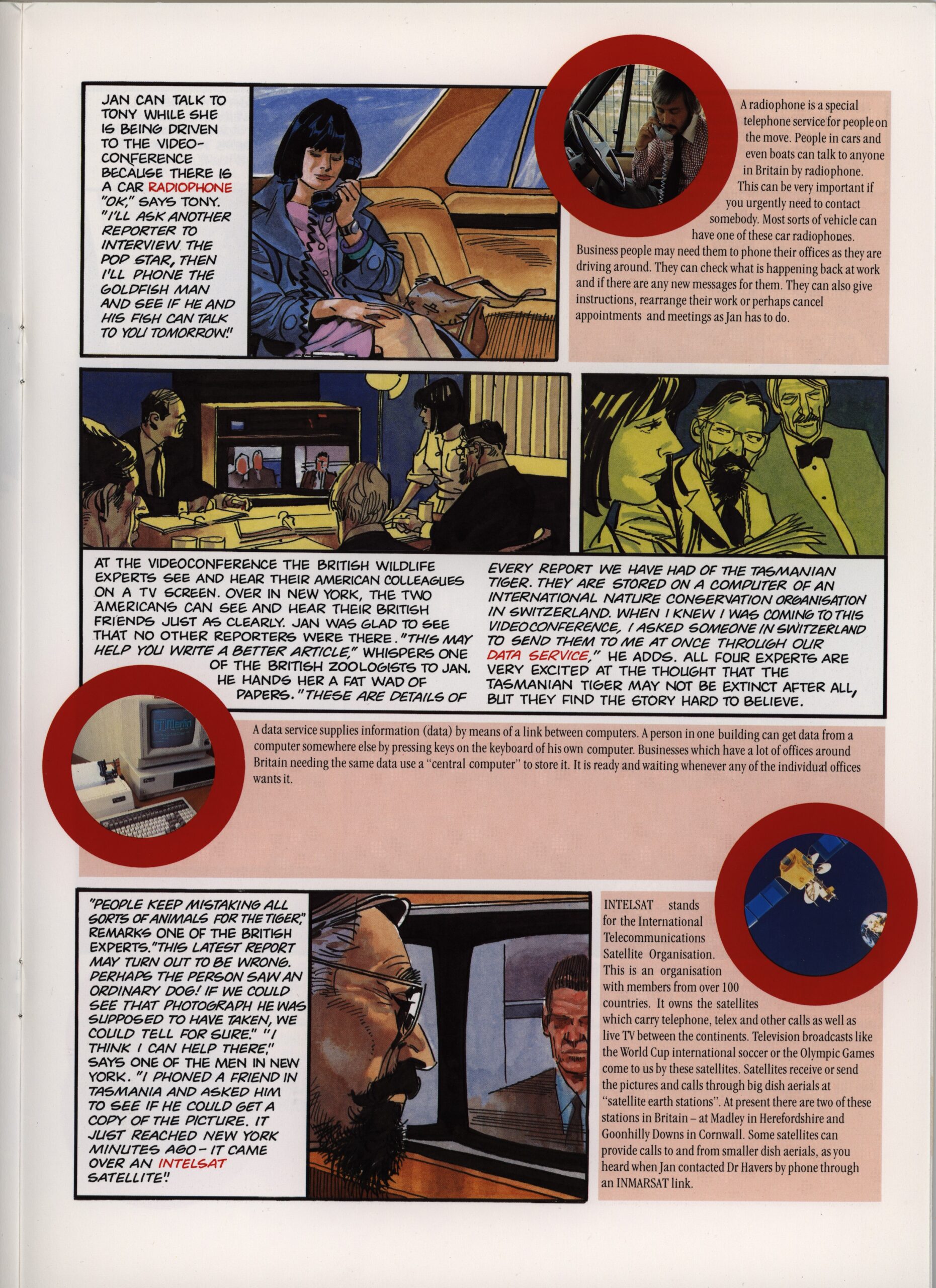
Tiger by the Tail is a story written and illustrated by the comic book artist, Michael Goss, and published by British Telecom Education Service in November 1984 (shortly after British Telecom became a privatised company). Aimed at 11-15 year olds, it centres around Jan, a young journalist who is writing a newspaper story about the sighting of a Tasmanian Tiger, and who is shown adopting many recent developments in telecommunications services. Jan uses a range of modern services throughout her working day, including Prestel (British Telecom’s Viewdata technology), answerphone, car phone and a videoconferencing service.

BT Group Archives: TCD 264/ES 50

Public Telephones (1985)

Public Telephones (1985)

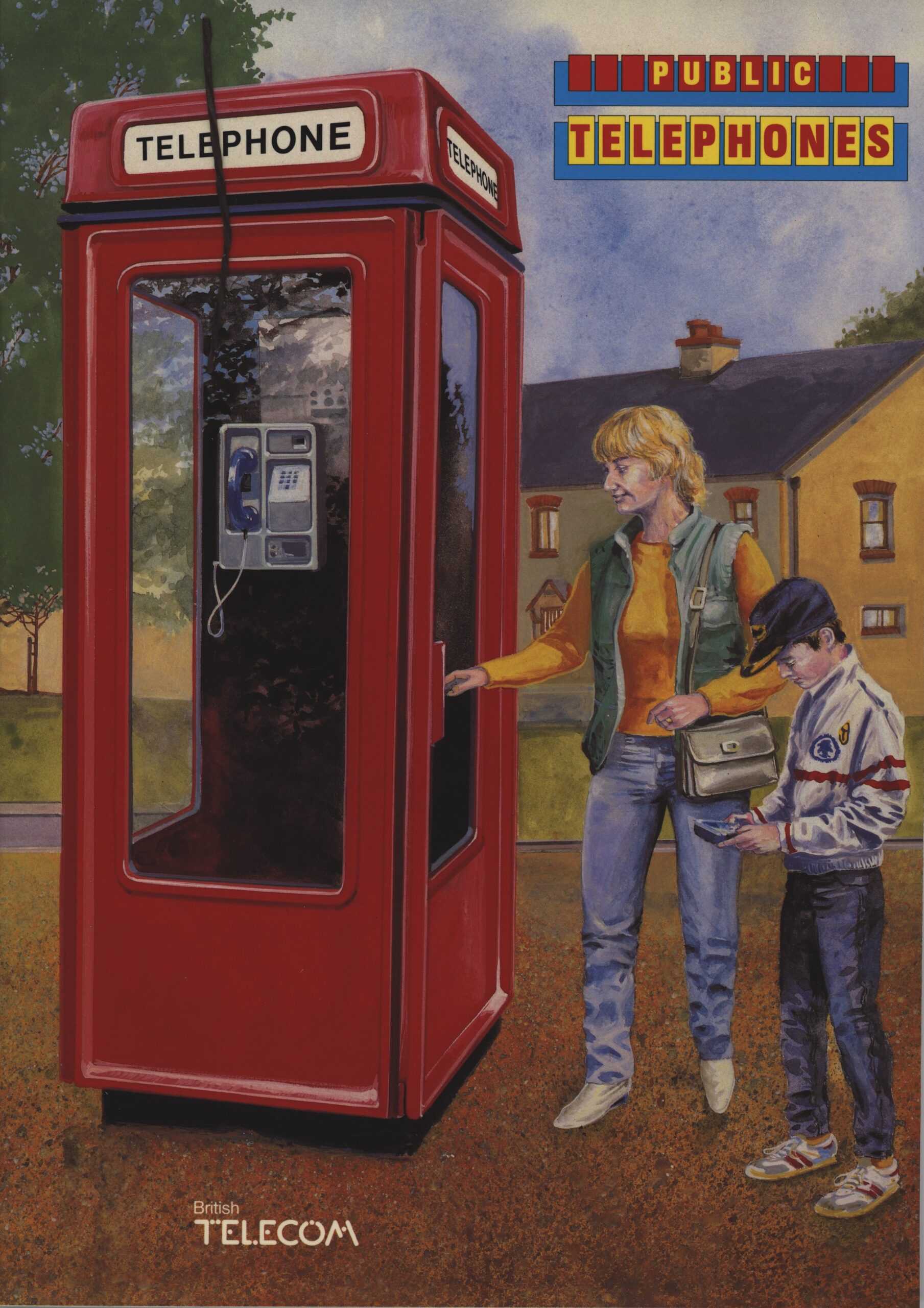
In 1985, the year following British Telecom’s privatisation, there were 77,000 BT payphones in public kiosks in operation in Britian. Telephone kiosks provided an everyday and an emergency service for children and adults alike. They could be essential to people who did not have a landline telephone at home. Public Telephones, a pack produced for primary school pupils aged 7-11, was also published by British Telecom Education Service. It included a children’s brochure, teacher’s notes and activity cards charting the history of public telephones in the UK from the 1880s. The front cover of the pack used an illustration of the K8 telephone kiosk, which had been introduced by the General Post Office in 1968. This kiosk model was superseded in 1985 by BT’s new KX100.

BT Group Archives: TCD 264/ES 59

Call Across the World (1985)

Call Across the World (1985)

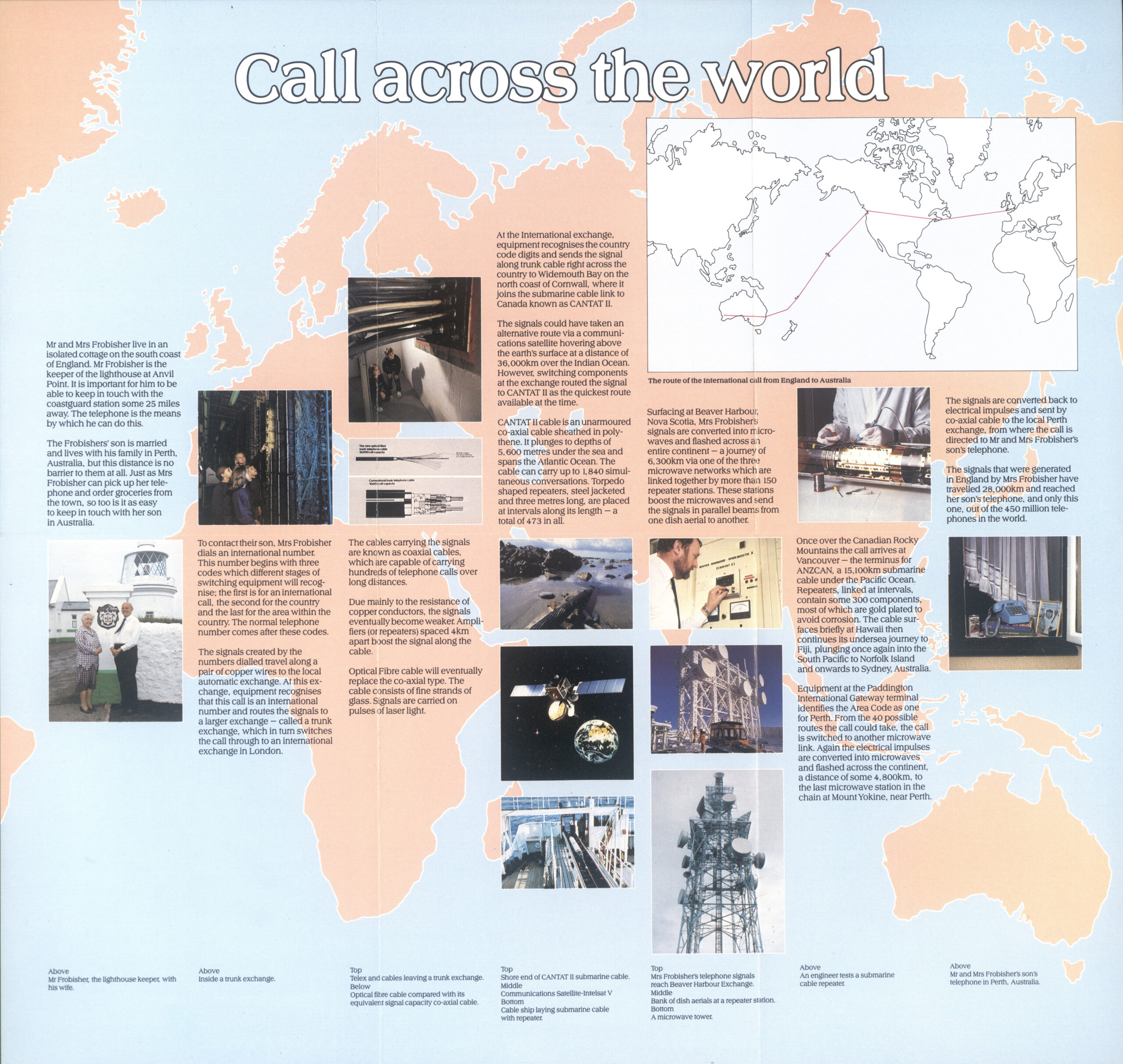
How did a telephone call travel across the world? Call Across the World was a video produced by British Telecom to answer this question. Fronted by the children’s television presenter, Tommy Boyd, it described the 28,000km journey of a phone call from Dorset, in the south of England, to Perth, in Western Australia. The video explained to young children the engineering that was needed to support an international call through cables and networks of telephone exchanges. This accompanying poster for use by teachers mapped the journey taken by the phone call from England to Australia, which enabled a mother to talk to her adult son using just two telephones ‘out of the 450 million telephones in the world’.

BT Group Archives: TCD 264/ES 69

Electricity and Telecommunications [Teaching pack] (1991)

Electricity and Telecommunications [Teaching pack] (1991)

In 1988 The National Curriculum was introduced in primary and secondary schools in England and Wales. Following this, British Telecom Education Service produced teaching aids to support parts of the new science and engineering curriculum.  The 1991 pack, Electricity and Telecommunications supported GSCE curriculum in physics and electronics, and was intended as a resource for teachers delivering lessons to 13-16 year olds. The section on the telephone included a test for school pupils about the evolution of the telephone, and an activity asking them to rank the functions of a modern electronic telephone.

BT Group Archives: BT2-COM11/5

Children at primary school, Sussex (1987)

Children at primary school, Sussex (1987)

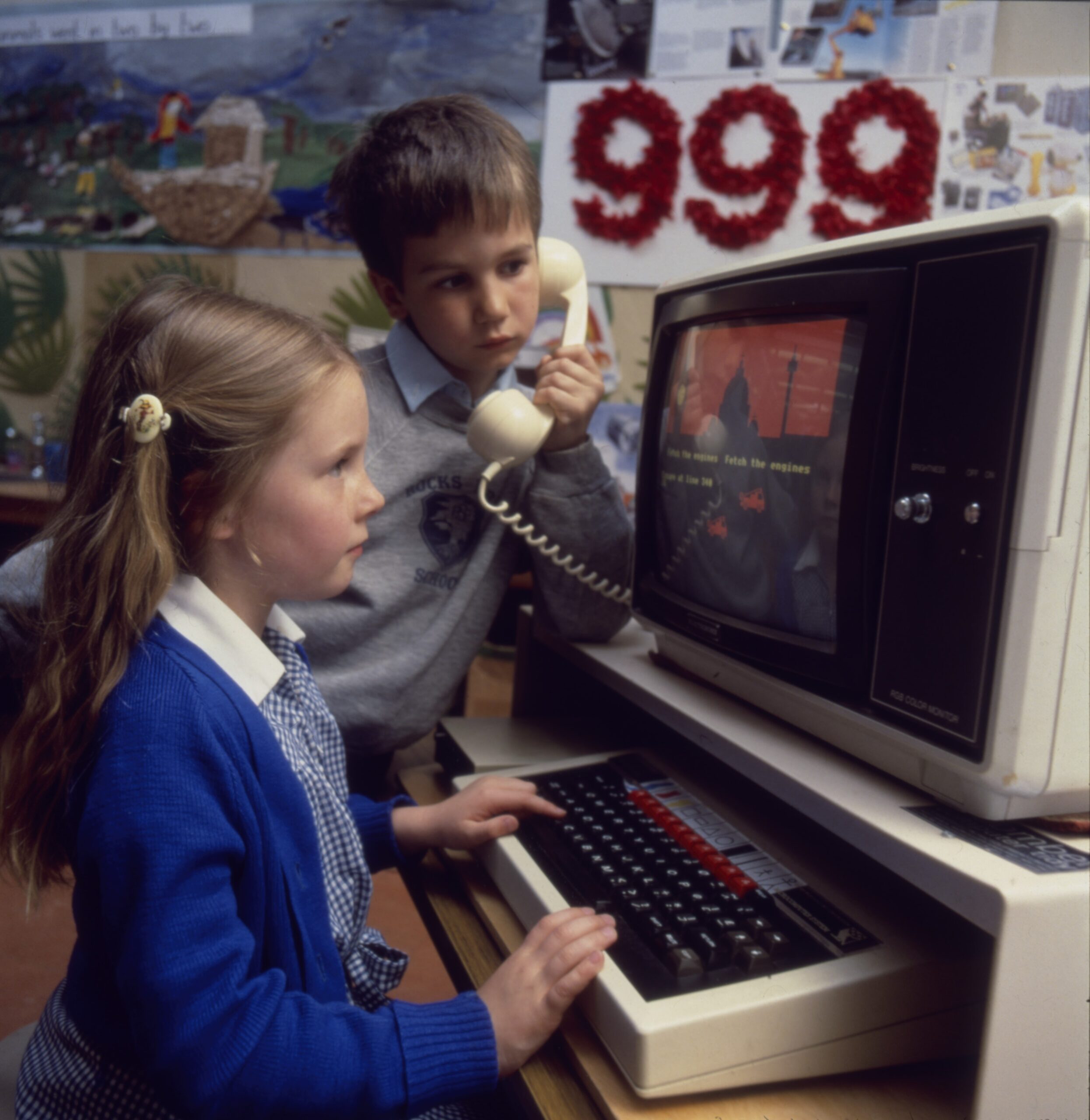
For young children, early learning about telecommunications often focused upon the role telephones might play in an emergency. This photograph shows two young children at a primary school in Sussex in 1987 learning about the 999 UK emergency service through playing a computer game. Computer software packages, including games, became an important part of British Telecom’s educational provision from the mid-1980s onwards, and were developed in collaboration with the Computers in the Curriculum Project at King’s College, London. The 999 emergency service number had been introduced in 1937, and celebrated its 50th anniversary in 1987.

BT Group Archives: TCC 474/HF 54/84/1

999 Teaching resource poster

999 Teaching resource poster

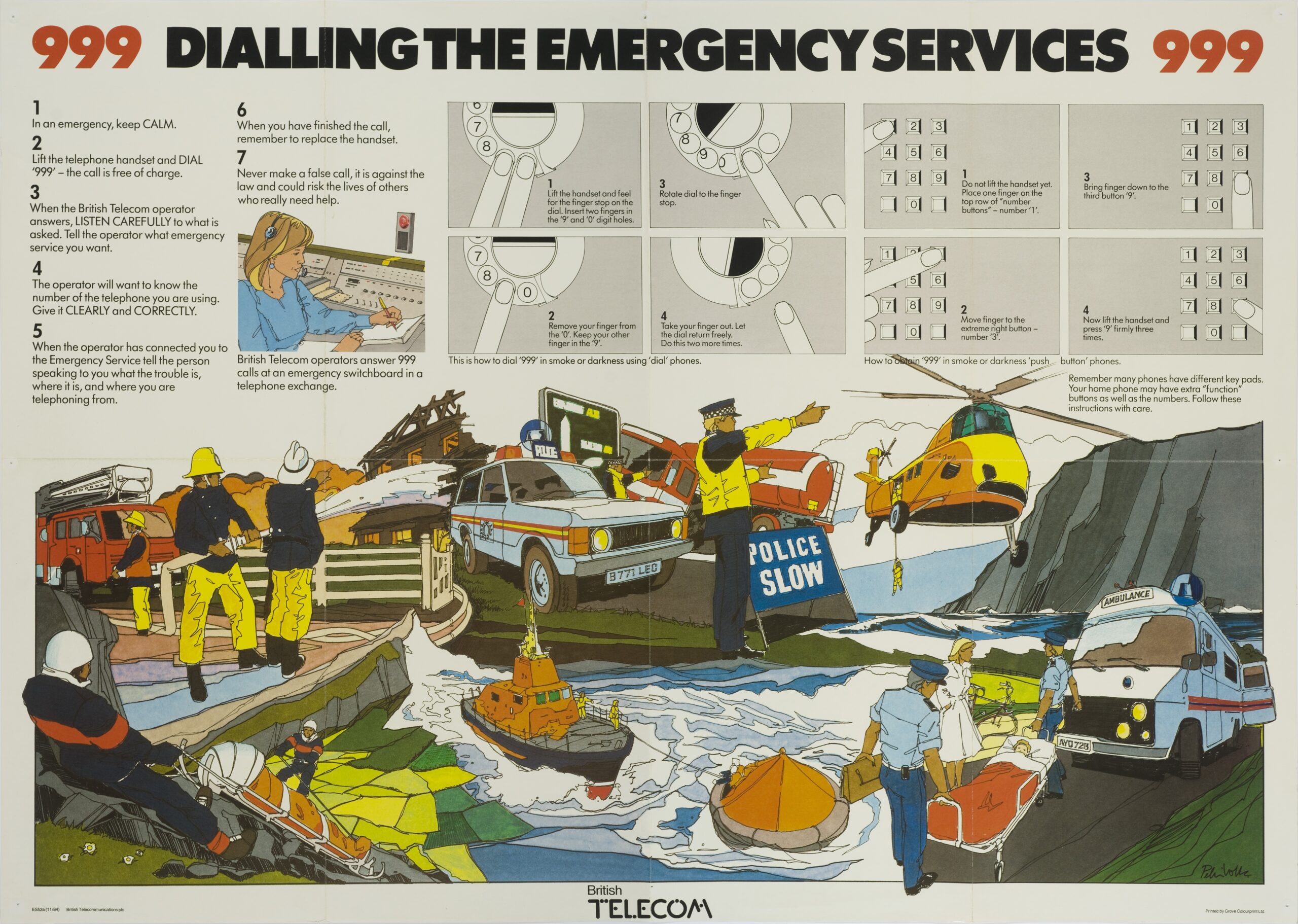
In 1984 British Telecom produced a teaching resource pack for primary schools on the ‘999 Emergency Service’. This poster illustrated the five emergency services that can be accessed via the 999 telephone number: police, ambulance, fire brigade, mountain rescue and coastguards. It also featured graphics on how to connect to 999 in smoke or darkness using a rotary dial telephone and a push button telephone. The teacher’s notes accompanying the poster suggested supporting activities for pupils, including practising dialling 999 on toy phones or old telephone handsets, and writing incident cards on how to deal with different emergency situations.

BT Group Archives: TCD 264/ES 52

999 Emergency Service (1995)

999 Emergency Service (1995)

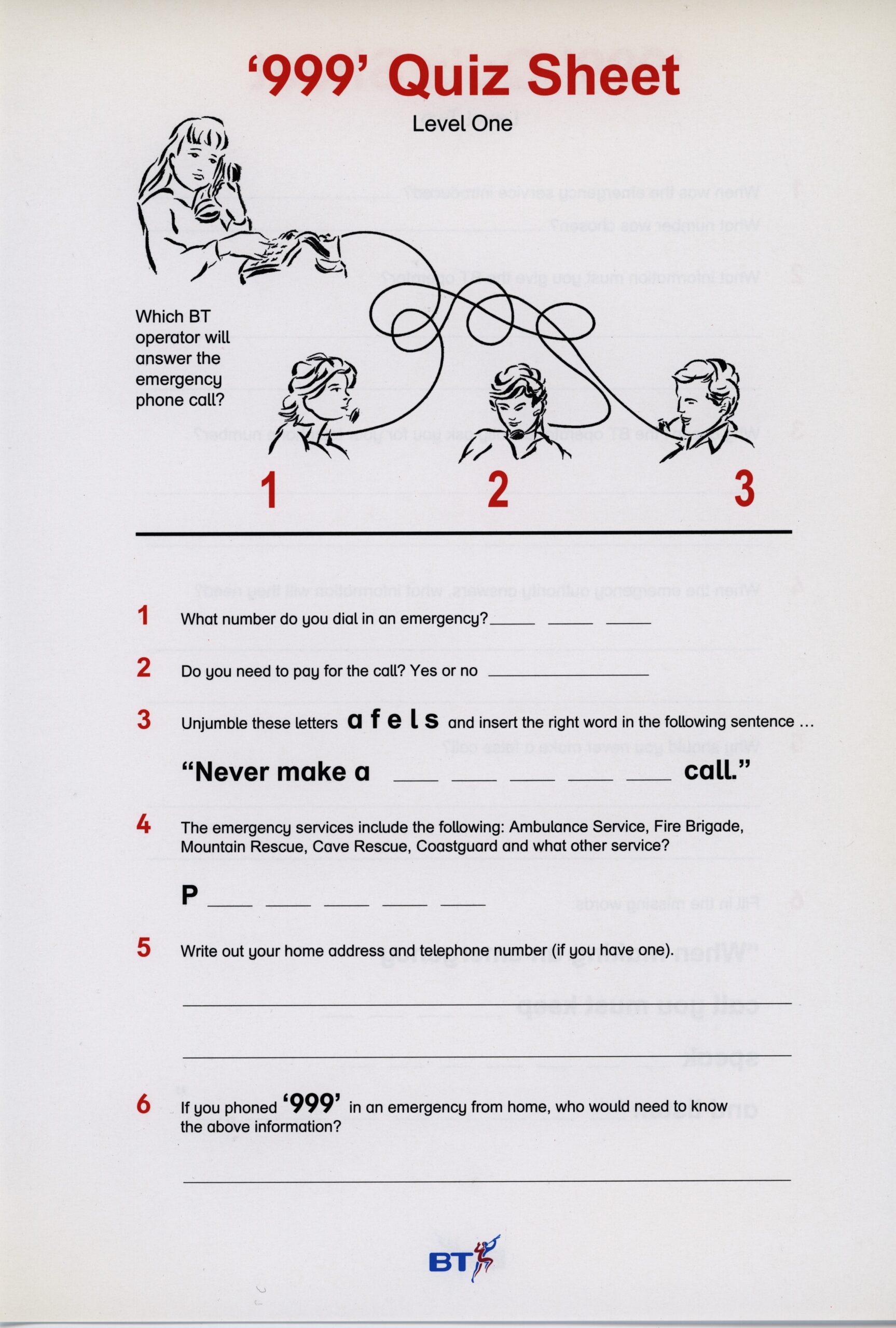
This quiz sheet was part of an updated primary school teaching pack produced by BT Education Services in the mid-1990s. It shows that children from young ages were taught that dialling the 999 emergency service number was free of charge, which was an exception from most telephone calls. Although General Household Survey data in 1994 found that 91% of UK households had a fixed-line telephone, for children living in households without a telephone, the activity to memorise their home telephone number was less relevant.

BT Group Archives: TCD 264/ES 52 P

Emergency 999 (1988)

Using a child’s perspective upon an emergency, this information video was narrated by a primary school aged child. It dramatized three scenarios in the narrator’s home town of Bedford when children dialled 999 to reach respectively the ambulance service, the fire brigade and the police service. In this clip, the sister of a school friend of the narrator sees a television set being stolen from a house and uses a telephone kiosk to telephone the police service. The video, which was produced by RTR, and commissioned by BT South Midlands and Chilterns District, also showed the inside of a British Telecom switchboard which received calls, and the Bedfordshire Fire Service on an emergency call.

BT Group Archives: FILM/726

Payphone Says…Street Wise Kids Don’t Vandalise! (1987)

Payphone Says…Street Wise Kids Don’t Vandalise! (1987)

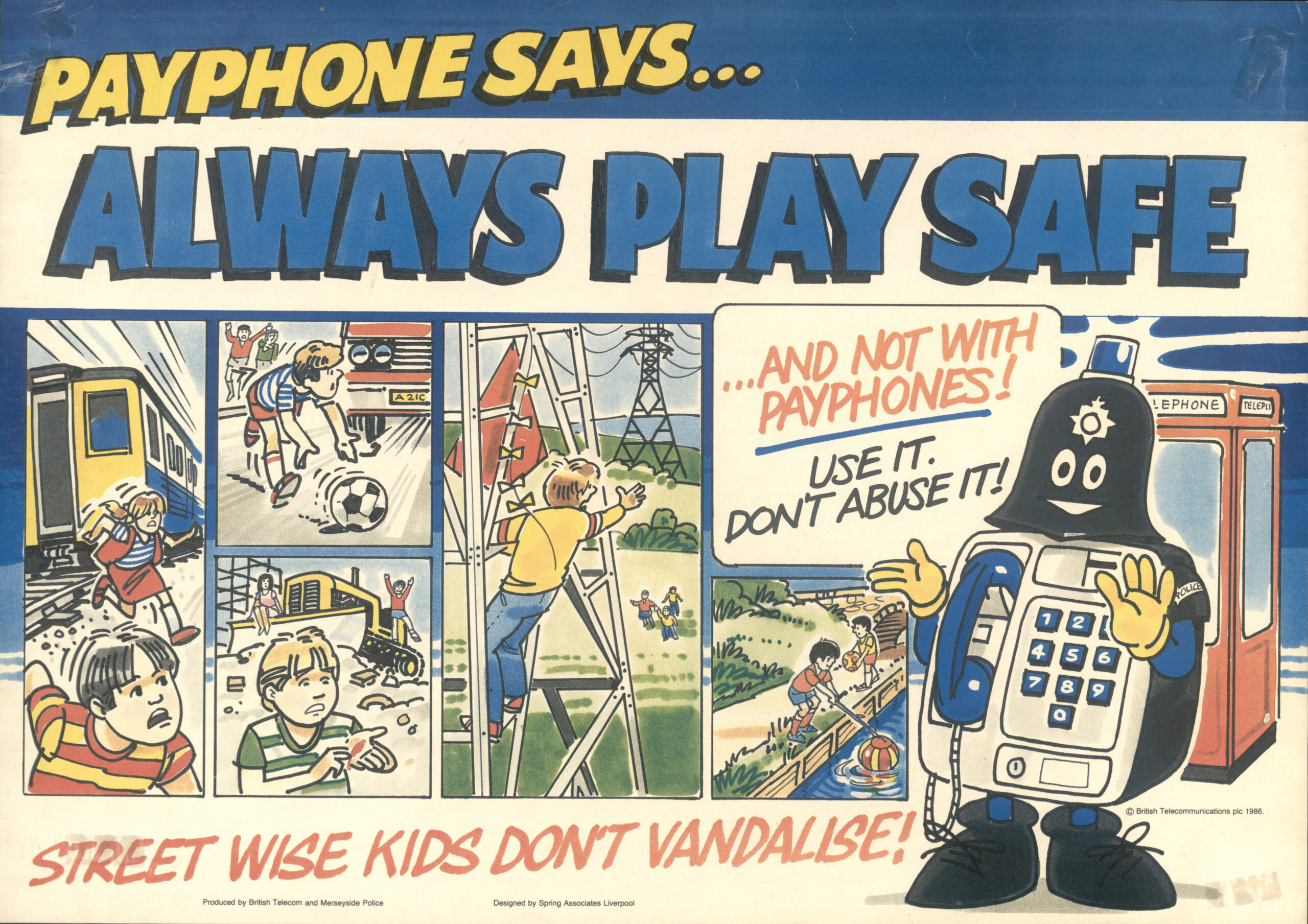
Telephones were often associated with children’s safety, but also with danger. Produced in conjunction with Merseyside police, this poster was part of British Telecom’s 1987 National Payphone Services campaign to prevent payphone vandalism. It shows children playing near train tracks, roads, building sites, electric telephone pylons, and the water edge. Kiosk vandalism, especially in large cities, had been of concern since the 1950s, and the poster also featured a cartoon police telephone kiosk. The slogan, ‘Use it, don’t abuse it – payphone saves lives’ was a familiar sight in British Telecom telephone kiosks, urging the general public to keep payphones in working order, especially for use in an emergency.

BT Group Archives: TCB 325/EHA 6020

Child holding a painting for the competition ‘Protect your payphone’ (1989)

Child holding a painting for the competition ‘Protect your payphone’ (1989)

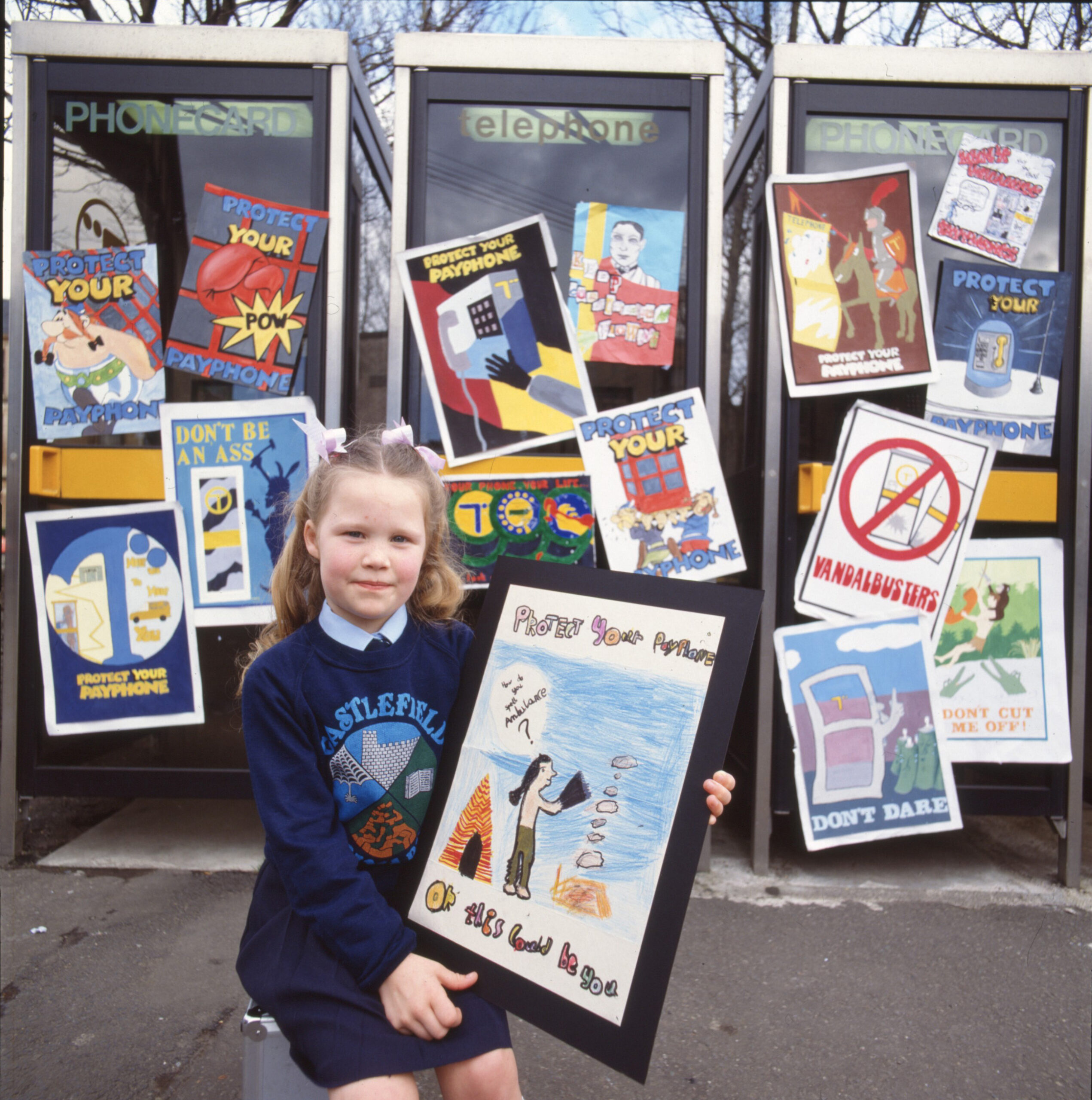
New payphone kiosk models in the 1980s were designed to be more resistant to damage. However, telecommunications companies continued to involve the public in vandalism deterrence campaigns. This photograph was part of publicity for British Telecom’s 1989 competition, ‘Protect your payphone’. It shows a primary school pupil in East Kilbride, Glasgow, Scotland in front of three KX100 kiosks that are used to display posters. The child holds what could be their own entry for the competition: a poster featuring a drawing of an early human sending a smoke signal, with a speech bubble asking, ‘How do you spell ambulance?’. The poster’s message relayed the importance of communication technologies over time in emergency situations.

BT Group Archives: TCC 474/HF 28V

Pete-payphone (1994)

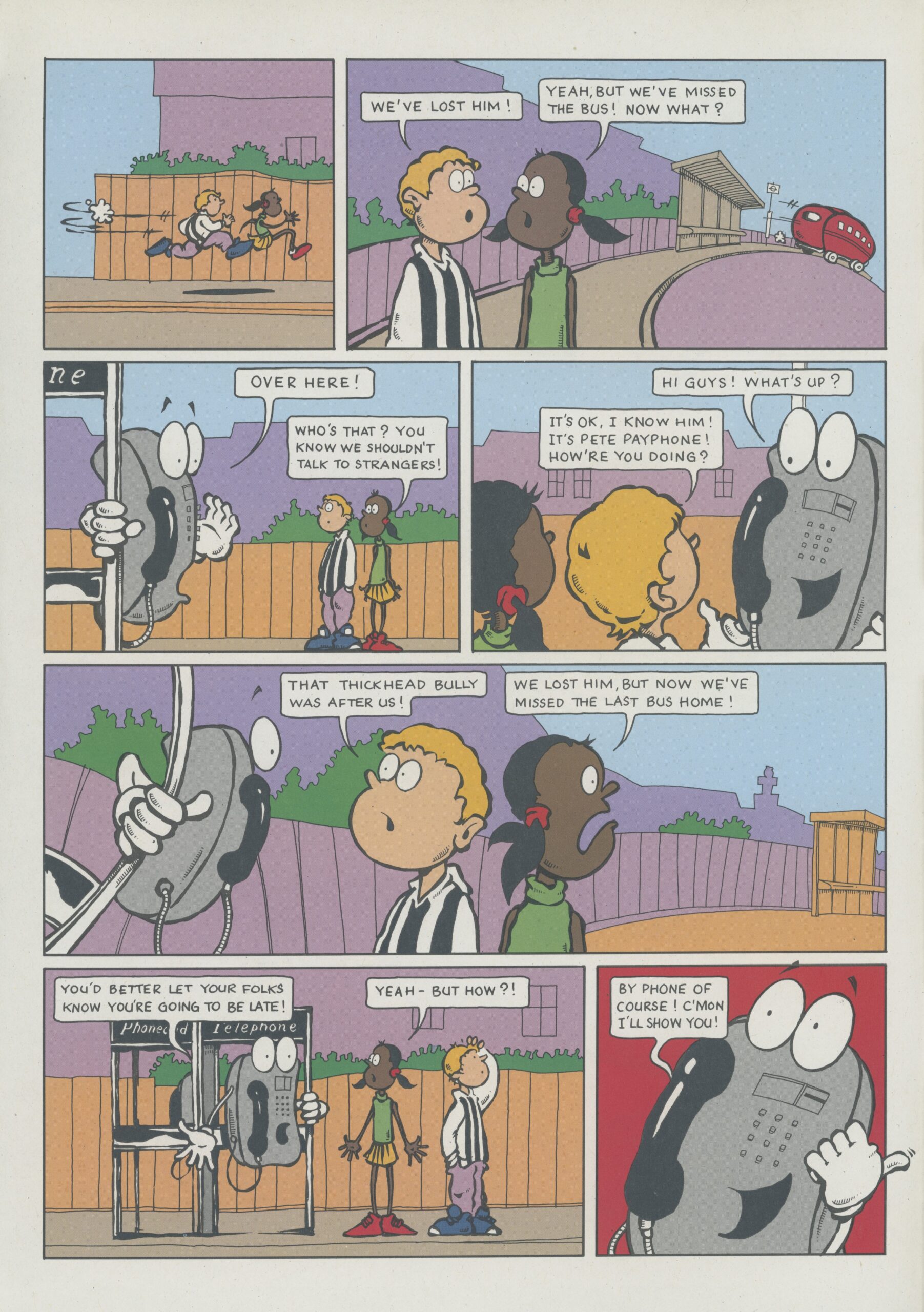
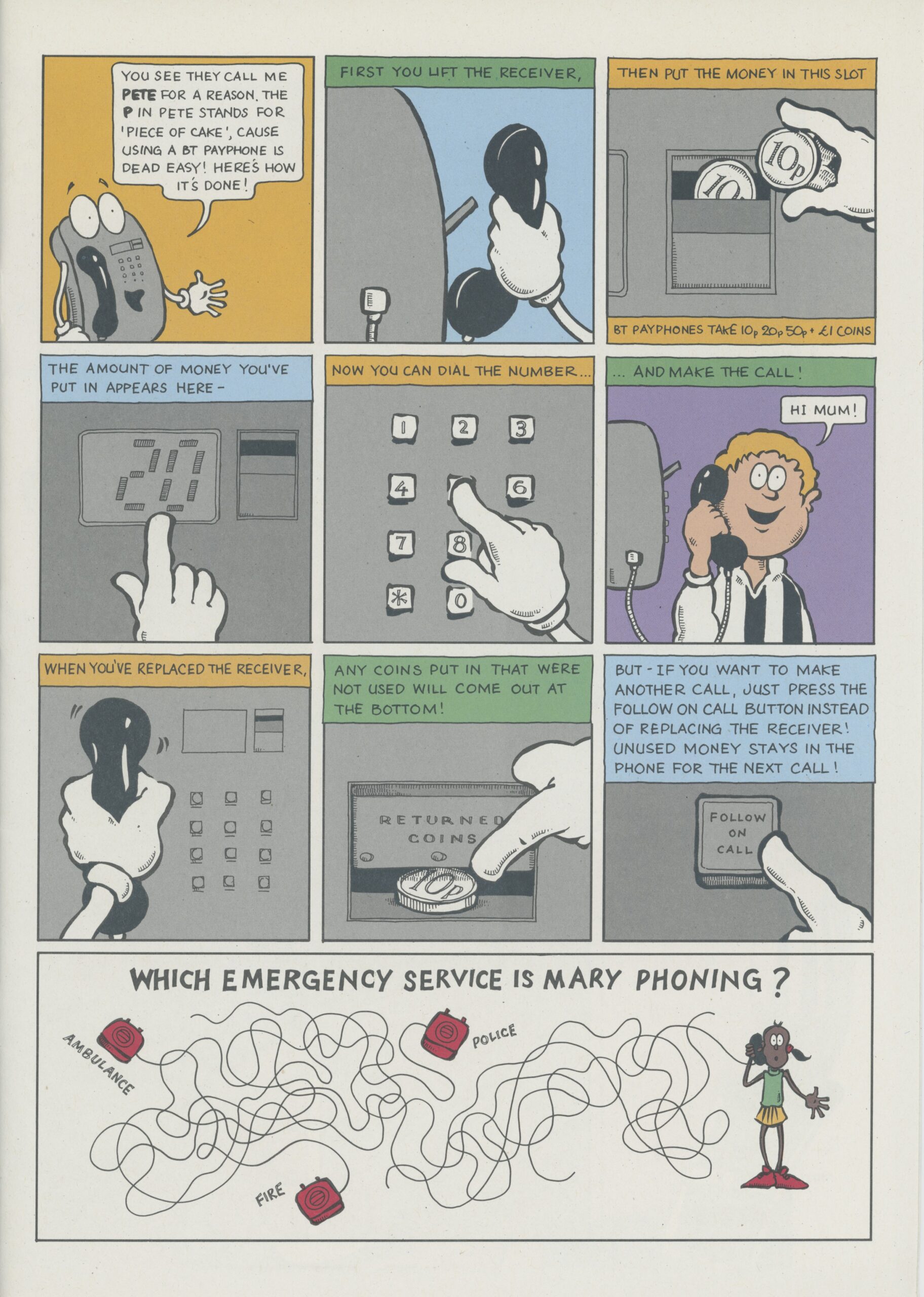
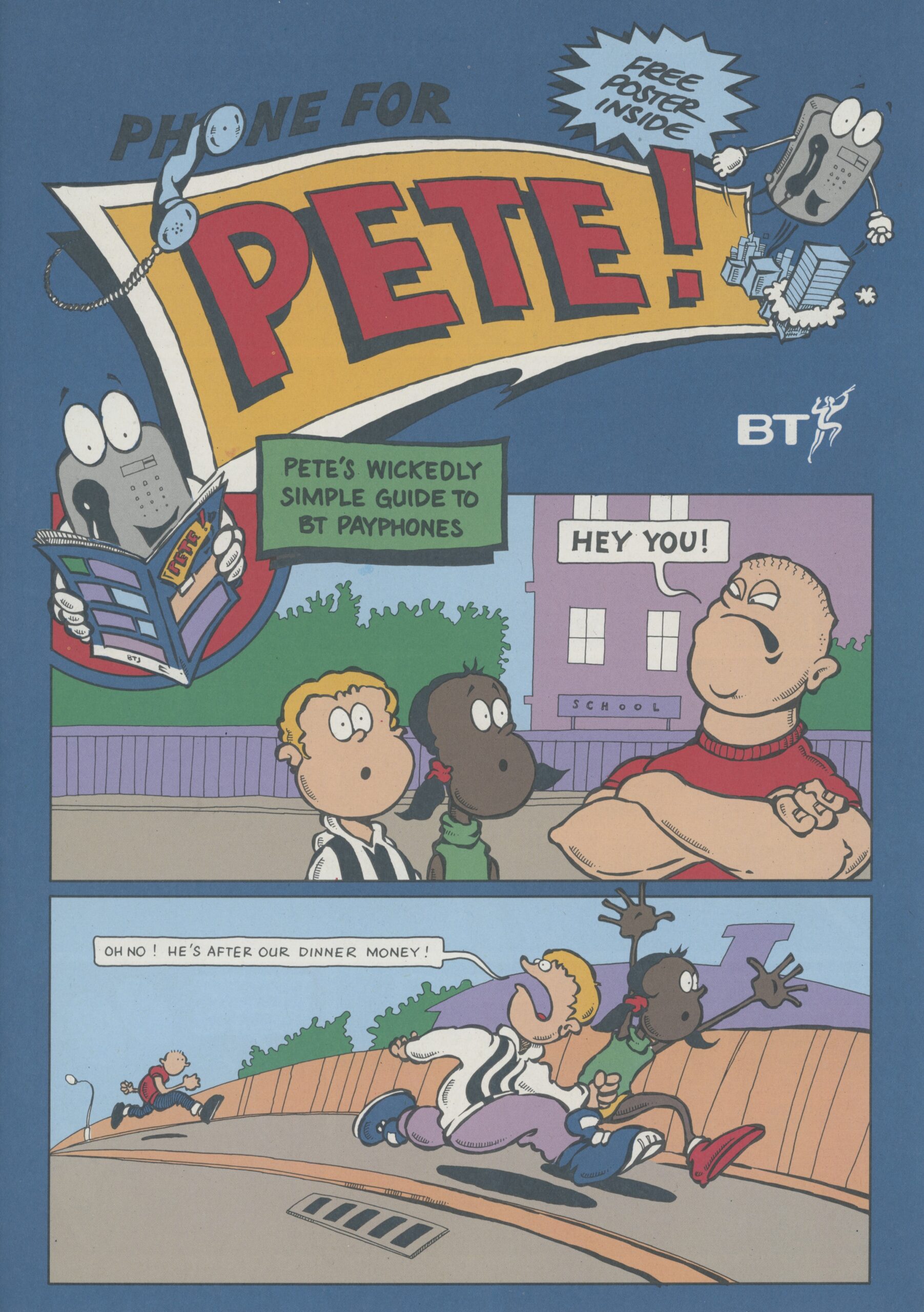
Pete-payphone was a BT Education Service publication, produced in the style of a comic. ‘Pete’ was an anacronym to teach children about payphone provision and behaviours: P stood for: ‘Piece of cake to use’, E: ‘Everywhere (where you’ll find BT payphones)’; T: ‘Thickheads who vandalise payphones’; and E: ‘Emergencies (calls are free).’ In this comic strip, two children were chased by a bully for their dinner money and missed their bus home. Encouraged by Pete-payphone, the children telephoned home to let their parents know what had happened. BT’s educational materials in the 1980s and 1990s repeated the message about the telephone’s role in helping children in various situations. Pete-payphone also emphasised the accessibility of payphones to children.

BT Group Archives: TCE 306/PHME 18460

Sound amplifying watch receiver

Sound amplifying watch receiver

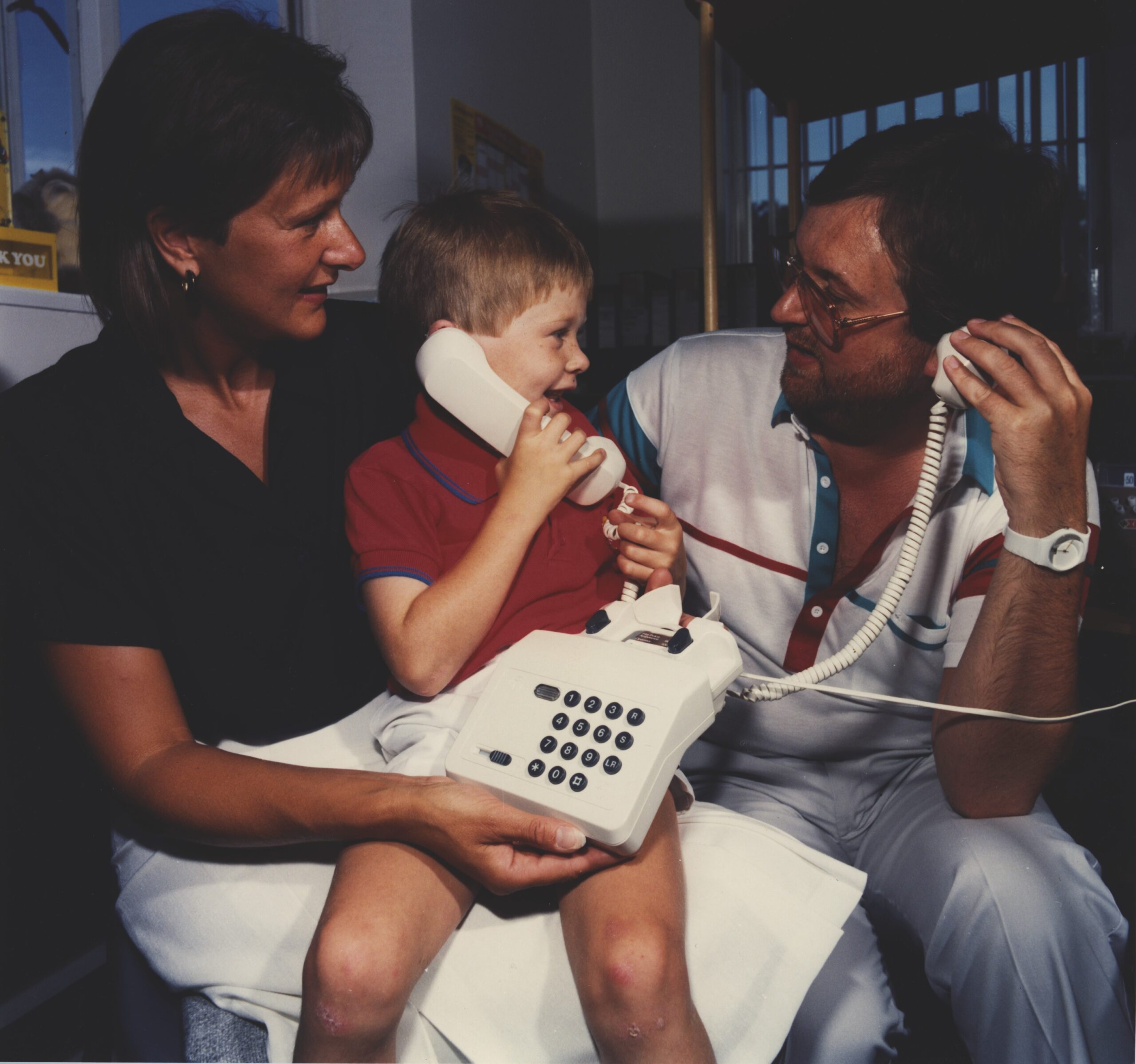
Technologies like inductive couplers and textphones have long enabled those with hearing loss to communicate over the telephone. In 1984, British Telecom set up the project, Action for Disabled Customers to identify additional needs and expand services. British Telecom worked with the Royal National Institute for Deaf People (RNID) to establish the Telephone Exchange for the Deaf. This photograph dates from 1989 and shows a young child using a watch receiver earpiece which helped to cut out background noises when using a landline telephone.

BT Group Archives: TCC 474/HF 41-36/1

Westminster Children’s Hospital patient

Westminster Children’s Hospital patient

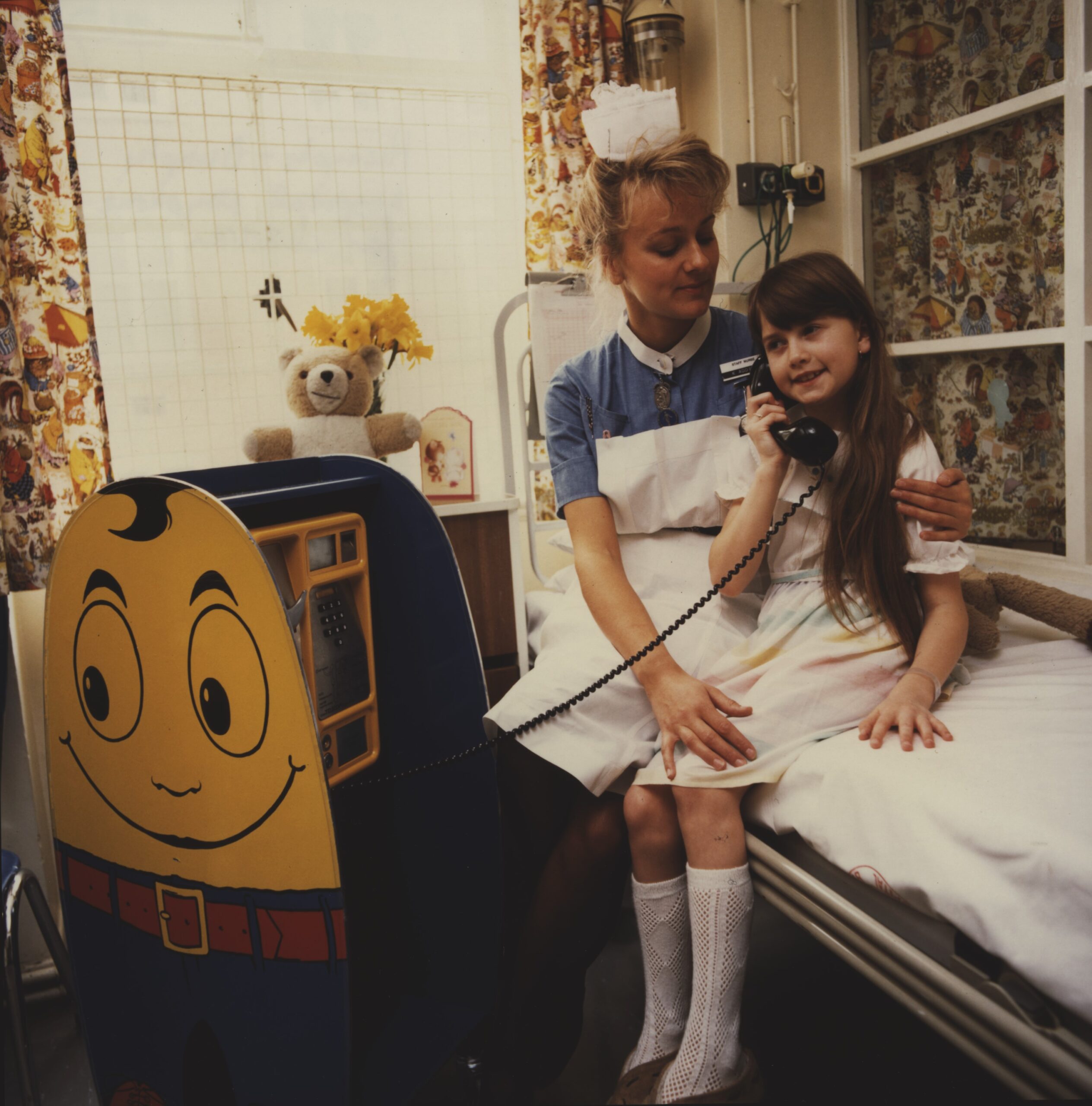
Before the widespread expansion of mobile phone ownership, portable telephone trolleys helped hospital patients to contact family and friends. Telephone trolleys were often paid for by volunteers in hospitals, and provision varied across regions. This payphone trolley, in the image of Humpty Dumpty, was one of two that British Telecom donated to Westminster Children’s Hospital in the late 1980s, and is shown in this photograph in use in 1987. A second trolley, designed especially for children to use at the hospital during the Christmas season, was shaped as Father Christmas.

BT Group Archives: TCC 384/ENV 1667

Lyons Coco Brek cereal box

Lyons Coco Brek cereal box

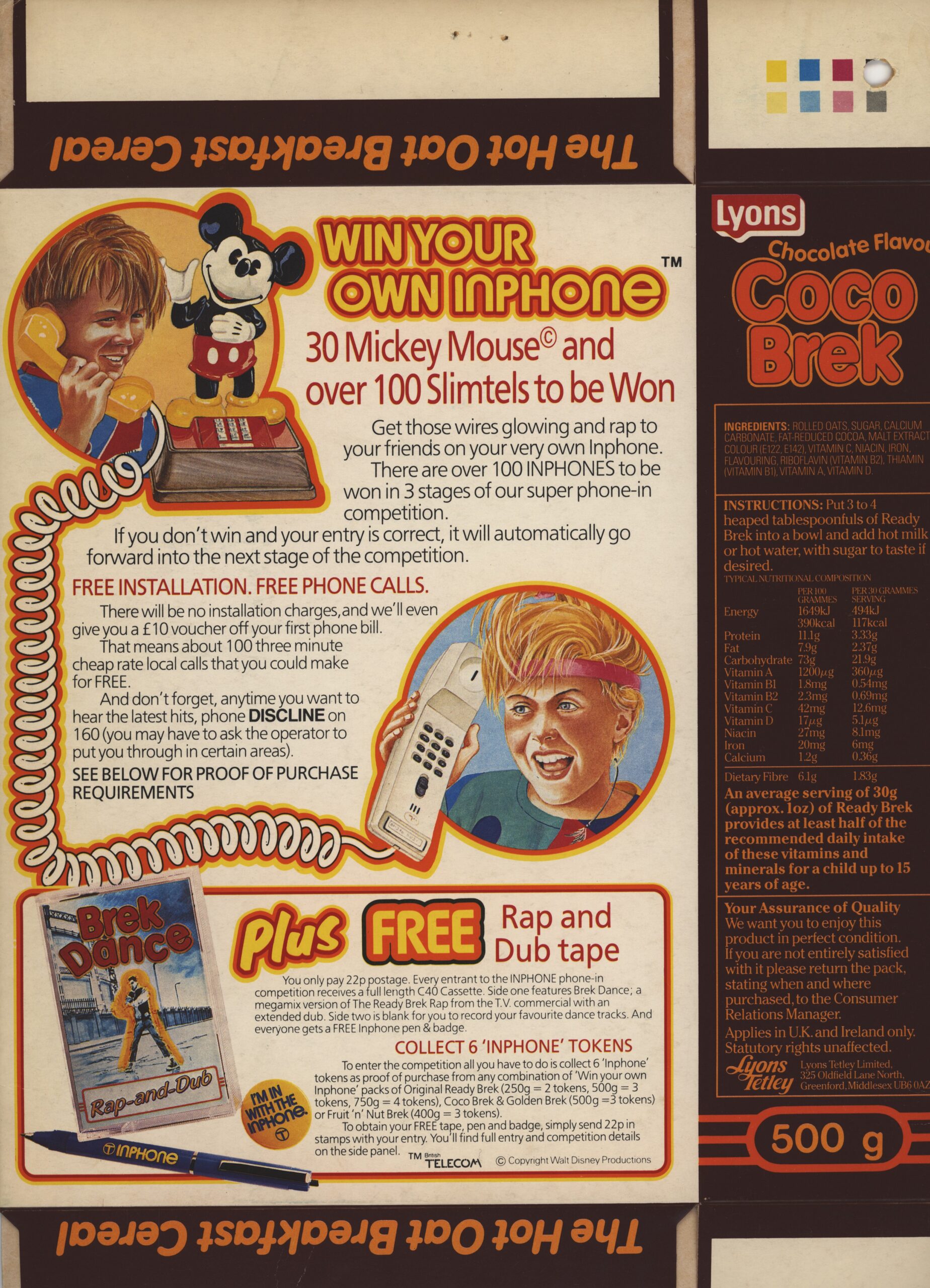
In 1985, British Telecom sponsored a promotional competition for the children’s breakfast cereal, Coco Brek, manufactured by Lyons. The back of the cereal box shows the competition prizes children could win, including the Mickey Mouse telephone (part of the Special Range Telephone series) and Slimtel telephone. The competition asked children to telephone their nearest competition phone line, listen to the start of a pop song and name the tune and the band. Callers were then asked to listen to the ‘Ready Brek Rap’ and come up with a name for the ‘Ready Brek Band’ that recorded the rap. The promotion also advertised Discline (formerly Dial-a-disc), British Telecom’s service which played pop music hits.

BT Group Archives: EHA 6040

Thanks to Unilever Archives for permission to reproduce this image.

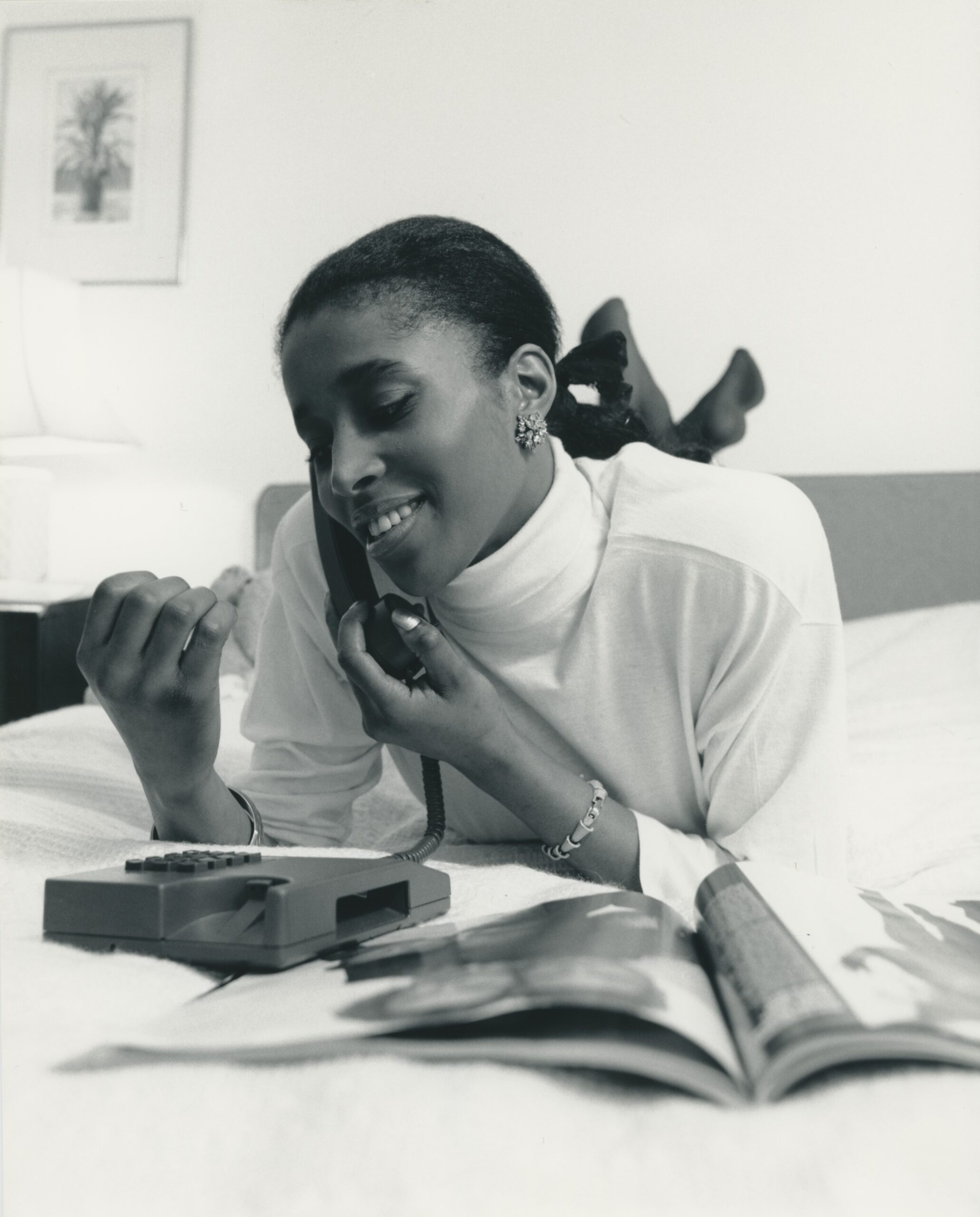
Young people using Tremolo phone

Young people using Tremolo phone

In the 1980s and 1990s, imagery of young people using a telephone in a bedroom signalled affluence and fashion. This marketing photograph uses this imagery to publicise the Tremolo phone, introduced in 1988 as one of British Telecom’s InPhones. Electronically operated, the Tremolo had new features including a ‘secrecy button’ (which, if pressed, would break the electronic microphone link between callers), and ‘last number redial’.

BT Group Archives: TCC 384 ENV 2069

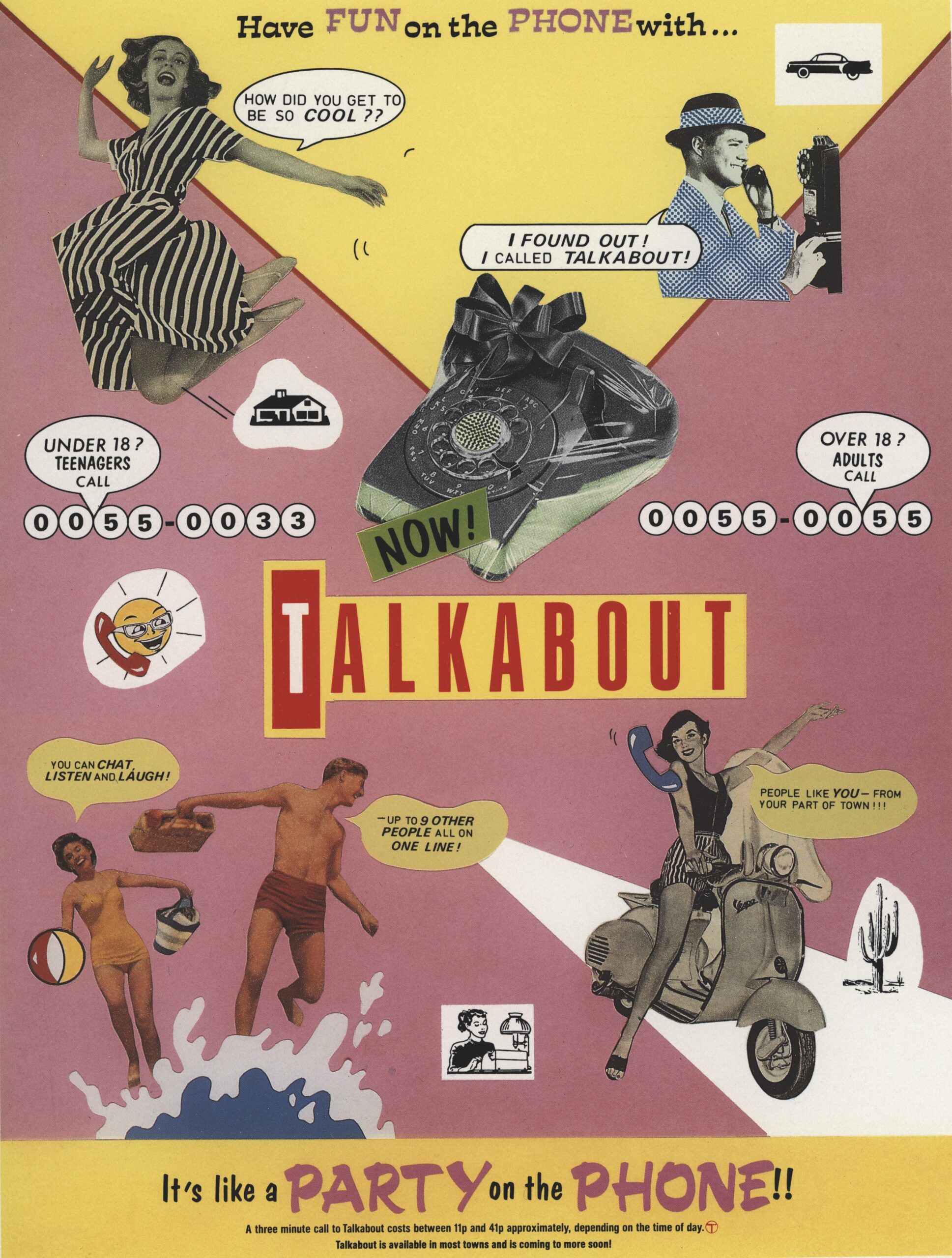
Now! Talkabout

Now! Talkabout

Talkabout was a British Telecom telephone chatline, launched in Bristol in 1983, shortly before British Telecom was privatised. By dialling the Talkabout telephone number, a caller could join a conversation on a phone line with up to ten other callers. Talkabout’s marketing was targetted at young people, and the chatline was described as a ‘party on the phone’. This advert from 1987 promotes two different telephone numbers respectively that over 18s and under 18s could call to connect to the line. Talkabout was withdrawn in 1988 following debates about young people, especially teenagers, running up large telephone bills by dialling the number.

BT Group Archives: TCB 325/EHA 5408

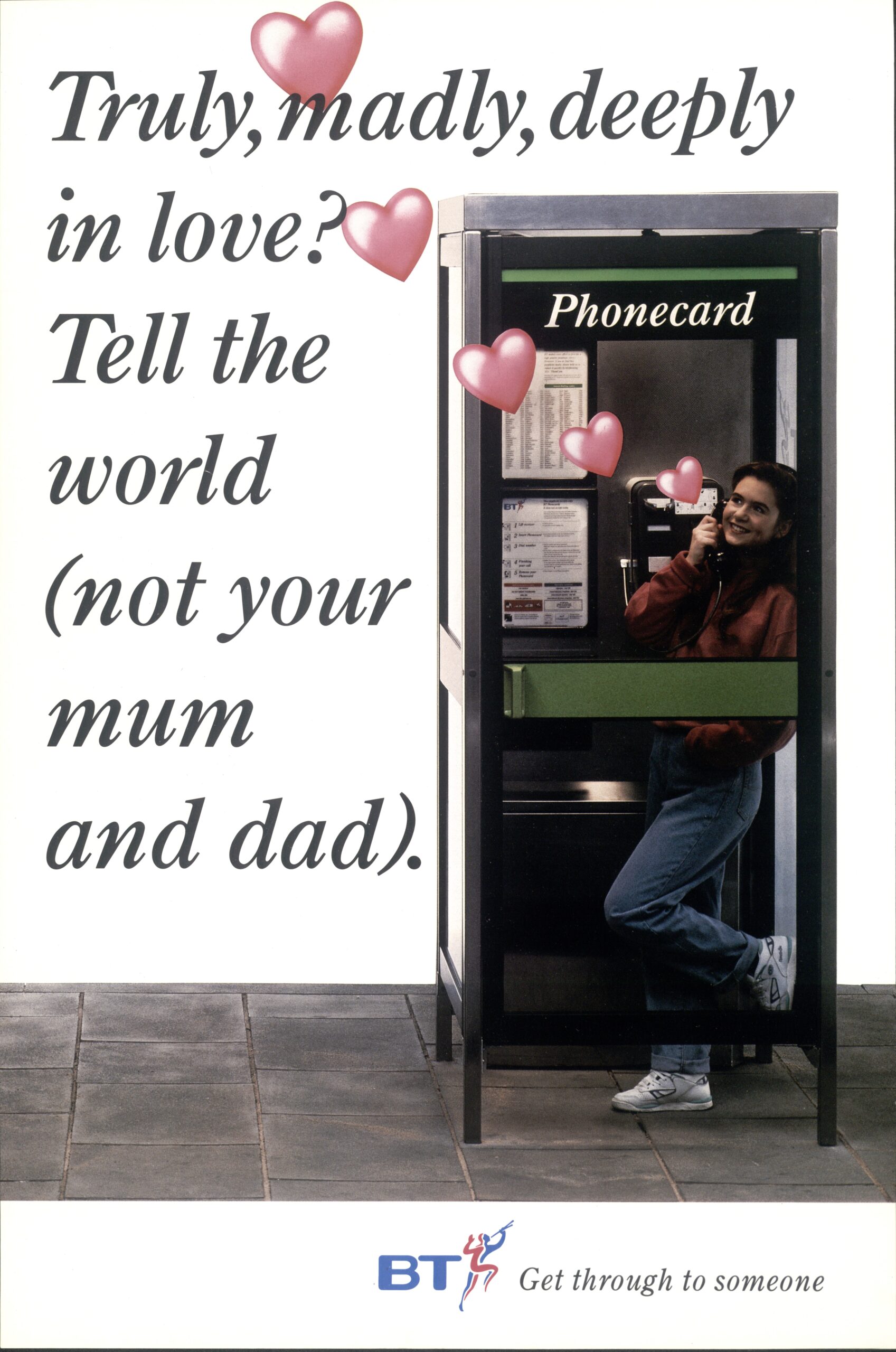
Truly, Madly, Deeply in Love? Tell the World (Not your Mum and Dad) (1992/3)

Truly, Madly, Deeply in Love? Tell the World (Not your Mum and Dad) (1992/3)

The smiling teenager leaning against a glass pane of a green KX100 telephone kiosk was part of BT’s advertising campaign for phonecard use on payphones, ‘Get through to someone’. Like other corporate campaigns in the 1990s, the poster depicted the telephone kiosk as a space for adolescents to find privacy away from family and parental authority. It also suggested that young people might want to keep some things secret from their parents, in this case, their romantic friendships.

BT Group Archives: TCB 325/EHA 5315

Private Payphone (1994)

The place of the payphone in adolescents’ romantic relationships was also the theme of this 1994 television advertisement in BT’s advertising campaign, ‘It’s Good to talk’. The television adverts, produced in 1994 by AMV BBDO, initially starred the actor, Bob Hoskins. This advert, Private Payphone, targetted both adolescents and their parents as telephone users. It repeated the familiar scenario of the difficulty adolescents experienced finding privacy for personal conversations on telephones in the home, and showed the telephone kiosk as a solution.

BT Group Archives: BTA-MI1/0222

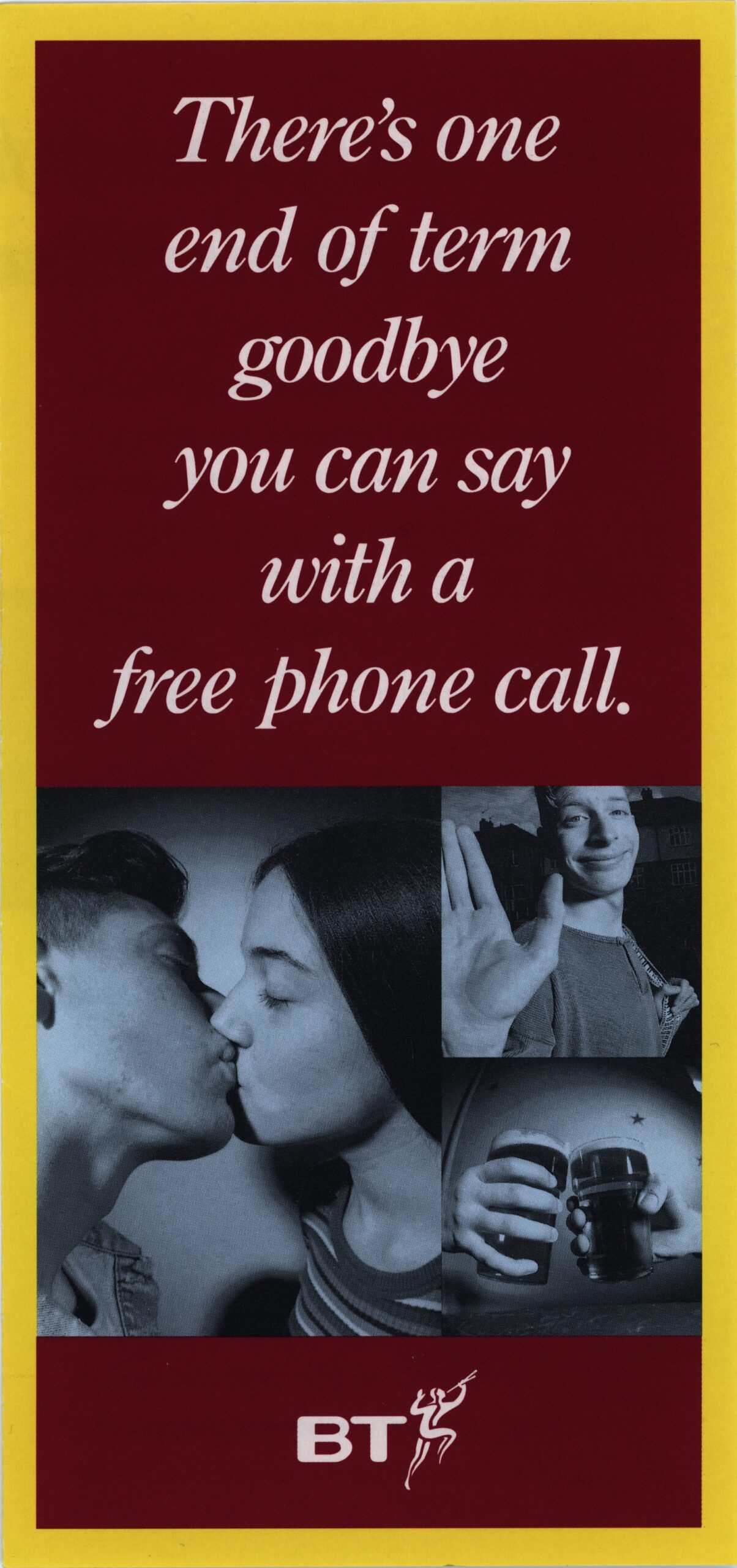
Student Services

Student Services

The early 1990s saw an expansion in student numbers at UK universities. Many of these students lived in university towns during term time, and moved back to family homes in vacations.  BT Student services targetted university students as users of domestic telephones and public payphones. This 1994 leaflet incorporated publicity for both types of phone use. It advertised a freephone service for students to manage their landline telephone contracts when they relocated during vacations. It also advertised BT’s Chargecard which could be used to telephone one chosen number (such as the family landline) from payphones in the UK and abroad. The call would be charged to the billpayer of the selected number.

BT Group Archives: TCE 306 PHME 18466

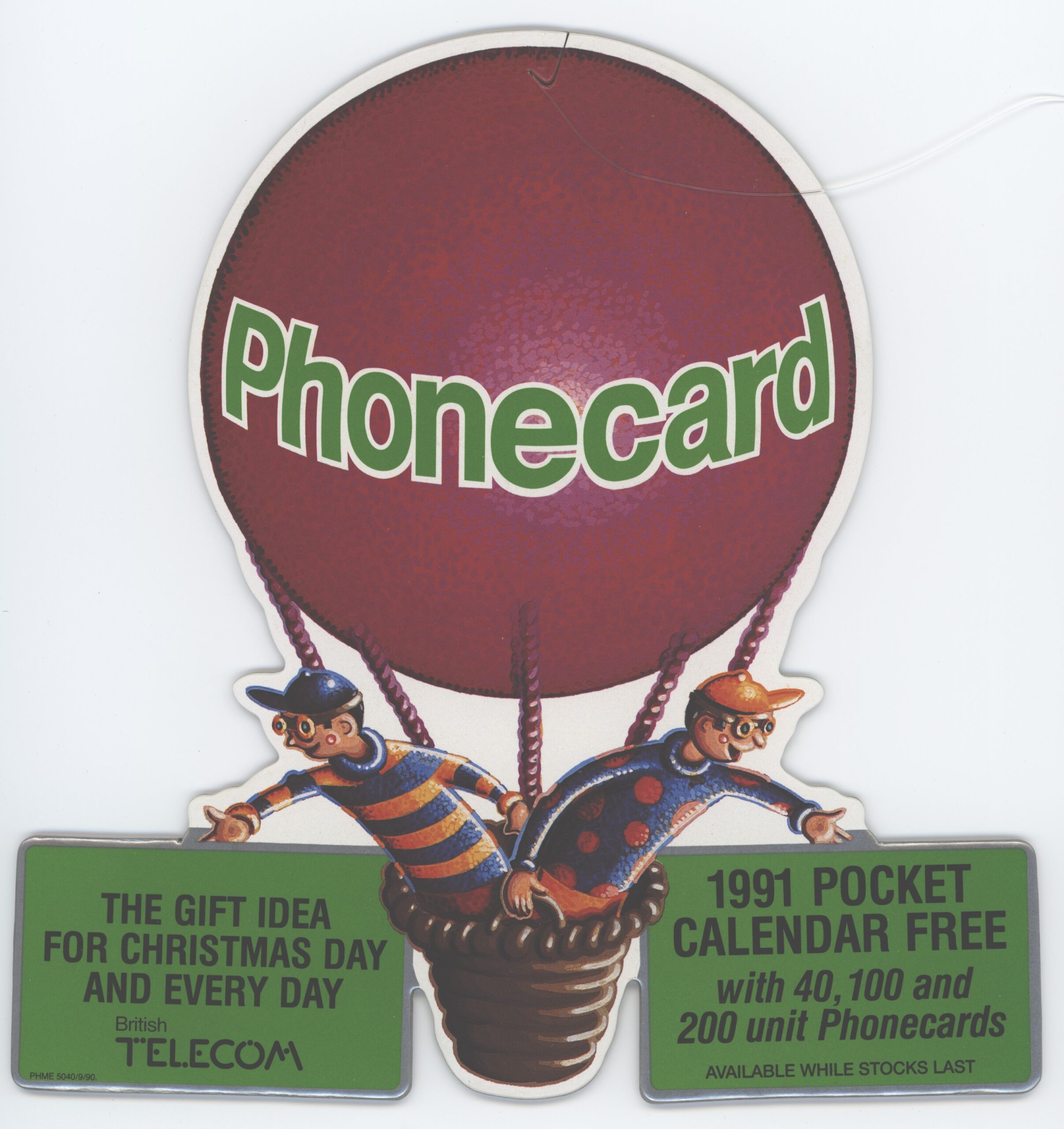
Phonecard Christmas promotion (1990)

Phonecard Christmas promotion (1990)

Prepayment cards for use on payphones were popularised initially in the 1980s in Japan, and then in Europe and America. British Telecom first installed cardphone kiosks in 1981. This fun promotion advertised phonecards as Christmas gifts. Young people were a key market for prepaid phonecards for use in telephone kiosks, and many specially designed cards were aimed at children and adolescents. The New BT Phonecard was introduced in 1996, when the number of BT payphones accepting phone cards increased to over 60,000. BT phonecards were discontinued in 2002 as use of payphones declined.

BT Group Archives: TCE 306/PHME 5040

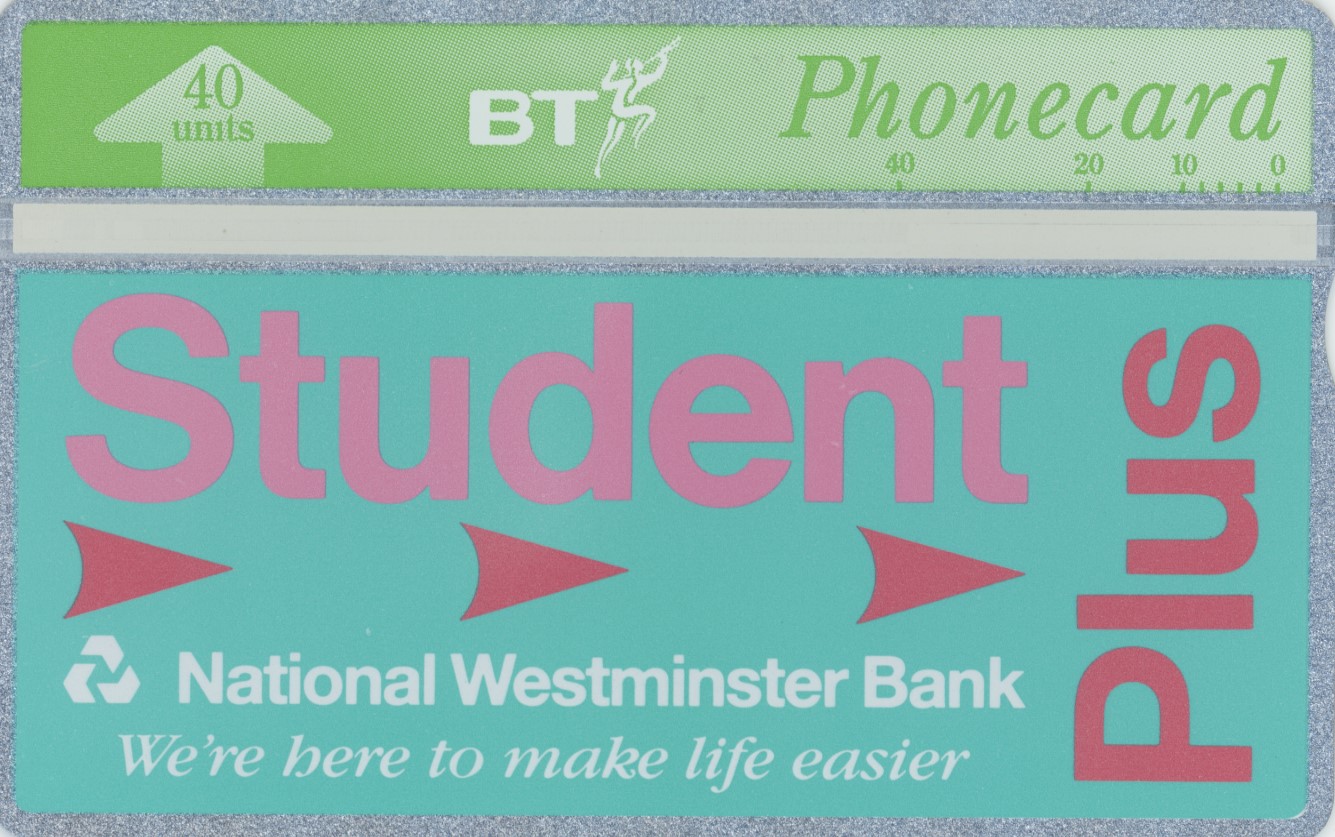
BT Phonecard BT63 Student Plus (1992)

BT Phonecard BT63 Student Plus (1992)

British Telecom started to produce promotional cards, alongside special edition phonecards, in 1987. This phonecard, promoting the National Westminster bank’s Student Plus account, shows prepayment cards were used in wider corporate promotional activity that could target specific groups of payphone users. National Westminster bank offered Student Plus accounts between 1990 and 1993 to customers entering full-time Higher Education for the first time.

BT Group Archives: BTA.0483

Thanks to Natwest Group Archives for permission to reproduce this image.

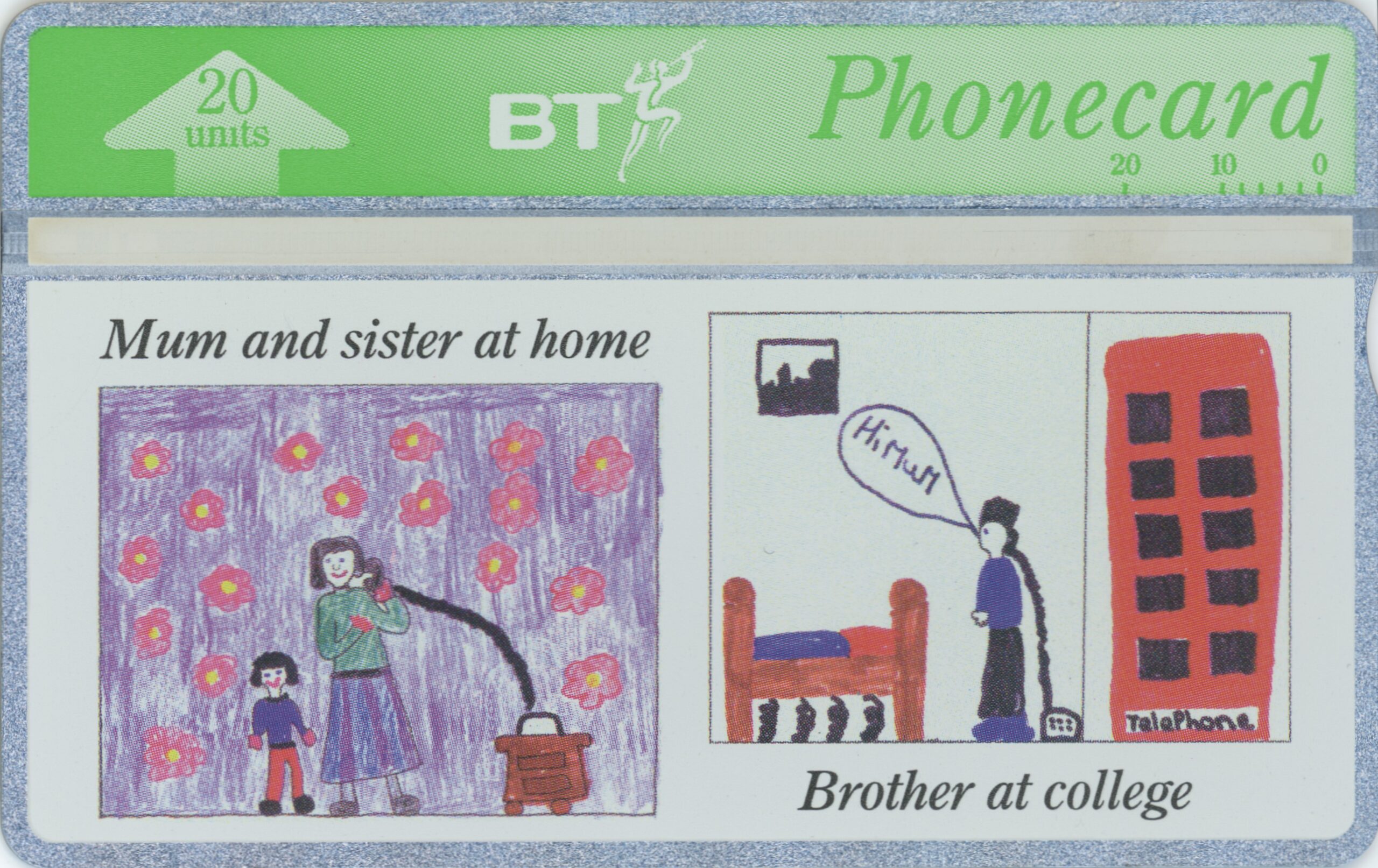
BT Phonecard BT227 (1994)

BT Phonecard BT227 (1994)

This BT phonecard was a special design featuring children’s drawings. The drawing on the left, ‘Mum and sister at home’, shows a young child standing next to a woman who is holding the handset of a telephone that is placed on a table. The drawing on the right, ‘Brother at college’, shows an older child talking on a landline telephone in a bedroom. A red telephone kiosk is drawn to the right of the child. The drawings suggested the importance of the telephone for family connection, including in instances where older children had moved away or out of the family home.

BT Group Archives: BTA.0647

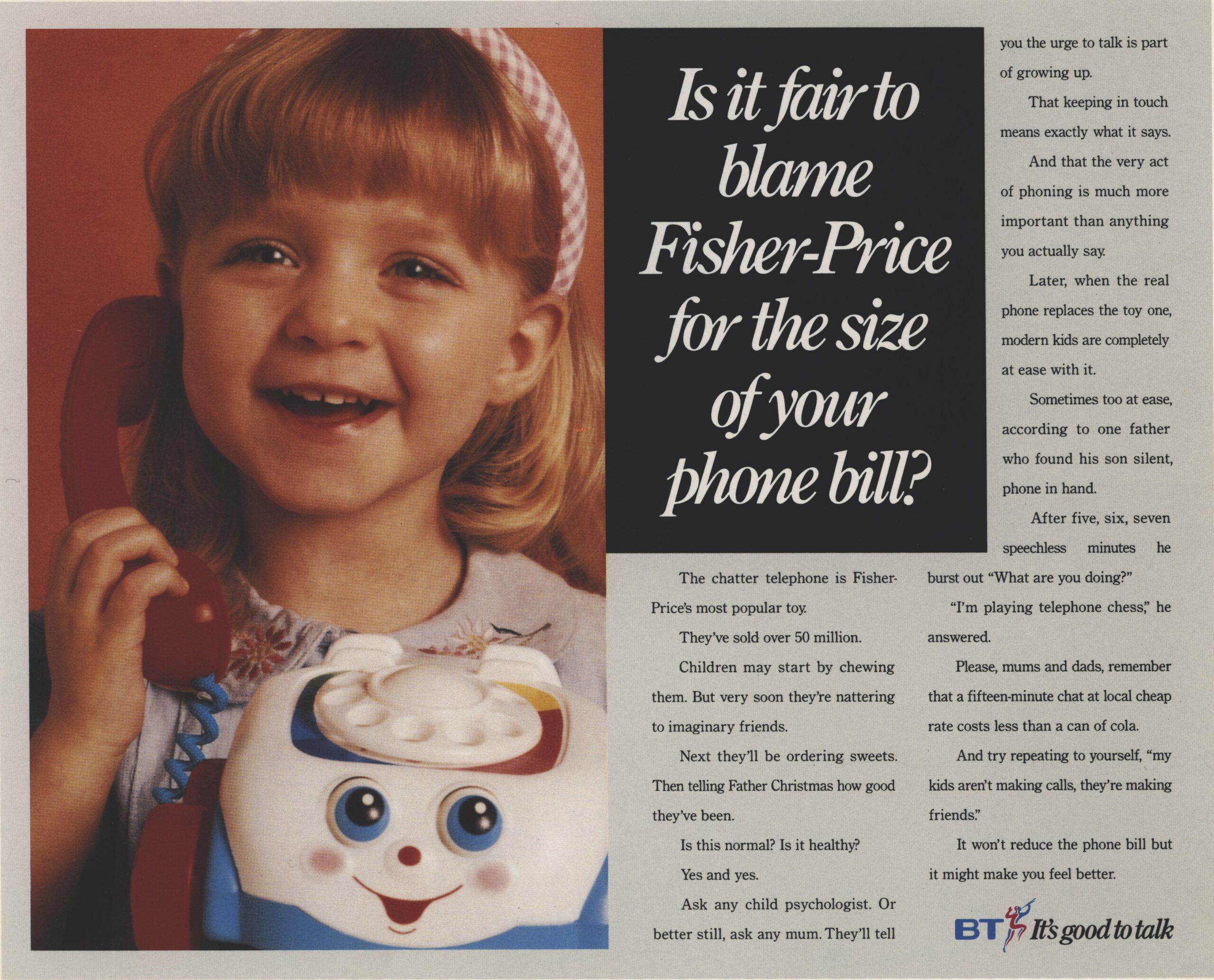
Is it Fair to Blame Fisher-Price for the Size of your Phone Bill? (1997)

Is it Fair to Blame Fisher-Price for the Size of your Phone Bill? (1997)

Itemised billing listing the telephone numbers called on a line, and the length of those calls, was first trialled among BT’s domestic customers in 1983. It was standard for all customers when this press advertisement was published in 1997. Directed to parents and their regulation of the time children spent on the telephone, the advert encouraged parents’ tolerance of children’s use of the landline phone. Whereas BT’s advertising campaigns in the 1980s, such as ‘Animal Instincts’, had focused on children’s phone use for keeping in touch with family, this advertisement presented telephone practice as important to help children to make friends.

BT Group Archives: TCB 325/EHA 5322

Teenager (1999)

The television advert, Teenager, was part of a campaign advertising BT’s ‘Call sign’ function for landline telephones. The function enabled a single landline phone line to have two different ‘rings’ on the receiving end, and therefore the potential to direct incoming calls to different users. The advert uses the stereotype of adolescent girls talking frequently on the phone to joke that telephone calls to a family landline were more likely to be for an older child than a parent. Versions of the advert were produced for Scottish viewers and Urdu speakers.

BT Group Archives: TCE 305/V 95822

Want to be part of the project?

Visit the digital map and submit your memories

View the digital map