
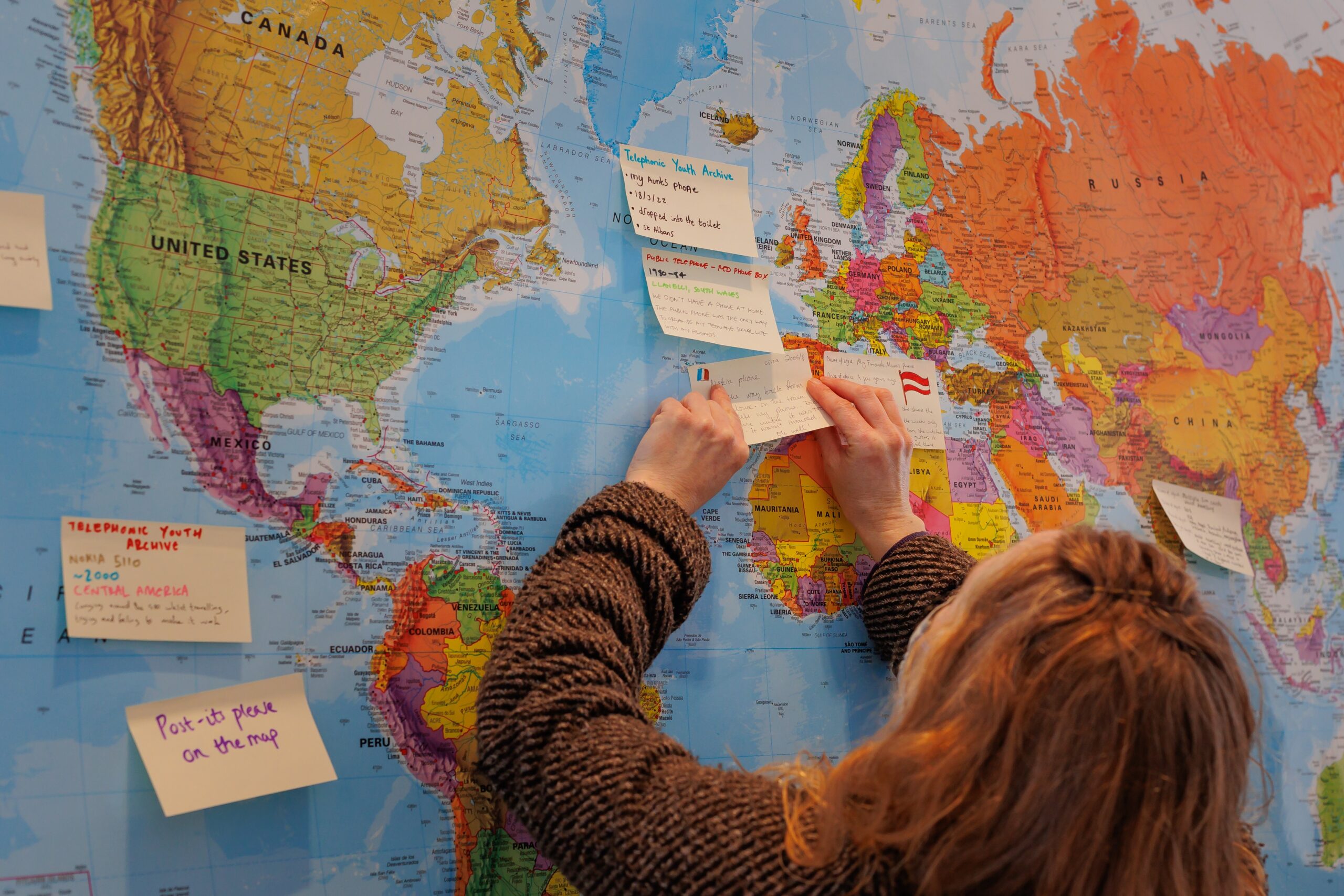
Throughout March and April, our friends at Southampton’s John Hansard Gallery have been running their 2022 Community Takeover events. Exploring the themes of environment, sustainability and wellbeing, the Gallery has worked with schools, local charities, artists, community leaders, and us to explore big questions about how we can help our planet and health.
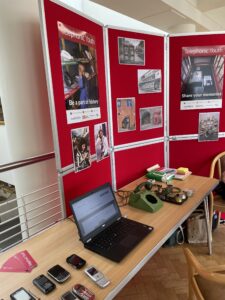
The Telephonic Youth team was very excited to be part of Community Takeover on the first day of its programme. Joined by two History undergraduate students from the University of Southampton, we set up an activity in the Gallery to turn old phones into community art. Where phones have become disposable items for many, we encouraged people to remember the stories that are attached to our old phones, and to think in different ways about how phone use and production impacts the environment.
We invited people to create an archive tag for one of their old phones. The tags asked people to describe an object, add the date of their memory and a description. The names people gave to their old phones pointed to intimate and personal connections that people have with their phones: ‘My old nokia’, ‘First telephone ever’, ‘The phone under the stairs’. Data left behind on sim cards were a reminder that phones themselves are made of many objects and are themselves miniature archives, holding memories of their owners’ everyday lives. As people stuck their archive tags onto a large 1980s map of Southampton and an even larger map of the world (on loan to the project), the community artwork began to take shape.
Professor Ian Williams, from the University of Southampton’s Engineering Faculty, also joined us on the day and spoke to people about e-waste. We learned about the amounts of carbon dioxide emissions that are caused during the manufacture of a digital device, but also what we can do to try to reduce the impact of e-waste. For example, if you keep your smartphone for 5 instead of 2 years, you can halve its carbon dioxide and water impacts. Community Takeover provided an opportunity to make a very small contribution to reducing e-waste, as some people also left behind old, unused mobile phones to be recycled or re-used.
The archive tags created during Community Takeover told stories about phone boxes and old landline phones, but memories about mobile phones featured prominently. We shouldn’t be surprised at this: the heritage of mobile phones is now explored in dedicated museums, such as the Mobile Phone Museum. As mobile phones become museum exhibitions, consumers increasingly turn back to ‘dumb phones’, and the climate crisis and resource finiteness threaten consumer habits, there has never been a more important time to re-think the mobile phone’s past, present, and future.
-

- Phones and archive tags
-
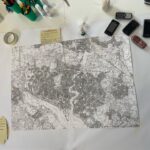
- The first memories added to the map of Southampton
-
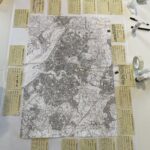
- More memories on the map of Southampton
-
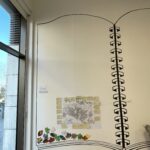
- Map of Southampton now a part of the gallery’s community scrapbook
-
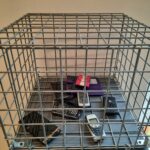
- Old phones being collected for recycling
Featured image by Nosa Malcolm.






Recent Comments