Month: December 2021

Six months of Telephonic Youth Space to Create!

Image shows arts materials laid out on a hexagonal table. Materials include post-its, some silver pots/cans, keys, wooden sticks, A4 sheets of paper with a colour-coded alphabet, an ipad, and some other pieces of paper. Around the table are four red/orange chairs. An individual in black clothing can be seen holding a stick.

Colourful heads, beautiful prints, drums and memory maps. Perhaps not your first thoughts when someone asks you about telephones. But with the artistic inspiration encouraged at John Hansard Gallery, families have been exploring all of these themes as part of Telephonic Youth’s Southampton-based activities.

Over the last few months, artist Joey Walters has led a series of workshops suitable for ages 4+ as part of the Gallery’s weekly, free Space to Create! programme. And it’s been wonderful to see what creative thinking telephones have sparked in those who have taken part.

Joey took inspiration from  the research we are doing at Telephonic Youth in a number of ways. The first workshop asked visitors to think about the journeys they make with their phones across the city.

A second workshop used binary coding to get families thinking about the words they associate with telephones. Once people had thought of their word, they were able to collage it onto the shape of a human head using tissue paper matching a colour-coded alphabet designed by Joey. The shape of the head encouraged families to think about how they communicate when they use a telephone. Using binary code meant that people could keep their chosen word secret – an added bonus, if you didn’t want to reveal all!

Image shows a set of coloured paper collaged over an outline of a human head. On A4 white paper, atop a light-coloured table.

One of the colour-coded collages produced at a Space to Create.

Inspired by how different it feels to hold a rotary dial telephone to a mobile phone, in a third workshop visitors created cyanotype prints. In this workshop, children and adults had fun taking apart old telephones and using disassembled telephone parts to create their prints. The results were beautiful, atmospheric prints in striking blue and white colours.

Telephones, of course, also make sounds, and in the fourth workshop, Joey was inspired by the sound of the phone ringing in a public phone box, and asked visitors to design their own ringtones. With the kind loan of tongue drums from Soco Music, everyday objects, and iPads, visitors got to compose, record and and take away their very own ringtones.

The final workshop linked to our Hands on Humanities Day where we had collected memories of young people’s telephone use. Joey asked visitors to think about what pictures they create when they map their memories of using phones. The prompt inspired people to draw and collage their phone stories in wonderfully creative ways. Joey’s customised ‘polaroid frames’, meant visitors captured their memory as a moment in time.

We want to say a really big thank you to everyone who created such amazing art at these workshops, to Joey for designing such brilliant activities, and to John Hansard Gallery for hosting us.
Telephonic Youth at Hands-On Humanities Day 2021

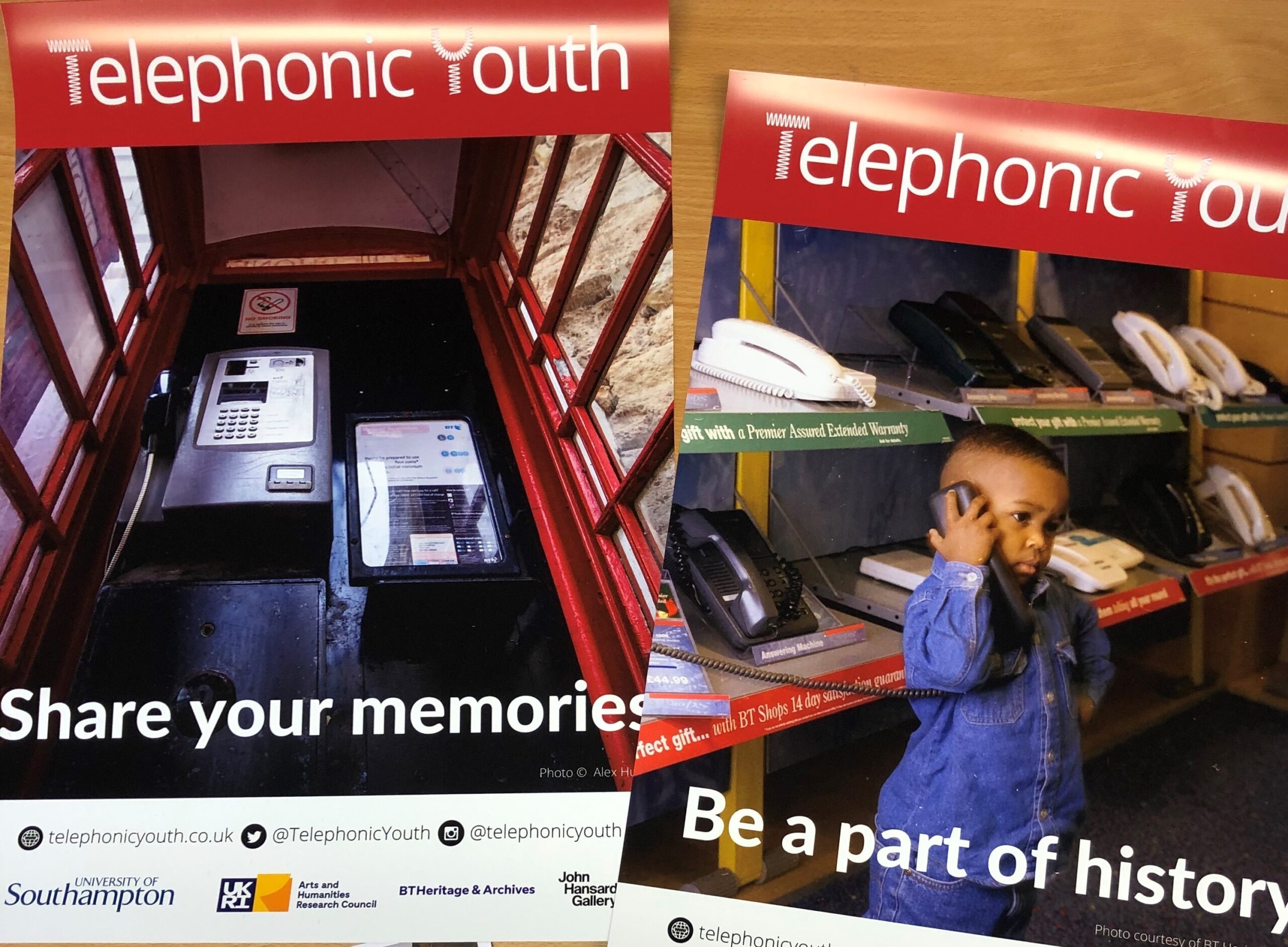
Image shows Telephonic Youth branded posters laid out on a table. The posters include the phrases 'Share your memories' and 'Be a part of history'. One has an image of the interior of a red telephone box; the second has an image of a young boy playing with a telephone in a shop.

Saturday 20 November was a great day for the Telephonic Youth team! With the help of two of Southampton university’s fantastic History undergraduate students, we spent the day speaking to members of the public in person about their memories of using the phone while growing up in Britain from the 1980s to the present. You can read their stories on our map.

Hands-On Humanities Day

Hands-On Humanities Day is an annual event organised by the Public Engagement with Research unit here at the University of Southampton. Part of the national Being Human Festival and the university’s own Southampton Arts and Humanities Festival, it is a celebration of research and a great opportunity to meet members of the public (masked)face-to-(masked)face.

As a project which puts your stories at the heart of our research, we are incredibly grateful to Silvia, Emma, Lou, Jo, Steve, Bethany and Connie for everything they did to make the day possible—and to all of the student ambassadors for their hard work throughout.

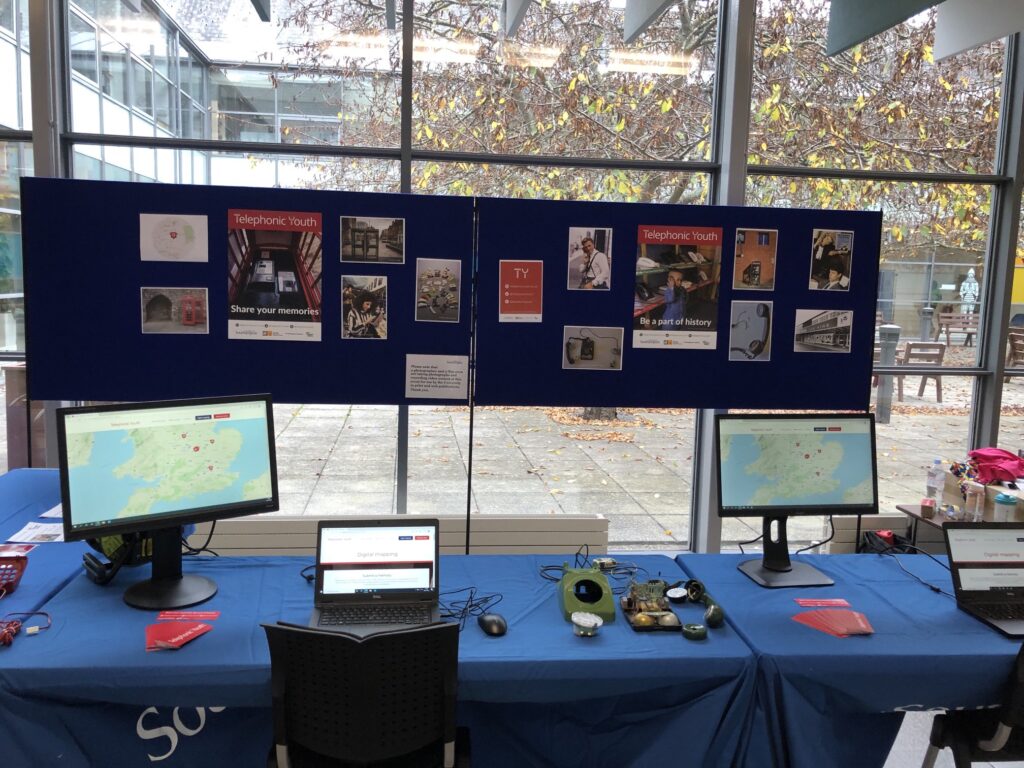
Image shows three tables in an 'L' formation with blue Southampton university-branded table cloths. On top of the tables are two laptops, two computer screens, and three disassembled phones. Behind the tables are two large poster boards with a number of posters featuring images of telephone users from the 1980s and 1990s. The stall is in front of a set of windows which look out onto a courtyard at the University of Southampton.

The Telephonic Youth stall at Hands-On Humanities Day 2021

The Telephonic Youth team spent the day at our stall, speaking to passers-by about their memories. And it was certainly hands-on. While we were speaking to adults about their memories (all of our participants need to be over the age of 16), a raft of budding engineers—and, hopefully, more than a few future historians—set about trying to reconstruct some old telephones kindly lent to us by our friends at BT Heritage & Archives, and which have frequently featured in our Space To Create events at John Hansard Gallery.

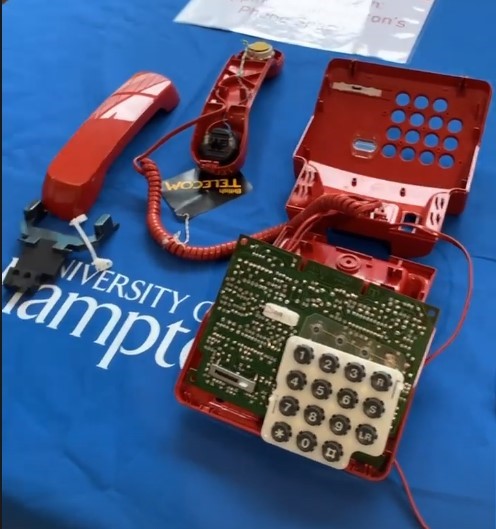
Image shows a disassembled red telephone on a blue Southampton university-branded tablecloth.

One of our disassembled telephones

It was amazing to see both how much the technology changed during the 1980s and 1990s, as rotary dials increasingly gave way to buttons and phones began to integrate digital technologies, but also the speed at which our young visitors were able to re-assemble them—no mean feat when the pieces are designed to fit together snugly and there are no instructions.

Your memories

The memories shared with us during the day showcased the many different ways that phones are integrated into our daily lives—and how important they were to us when growing up.

There were many memories of shared telephones—whether these were with family, friends, or neighbours in the form of a party line.

I lived with a family’s friend flat and she had a phone that was located very near her TV. Whenever the phone rang (dring dring dring) would she be upstairs, she will run down the stairs at speed and lift up the handset as quick as she could so she didn’t miss the caller.
(Barking, London, 2004)

Phone calls were expensive—especially for young people who didn’t always have change for a pay phone.

I remember using telephone boxes, these were used to tell my parents what time I’d be home. You could to do a return call where you would be connected to the other line. Just before you were connected, the operator would say to your parent, you have a call from ….. would you like me to connect you. The parent would be charged, but I’d say, “mum call me back”, and put the phone down. My mum would call back and it would not cost me or my mum anything. I had no money so it was only method I had to contact my mum if I was out and about.
(Lewisham, London, 1994)

As a team of historians, we’re interested in hearing your stories about growing up, using the phone, and what these can tell us about the histories of childhood and youth culture in late twentieth-century Britain. But another one of the memories shared with us also highlights the importance of technology as a means of staying in touch with loved ones—even under the most difficult of circumstances.

Over the pandemic our reliance on phones and telecommunications sky rocketed as they became our only bridge to our friends, family and outside world while being isolated. Before the lockdown I never really used my phone or appreciated how much smaller it makes the world and the ability to talk with different people no matter their world locations or the time.
(Highcliffe, Dorset, 2020)

There are many more stories which you can explore on our digital map—and don’t forget to add your own!