
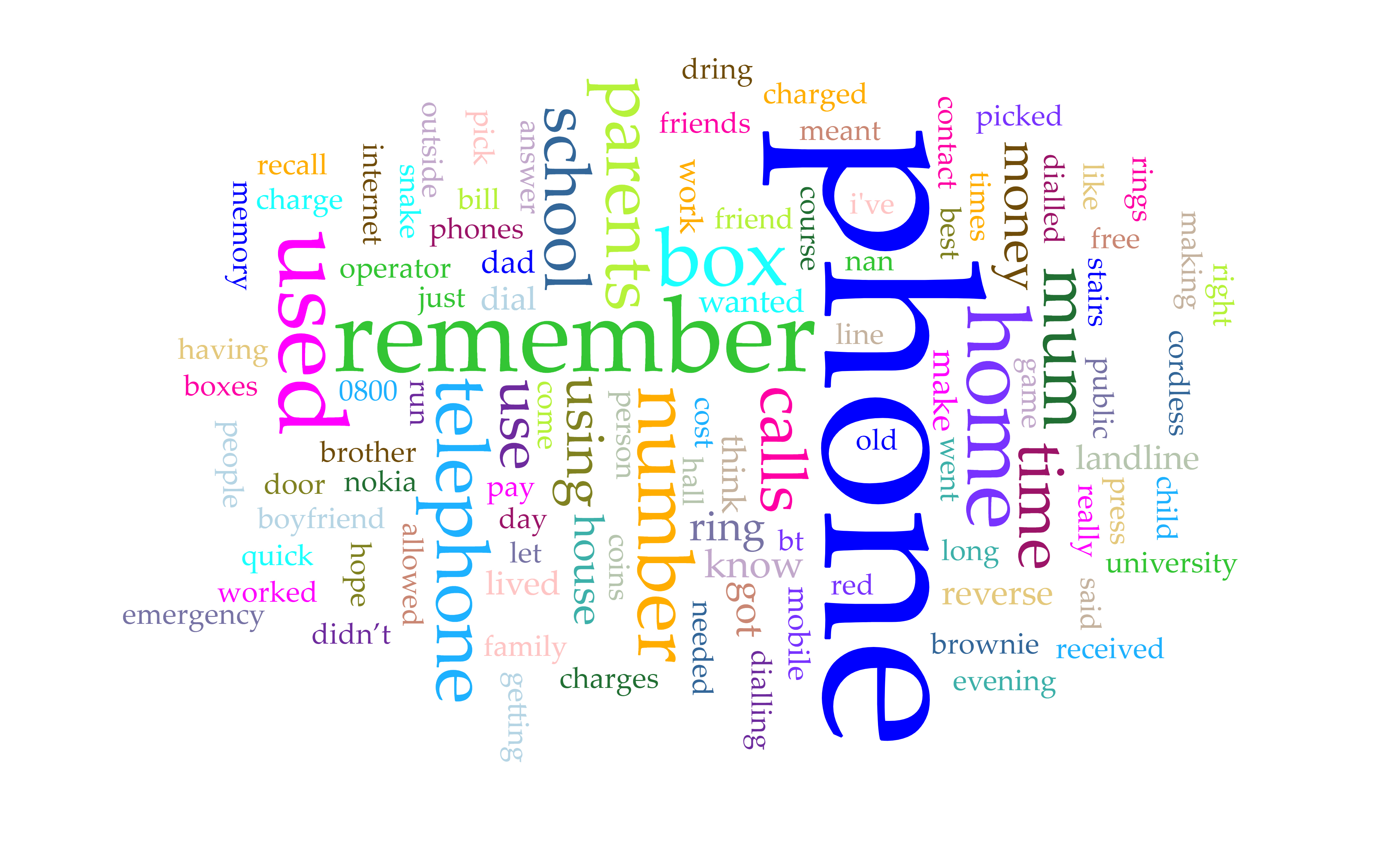
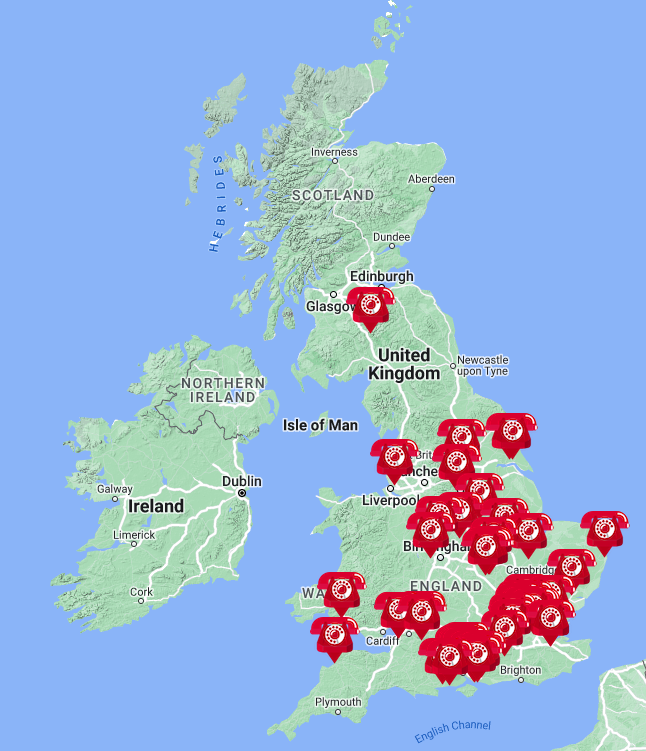
As we look back on a year of submissions to the Telephonic Youth digital map, in this post we identify key themes in the memories that are now published on our map.* A thematic analysis of the memories which have been shared with us reveals some interesting factors in the way that people articulate their memories of using the telephone. It also provides an insight into how memories shared by individuals relate to the wider history of childhood, history of youth culture, the history of the family and history of technology in the late twentieth century.
Technologies
In articulating their memories, 47 per cent of contributors specifically engaged with the telephone as a piece of technology. Submissions often reference distinct factors relating to its changing form and function during our time period. One contributor, for example, noted:
The phone was on a cord (no cordless in those days). In later years I remember sitting for ages on the stairs talking to school friends on the phone planning the latest shopping trip or junior nightlife activity for teens! […] The day we went cordless was a momentous one with much excitement.
(Clare Court, Loughor, Swansea, 1990s)
This technological change was significant as it continually reshaped how, where, when, and why children and adolescents used the telephone, reshaping youth culture and youth leisure in the process.
Submissions shared by contributors suggest the process of adapting to new technologies—whether this is understood as being new to the user, such as a cordless phone, or a relatively new innovation like mobile phones—was understood often to be a significant ‘moment’.[1] However, as many as 10 per cent also remembered being taught to use long-established telephonic devices.[2]
One especially important experience in two contributors’ childhoods was learning to use a telephone kiosk (phone box) in Brownies, a section of the Girl Guides for girls aged between 7 and 10.[3] As one former Southampton-based Brownie recalled:
[Brown Owl] taught us to how to use a public phone as part of a Brownie Badge. I remember waiting anxiously for my turn rubbing my coins together (two big 5 pences I think), would I remember all the instructions? Snowy Owl was back in the Church Hall answering all our calls!
(Water Lane, Totton, Southampton, 1984)
The Cub Scouts also taught their members to use the telephone as part of various badges but we received no memories of this, despite efforts to engage the Scout Association and its followers on social media. Given the small sample size of our dataset (61 memories submitted at the time of this analysis), it would be difficult to draw firm conclusions about the relative significance of telephony training to Girl Guides and (what was then called) Boy Scouts, though it seems clear that the experience of learning to use a phone box in Brownies was of such significance that it was recalled decades later.
Safety
There were many reasons that children and young people were taught to use telephone kiosks in organisations such as Brownies and Cubs. For most of the twentieth century, they were the most accessible means of making a telephone call either because people did not have phones in their own homes, or because they were away from their fixed landlines. However, public payphones were also crucial for what we might define as personal safety, with memories on this theme recorded in 21 per cent of submissions.
One contributor, for example, submitted a general recollection of using the payphone to keep in touch with parents:
I remember using telephone boxes, these were used to tell my parents what time I’d be home. You could do a return call where you would be connected to the other line. Just before you were connected, the operator would say to your parent, you have a call from…would you like me to connect you.
(Lewisham, London 1994)
For another contributor, the phone box itself became a physical refuge from a dangerous animal:
I was on my way home from school, when I got chased by [a] German Shepherd. I hid in a red phonebox and phoned the operator, asking them to reverse charges and call home. I spoke to my mum who sent my uncle to come and rescue me. I waited in the phone box til he arrived, I’ve been scared of German Shepherds ever since.
(Boundary Way, Havant, 1995)
Access
By far the most widely mentioned theme, occurring in 59 per cent of the memories we received, was access. Ownership of a telephone is a key issue here. Across our time period, although the number of households with a landline steadily increased, some did not have a landline.[4] Access is defined broadly also to include factors such as having to share the telephone with other family members or neighbours, and billpayers attempting to restrict the amount of time (and money) spent on the phone.
Underpinning the question of access, and often linked to it, was the issue of money. 47 per cent of submissions mentioned money as a factor in their childhood or adolescent telephone use. Some recalled the requirement to take spare change in case of an emergency and the noted ability to reverse charges as a way to avoid having to pay. For others, finances were a concern for parents trying to reduce or control telephone bills. Submissions to our map show that this was a financial issue of which children and young people were aware acutely, either because their parents made them contribute to the costs of the bill, or because their own subversive use of the telephone was exposed upon receipt of a bill.[5] There are many conclusions to be drawn about the significance of money in shaping children and young people’s telephone use. Certainly their awareness of the financial implications provides an insight into the way young people understood their position within the domestic economy and the decisions they might take to participate within telephone cultures —whether calling friends, or, in the 2000s, voting for participants on reality television programmes.
Play
The submissions we have received so far suggest the use of the telephone in what we might define broadly as ‘play’ or recreation was becoming increasingly important in our period of interest. The theme of ‘play’ was present in 29 per cent of submissions, the majority of which were memories dating from the 1990s and 2000s. While, especially from the 2000s, many of the submissions referred to phone-based games, such as ‘Snake’ (first featured on the Nokia 6110), earlier memories point to playful or creative uses of telephones.[6] For example, one story of siblings recalled humorously responding to cold callers in the late 1990s:
As young teens at the end of the 90s/early 00s, my sister and I often used to answer calls from marketing firms asking for our mother. We always said she had run off with the window cleaner & not to call again as we were v upset.
(Conkell, Winsley, Bradford-on-Avon, BA15 2JF, c.1999)
What might this tell us?
In our previous blog we noted that as engaged researchers we need to be attuned to the implications of our research practice and the ways in which public engagement as a research method might have shaped the kinds of memories we have received. Nevertheless, the striking overlap in the themes which people have shared can tell us much about the key reasons why children and young people used the telephone in late twentieth and early twenty-first century Britain. There are notable continuities with earlier periods in some cases, whilst also the novelty of the new. The submissions also provide a useful insight into the cultures which children and young people created as conscious consumers and users of telephones. Memories from some contributors link to the idea of ‘children’s worlds’, but others point to how children and adolescents negotiated spaces shared with adults. Our third blog post in the series will explore this topic further by thinking about the importance of place in the telephone memories we have received.
* The analysis in this blog post is linked to the data collected in submissions to the Telephonic Youth Digital Map during the first year of data collection. Following the completion of the research project and the period that the website remains publicly available, the dataset will be deposited and made accessible through a repository, in accordance with the Arts and Humanities Research Council (AHRC) / UKRI policies.
[1] For discussion of cordless telephony as part of the development of the idea of ‘personal communications’, see John Gardiner and Wally Tuttlebee, ‘The Future of Personal Communications’, in W. H. W. Tuttlebee, Cordless Telecommunications in Europe: the Evolution of Personal Communications (London; New York, 1990), pp. 223-250. On the history of the mobile phone, see Jon Agar, Constant Touch: A Global History of the Mobile Phone (Cambridge: 2004).
[2] This finding fits with Sonia Livingstone’s argument that new media supplement rather than replace old media and ‘new forms of media transform or are transformed by patterns of use surrounding older forms of media’: Sonia Livingstone, Young People and New Media: Childhood and the Changing Media Environment (London: 2003), p. 15.
[3] The junior section of the Guide Association was officially recognised in 1914 (first known as Rosebuds, then Brownies), and by 1920 the age range of the Brownie section was fixed as under 11 years: Tammy Proctor, Scouting for Girls: A Century of Girl Guides and Scouts (Santa Barbara, Calif., 2009), p. 37.
[4] The percentage of UK private households with a fixed-line telephone increased from 50% in 1974 to 78% in 1984, to 91% in 1994 and 92% in 2004. Statistics taken from: The General Household Survey 1974 (London, 1977), p. 83; General Household Survey 1984 (London, 1986), p. 63; Living in Britain: Results from the 1994 General Household Survey (London, 1996), p. 26; General Household Survey: Results for 2004 (London, 2006), p. 178.
[5] BT trialled itemised telephone billing in some areas of the UK as early as 1983. See ‘BT’s Innovation Timeline’ <https://shop.bt.com/mini-sites/techinnovation> [last accessed 25 August 2022].
[6] Nokia introduced the game of Snake into the Nokia 6110 in 1997. See Nigel Linge and Andy Sutton, 30 Years of Mobile Phones in the UK (Stroud, 2015), p.33.
Main image: Word cloud showing the most common words used in written memories submitted to the Telephonic Youth Digital Map in its first year.




Recent Comments