Participant Information – Crowd-sourced Online research (v.5)
Project Title: Children and young people’s telephone use and telephone cultures in Britain, c. 1984-1999 (University of Southampton Ethics and Research Governance Online number 56966).
This research is funded by the Arts and Humanities Research Council (AHRC), part of UK Research and Innovation.
You will need to tick the boxes on the Submission form to indicate that you have understood this information before you can submit your memory and files. You must also be aged over 16 to participate. By ticking the box on the Submission form, you are indicating that you are aged over 16, and you are consenting to participate.
What is the research about?
This research traces the history of children and young people’s telephone use in Britain between 1984 and 1999. It is a collaboration between Dr Eve Colpus (Associate Professor at the University of Southampton), John Hansard Gallery and BT Heritage & Archives. Dr Colpus is an historian and is interested in particular in how young people used telephones in the 1980s and 1990s. But our research asks a bigger question about what phones have meant to young people growing up then and now.
As part of this research, we are crowd-sourcing memories about young people’s phone use since the 1980s. These memories and information will form part of the materials used to create an interactive online map, which will trace where, how, and when young people have accessed and used phones over the last forty years.
What will I be asked to do?
We invite you to submit a photo/s, video or other image/s to the project website that can help us to tell this history. We want to trace young people’s phone use since the 1980s, so your photo/image might be of yourself when you were growing up in the 1980s/90s or 2000s, or it might be of you today or recently. We will ask you to upload the image as a file (such as a JPEG, MOV or other). You will also be invited to submit a short written memory that gives a bit more detail about the photo or other image that you submit, should you wish to. You will be asked to provide your email address, so that the researchers can contact you to follow up about your submission and can keep a mailing list for the project.
What data will be collected and how will it be used and stored?
A third-party web design company, boxChilli has created the website for the project. If you submit content to the website, it will be saved on to the web company’s server. For their privacy policy see https://www.boxchilli.com/privacy-cookie-policy.
The content you submit will be reviewed by the research team. If the image provides new or helpful information to the project research team, it will then be approved and saved as part of the data set that will be used to produce an interactive map. The interactive map will be hosted on the project website, which will be freely accessible to the public.
If the research team is able to use the content that you submit to the website, we will also collect your written memory, if you have provided one, and this information will be attached to the image/video file in the database. In your memory, you may share details that identify you. We will not use, quote from or share this data with anyone without your express permission.
If the research team is unable to use the content that you submit, the file/s will be deleted from the web company’s server, along with the written memory, if you submitted this.
If you choose to share a photograph, video or audio recording of yourself for this project or other materials that show you, then you might be able to be identified in the research either from your image of your voice. In your memory, you may share details that identity you. We will not use, quote from or share this identifiable data with anyone without your express permission.
Your email address will be used by the researchers so that they can contact you about your submission and to keep a mailing list for the project.
If you have submitted a memory of a location we are not currently mapping, we will email you before we publish the memory to check that you are still happy for this to happen. If your memory is not uploaded at a later date, we will delete it from the server.
Archiving the website
The research team will keep a link that identifies you and your personal information to your submissions to the project, but this link will be kept secure and available only to members of the research team during the study period. Any information that can identify you will remain confidential and will be destroyed after the study is complete. The information you submit to the website will be publicly available on the study website during the project and for three years afterwards, and the website will be registered with the UK Web Archive where it will be accessible for anyone to look at and use in future studies or teaching. At the end of this period, the website will be archived in the University of Southampton repository.
Are there any risks to participating?
Your participation in this research is entirely voluntary, and we therefore hope you will not experience any anxieties or concerns when you are here. However, if participating in this study raises any issues for you, we recommend that you contact one of the following resources: Childline (free phone number 0800 1111) or MIND (MIND Infoline is 0300 123 3393).
Further Information
If you have any questions about your rights as a participant in this research, or if you feel that you have been placed at risk, you may contact the Head of Research Integrity and Governance at the University of Southampton: rgoinfo@soton.ac.uk
Data Protection Privacy Notice
The University of Southampton conducts research to the highest standards of research integrity. As a publicly-funded organisation, the University has to ensure that it is in the public interest when we use personally-identifiable information about people who have agreed to take part in research. This means that when you agree to take part in a research study, we will use information about you in the ways needed, and for the purposes specified, to conduct and complete the research project. Under data protection law, ‘Personal data’ means any information that relates to and is capable of identifying a living individual. The University’s data protection policy governing the use of personal data by the University can be found on its website (https://www.southampton.ac.uk/legalservices/what-we-do/data-protection-and-foi.page) .
The information above tells you what data will be collected for this project. Please ask the research team if you have any questions or are unclear what data is being collected about you.
Our privacy notice for research participants provides more information on how the University of Southampton collects and uses your personal data when you take part in one of our research projects and can be found at http://www.southampton.ac.uk/assets/sharepoint/intranet/ls/Public/Research%20and%20Integrity%20Privacy%20Notice/Privacy%20Notice%20for%20Research%20Participants.pdf
If you have any questions about how your personal data is used, or wish to exercise any of your rights, please consult the University’s data protection webpage (https://www.southampton.ac.uk/legalservices/what-we-do/data-protection-and-foi.page) where you can make a request using our online form. If you need further assistance, please contact the University’s Data Protection Officer (data.protection@soton.ac.uk).
Digital mapping
Submit a memory
Please submit your photographs, videos, audio clips or written memories of the phones you used growing up around the UK since the 1980s. We are collecting memories covering the whole of the UK and particularly encourage any stories covering Southampton and the surrounding area.
Important: Please make sure you have read through the above link thoroughly before submitting a memory form
Dig through your archives and submit your photos, videos, and memories of where and how you used phones growing up and help us to map the spaces where young people have accessed phones since the 1980s.
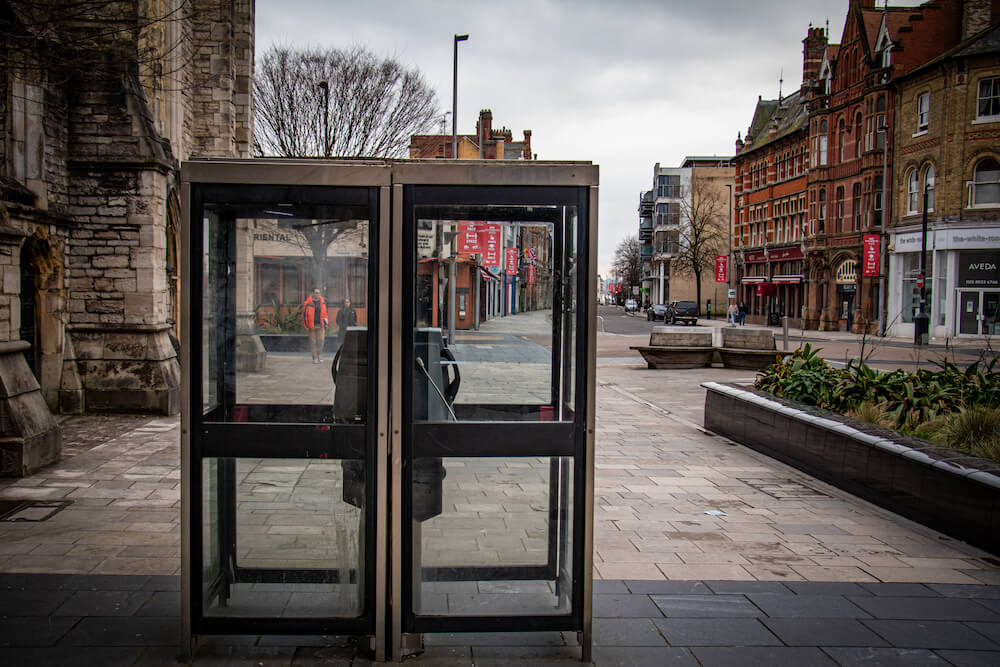
View the map, click on the red telephones and look through other people's memories of where they recall using phones as children and teenagers.