Category: Uncategorised

Telephone memories and the importance of place

Our research explores the changing nature of children and young people’s telephone use and telephone cultures in late-twentieth century Britain. Within this wider focus, we have been keenly aware of the importance of place in this history. In this post, we think further about the memories that people have shared with us in the first year of our work collecting stories on our digital map. We examine the importance of place to our research methods, how people articulate their memories, and in the experience of growing up (and using the telephone) over the last four and a half decades.

Place and our research

When people submitted their memories through our website, one of the things that we asked for was the ‘Address of Memory’. This information (as set out in the Privacy Notice) was required in order to create an interactive online map through which users could explore other people’s memories. In our in-person engagement, if asked about the address, we told people that they could be as detailed as they liked—many chose to give a street address including house number and postcode, but others chose to link their memories to particular neighbourhoods, towns or villages. This ensured that, as closely as possible, the pin on the map aligned with the contributor’s own geographical imagination.

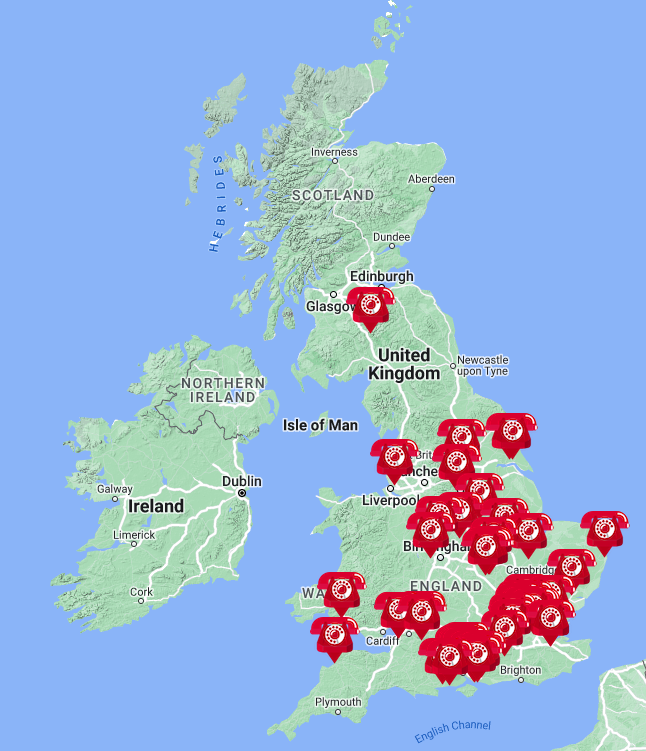
As we have discussed previously in other posts on this site, our project focused initially on our home city of Southampton and the surrounding Hampshire area. We soon broadened out the scope of our research to avoid being too prescriptive about the location of memory submissions, especially as many of the people we spoke to in our public engagement work at locations around Southampton did not grow up in the city. Our use of social media also returned submissions from people from across England. We wanted to honour this engagement, and so adapted our geographical focus.

We did also receive memories from people who grew up in countries other than the UK. This again presented an important methodological and ethical challenge, and we adapted our practice to invite these contributors to submit a memory linked to a place in the UK. These submissions are a reminder that some people’s geographical imagination of their childhood and youth are global, and even if they spent their youth in the UK, the memories they most wanted to share were linked to other places.[1]

A geographical analysis of the submissions to our website did not reveal a substantial difference between memories linked to urban and rural locations. In part, this is a result of the small sample size, with the greatest differences evident over time. It is also a result of Britain’s heavily urbanised society and the massification of (youth) culture, of which the telephone was part, that there was a striking similarity in experiences.[2]

Place and people’s memories

Some of the memories we received provide forms of evidence of what geographers and social scientists call ‘sense of place’. Broadly speaking, sense of place is a term used to describe the links between people’s identities, the meanings they give to particular places, and their attachment (or lack of) to them.[3] The way that people talk about places and spaces in their memories might therefore be illustrative of their sense of place and how they, now as adults, have given meaning and developed attachments to the sites and spaces they frequented as children.[4]

One example, submitted by someone who lived in Southampton in 1996, gives an insight into how a ‘sense of place’ might work in some of the stories on our map:

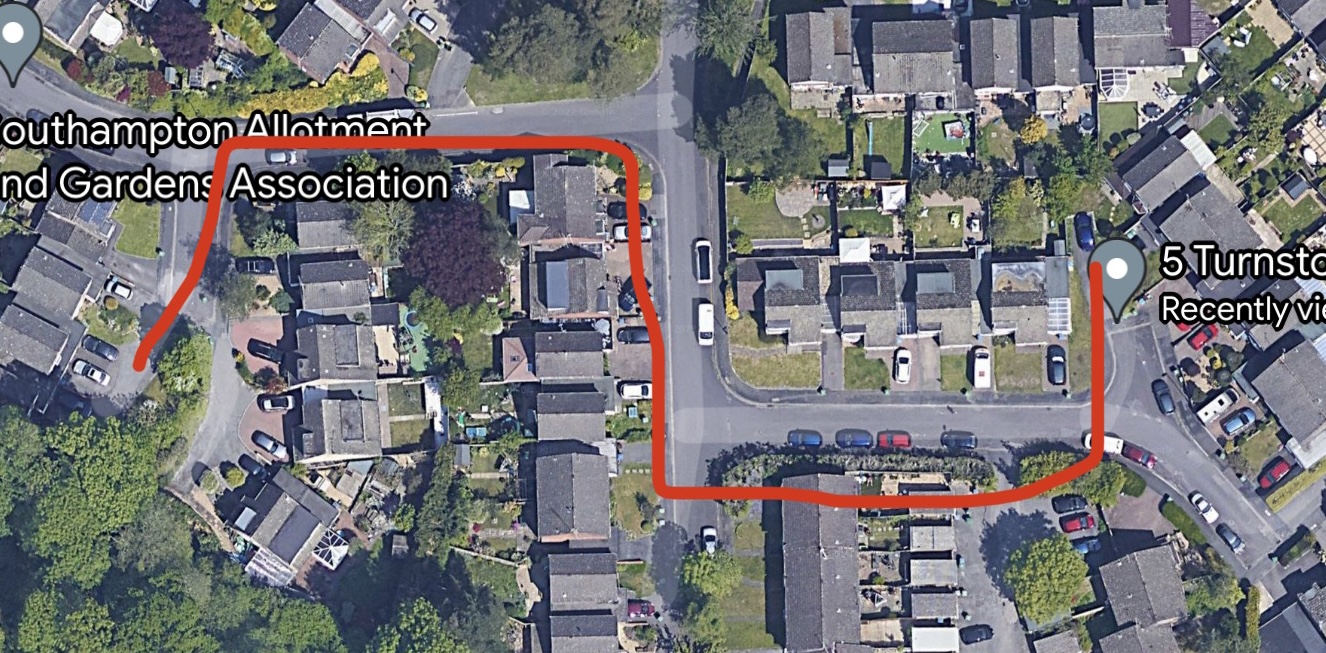
Growing up I lived at number 5 Turnstone Gardens, and my friend lived at number 40. It was probably a 2 minute stroll to her house. And yet, every time I went to her house or she came to mine, we had to call our house phone for two rings then hang up, so our parents knew we were there safely.

(5 Turnstone Gardens, Southampton, UK, 1996)

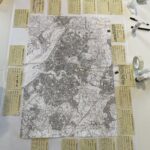
The individual also shared a map of the route from their house to their friend’s house (see the Main Image of this blog post) indicating the dissonant senses of place between the short, relatively safe route travelled by the contributor and the danger implied by the parents’ insistence on the then near-ubiquitous rule to give ‘two [or three] rings then hang up’ to let them know that they were safe.

Alongside the physical mapping by the contributor above, some memories suggested a process of mental mapping. Examples included measuring the distance to a phone box and inferred the theme of safety, which we discussed in our previous blog. Some submissions pointed to this usage within an emergency situation. One contributor, who recalled a memory linked to them being of an age when they were legally able to drive a car, submitted: ‘I can remember having to walk almost 8 miles to find a telephone box this was because I had broken down and had no clue where the next telephone box would be’.

Another contributor, who attended university in Hull, recalled that ‘one of the first things you learnt about Hull was it had its own telephone exchange and distinct white phone boxes’. In their memory, the colour and location of the phone boxes provided a vivid recollection of a significant aspect of their time as a student—calling home—with the distinct character of Hull’s street furniture adding to their sense of place in their university town.
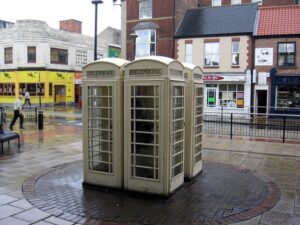
Photograph of four cream telephone kiosks in Hull. Photograph by David Wright (CC BY-SA 2.0) <https://www.geograph.org.uk/photo/244069> [Last accessed 4 October 2022]

Place, childhood, and youth

In the submissions we have collected in the first year of our digital mapping work, the most significant shift in terms of the places and spaces associated with children and young people’s telephone use have been the result of technological change. Of the 58 memories shared with permissions to use in publications, 19 (33 per cent) were of using a telephone kiosk (phone box); 34 (59 per cent) were memories of landline usage; and 13 (22 per cent) were related to mobile phones. The phone box memories were primarily from the 1970s and 1980s, with five dating from the 1990s and one from the 2000s. This should not be surprising. The number of BT phone boxes in the UK peaked in 1992, when there were 92,000 in operation, alongside those offered by other providers.[5] Since then, their numbers and usage have declined.

The continued increase in ownership of domestic landline phones and, from the late 1990s, mobile phones, meant that, over time, children and young people’s telephone use became disassociated from the phone box.[6] The significance of phone boxes as landmarks within young people’s everyday lives—as highlighted by the mental mapping discussed above—likely slowly diminished.

Within the home, the location of the landline—often in the living room or hallway—shaped children and young people’s experiences of telephone use. The fixedness of the landline meant that privacy was an issue, but it also situated emerging telephone cultures—whether this is understood as extended phone calls to friends and romantic partners or the burgeoning use of the telephone for other forms of entertainment, including television phone-ins—within a limited distance of the phone socket.

Portability and personalisation, in contrast, are defining features of mobile phone and smartphone use. Yet, childhood memories shared with us suggest there was a gradual uptake of the practice of using a mobile phone outside of children’s immediate local geographies. Submissions to our map have included two memories of mobile phone use dating from the late 1990s, one being a child’s first use of a mobile phone (using a parent’s work mobile phone in the kitchen of the family home), and the second, a recollection of using a friend’s mobile phone at school to play games during breaks. Although only two examples at the time of analysis, these submissions remind us of the value of looking at evidence of young people’s mobile phone use within family and peer settings, as much as ‘personalised’ modes of use.

Our reflections in this blog, as in our previous two blogs, are based on the submissions we had published on the Telephonic Youth Digital Map by 15 August 2022.[7] We are continuing to collect memories on our map, and you can add your own submissions here.


[1] We discussed our approach and some preliminary conclusions on this theme in a seminar paper we gave at the Britain at Home and Abroad seminar, at the Institute of Historical Research: Aaron Andrews and Eve Colpus, ‘Community histories and the challenge of scale: a global history of Britain’s telephonic youth, c. 1984-1999’ (10 March 2022).

[2] There is a great deal of writing on the massification of culture, but for a very influential theory see the essays in T. W. Adorno, The Culture Industry: Selected Essays on Mass Culture, edited by J. M. Bernstein (London, 1991).

[3] On sense of place, see Maria Lewicka, ‘Place attachment: How far have we come in the last 40 years?’, Journal of Environmental Psychology, 31, 3 (2011), pp. 207-30.

[4] On children’s sense of place, see Lucy Grimshaw and Lewis Mates, ‘“It’s Part of Our Community, Where We Live”: Urban Heritage and Children’s Sense of Place’, Urban Studies, 59, 7 (2022), pp. 1334–52.

[5] Nigel Linge and Andy Sutton, The British Phonebox (Stroud, 2017), p. 55.

[6] See statistics of the increase in domestic landline phone ownership cited in footnote 4 in ‘Tracing themes in our digital map’, Telephonic Youth website, 25 August 2022 <https://telephonicyouth.co.uk/tracing-themes-in-our-digital-map/> [accessed 4 October 2022]. The UK General Household Survey began publishing annual data on mobile phone ownership in 2000.

[7] Following the completion of the research project and the period that the website remains publicly available, the dataset of submissions to the Telephonic Youth Digital Map will be deposited and made accessible through a repository, in accordance with Arts and Humanities Research Council (AHRC) / UKRI policies.

Main Image: Map submitted by a contributor as part of the memory they shared to the Telephonic Youth Digital Map.
Tracing themes in our digital map

As we look back on a year of submissions to the Telephonic Youth digital map, in this post we identify key themes in the memories that are now published on our map.* A thematic analysis of the memories which have been shared with us reveals some interesting factors in the way that people articulate their memories of using the telephone. It also provides an insight into how memories shared by individuals relate to the wider history of childhood, history of youth culture, the history of the family and history of technology in the late twentieth century.

Technologies

In articulating their memories, 47 per cent of contributors specifically engaged with the telephone as a piece of technology. Submissions often reference distinct factors relating to its changing form and function during our time period. One contributor, for example, noted:

The phone was on a cord (no cordless in those days). In later years I remember sitting for ages on the stairs talking to school friends on the phone planning the latest shopping trip or junior nightlife activity for teens! […] The day we went cordless was a momentous one with much excitement.

(Clare Court, Loughor, Swansea, 1990s)

This technological change was significant as it continually reshaped how, where, when, and why children and adolescents used the telephone, reshaping youth culture and youth leisure in the process.

Submissions shared by contributors suggest the process of adapting to new technologies—whether this is understood as being new to the user, such as a cordless phone, or a relatively new innovation like mobile phones—was understood often to be a significant ‘moment’.[1] However, as many as 10 per cent also remembered being taught to use long-established telephonic devices.[2]

One especially important experience in two contributors’ childhoods was learning to use a telephone kiosk (phone box) in Brownies, a section of the Girl Guides for girls aged between 7 and 10.[3] As one former Southampton-based Brownie recalled:

[Brown Owl] taught us to how to use a public phone as part of a Brownie Badge. I remember waiting anxiously for my turn rubbing my coins together (two big 5 pences I think), would I remember all the instructions? Snowy Owl was back in the Church Hall answering all our calls!

(Water Lane, Totton, Southampton, 1984)

The Cub Scouts also taught their members to use the telephone as part of various badges but we received no memories of this, despite efforts to engage the Scout Association and its followers on social media. Given the small sample size of our dataset (61 memories submitted at the time of this analysis), it would be difficult to draw firm conclusions about the relative significance of telephony training to Girl Guides and (what was then called) Boy Scouts, though it seems clear that the experience of learning to use a phone box in Brownies was of such significance that it was recalled decades later.

Safety

There were many reasons that children and young people were taught to use telephone kiosks in organisations such as Brownies and Cubs. For most of the twentieth century, they were the most accessible means of making a telephone call either because people did not have phones in their own homes, or because they were away from their fixed landlines. However, public payphones were also crucial for what we might define as personal safety, with memories on this theme recorded in 21 per cent of submissions.

One contributor, for example, submitted a general recollection of using the payphone to keep in touch with parents:

I remember using telephone boxes, these were used to tell my parents what time I’d be home. You could do a return call where you would be connected to the other line. Just before you were connected, the operator would say to your parent, you have a call from…would you like me to connect you.

(Lewisham, London 1994)

For another contributor, the phone box itself became a physical refuge from a dangerous animal:

I was on my way home from school, when I got chased by [a] German Shepherd. I hid in a red phonebox and phoned the operator, asking them to reverse charges and call home. I spoke to my mum who sent my uncle to come and rescue me. I waited in the phone box til he arrived, I’ve been scared of German Shepherds ever since.

(Boundary Way, Havant, 1995)

Access

By far the most widely mentioned theme, occurring in 59 per cent of the memories we received, was access. Ownership of a telephone is a key issue here. Across our time period, although the number of households with a landline steadily increased, some did not have a landline.[4] Access is defined broadly also to include factors such as having to share the telephone with other family members or neighbours, and billpayers attempting to restrict the amount of time (and money) spent on the phone.

Underpinning the question of access, and often linked to it, was the issue of money. 47 per cent of submissions mentioned money as a factor in their childhood or adolescent telephone use. Some recalled the requirement to take spare change in case of an emergency and the noted ability to reverse charges as a way to avoid having to pay. For others, finances were a concern for parents trying to reduce or control telephone bills. Submissions to our map show that this was a financial issue of which children and young people were aware acutely, either because their parents made them contribute to the costs of the bill, or because their own subversive use of the telephone was exposed upon receipt of a bill.[5] There are many conclusions to be drawn about the significance of money in shaping children and young people’s telephone use. Certainly their awareness of the financial implications provides an insight into the way young people understood their position within the domestic economy and the decisions they might take to participate within telephone cultures —whether calling friends, or, in the 2000s, voting for participants on reality television programmes.

Play

The submissions we have received so far suggest the use of the telephone in what we might define broadly as ‘play’ or recreation was becoming increasingly important in our period of interest. The theme of ‘play’ was present in 29 per cent of submissions, the majority of which were memories dating from the 1990s and 2000s. While, especially from the 2000s, many of the submissions referred to phone-based games, such as ‘Snake’ (first featured on the Nokia 6110), earlier memories point to playful or creative uses of telephones.[6] For example, one story of siblings recalled humorously responding to cold callers in the late 1990s:

As young teens at the end of the 90s/early 00s, my sister and I often used to answer calls from marketing firms asking for our mother. We always said she had run off with the window cleaner & not to call again as we were v upset.

(Conkell, Winsley, Bradford-on-Avon, BA15 2JF, c.1999)

What might this tell us?

In our previous blog we noted that as engaged researchers we need to be attuned to the implications of our research practice and the ways in which public engagement as a research method might have shaped the kinds of memories we have received. Nevertheless, the striking overlap in the themes which people have shared can tell us much about the key reasons why children and young people used the telephone in late twentieth and early twenty-first century Britain. There are notable continuities with earlier periods in some cases, whilst also the novelty of the new. The submissions also provide a useful insight into the cultures which children and young people created as conscious consumers and users of telephones. Memories from some contributors link to the idea of ‘children’s worlds’, but others point to how children and adolescents negotiated spaces shared with adults. Our third blog post in the series will explore this topic further by thinking about the importance of place in the telephone memories we have received.


* The analysis in this blog post is linked to the data collected in submissions to the Telephonic Youth Digital Map during the first year of data collection. Following the completion of the research project and the period that the website remains publicly available, the dataset will be deposited and made accessible through a repository, in accordance with the Arts and Humanities Research Council (AHRC) / UKRI policies.

[1] For discussion of cordless telephony as part of the development of the idea of ‘personal communications’, see John Gardiner and Wally Tuttlebee, ‘The Future of Personal Communications’, in W. H. W. Tuttlebee, Cordless Telecommunications in Europe: the Evolution of Personal Communications (London; New York, 1990), pp. 223-250. On the history of the mobile phone, see Jon Agar, Constant Touch: A Global History of the Mobile Phone (Cambridge: 2004).

[2] This finding fits with Sonia Livingstone’s argument that new media supplement rather than replace old media and ‘new forms of media transform or are transformed by patterns of use surrounding older forms of media’: Sonia Livingstone, Young People and New Media: Childhood and the Changing Media Environment (London: 2003), p. 15.

[3] The junior section of the Guide Association was officially recognised in 1914 (first known as Rosebuds, then Brownies), and by 1920 the age range of the Brownie section was fixed as under 11 years:  Tammy Proctor, Scouting for Girls: A Century of Girl Guides and Scouts (Santa Barbara, Calif., 2009), p. 37.

[4] The percentage of UK private households with a fixed-line telephone increased from 50% in 1974 to 78% in 1984, to 91% in 1994 and 92% in 2004. Statistics taken from: The General Household Survey 1974 (London, 1977), p. 83; General Household Survey 1984 (London, 1986), p. 63; Living in Britain: Results from the 1994 General Household Survey (London, 1996), p. 26; General Household Survey: Results for 2004 (London, 2006), p. 178.

[5] BT trialled itemised telephone billing in some areas of the UK as early as 1983. See ‘BT’s Innovation Timeline’ <https://shop.bt.com/mini-sites/techinnovation> [last accessed 25 August 2022].

[6] Nokia introduced the game of Snake into the Nokia 6110 in 1997. See Nigel Linge and Andy Sutton, 30 Years of Mobile Phones in the UK (Stroud, 2015), p.33.


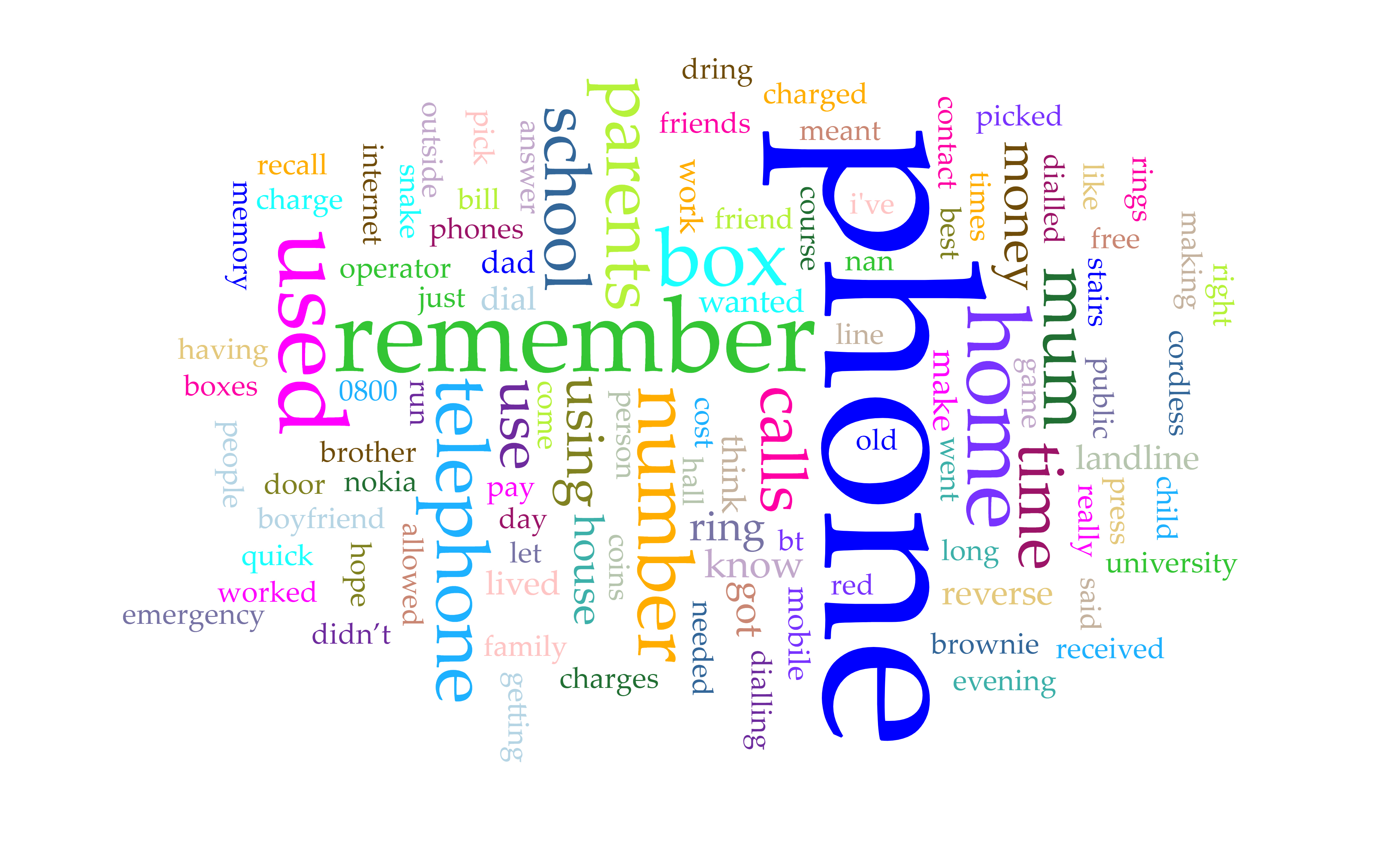
Main image: Word cloud showing the most common words used in written memories submitted to the Telephonic Youth Digital Map in its first year.

Digital mapping one year in: our research methods; or what we did

In August 2021, the Telephonic Youth team began to collect memories through our social media channels and at in-person public events in Southampton. Over the next twelve months, dozens of people came forward to share their stories, most of which are available on our digital map. Our aim was to uncover aspects of the largely ‘untold’ history of children and young people’s telephone use and telephone cultures in 1980s and 1990s Britain.

This research is still ongoing—if you haven’t already, please do share your memories. But, one year in, we want to think about some of the things that the memories we’ve received so far might tell us about the history of children and young people’s telephone use and the wider histories of childhood and youth. Our digital mapping work is part of the engaged research strand on our project, and we are also reflecting on the practice of engaged research.[1] In this post, we will briefly outline the methodology we have adopted in this part of our research by explaining what we did and why. In two follow-up posts, we will examine some of the key themes discussed in many of the submissions to our map, and the spaces and places in which children and young people used the telephone.

In order to better understand the stories we have gathered, it is important to begin with how we collected them. Well before the August 2021 launch, Dr Eve Colpus worked with a web development team at boxChilli to design our website and the University of Southampton Research Ethics and Research Integrity and Governance teams to ensure that appropriate guidelines, participant choices and data storage mechanisms were in place (ERGO 56966). This allowed us to collect memories through the website and publicise this using our social media channels. After the launch of the website, we began to collect stories and started the process to gain University research ethics approvals also to collect data using social media (which was approved in ERGO 67005).

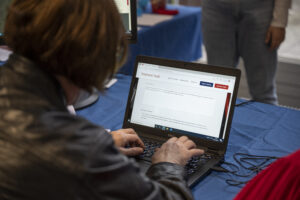
Image of a white woman with medium length brown hair using a laptop to visit telephonicyouth.co.uk.

A participant submitting a memory to Telephonic Youth’s digital map at the University of Southampton’s Hands-on Humanities Day, November 2021.

Our online and in-person memory-collection has taken place alongside more established forms of historical research, notably archival research in collections including those of our partner BT Group Archives, and oral history interviews. Clips from these interviews have formed part of our exhibition at K6 Gallery in Southampton, with others soon to be available on this site. Archival and oral history research will help us to contextualise the memories we have received through our digital mapping research. This is especially important as many of the submissions to our map are, to a certain extent, decontextualised. We do not know any more details about our contributors’ lives beyond that which they chose to share with us. Although we are aware of instances where contributors shared more than one memory, the great majority submitted one. As a result, our mapping gives us a fascinating series of snapshots into people’s experiences and memories of growing up.

Of the 61 published memories which were submitted through our website —there were more which, for various reasons, we have not been able to publish on the map at the time of writing—30 of them came through our online engagement. The remaining 31 came through a series of in-person events in Southampton, including Hands-on Humanities Day, Science and Engineering Day, and pop-up stalls at local libraries across the city. Of the memories published on our digital map, 58 have been included in our analysis owing to the permissions granted by the contributors. Publishing people’s memories on a map has enabled them to be accessible and interactive, but as we explain in a follow-up post, also provides an insight into the way that geography might shape people’s experiences of growing up, as told through their memories of using the telephone.

Throughout our online and in-person public engagement work we have endeavoured to be led by the individual contributor, using as few prompts as possible to ensure that the memories we collected were those which our respondents most wanted to share at that moment in time. There have, of course, been exceptions to this, especially in the way that our social media engagement has been framed. The nature of social media-based engagement, for example, requires closer attention to themed posts during events such as LGBT+ History Month, Black History Month, and Disability History Month, or relating to specific materials we have collected in the archives. Nevertheless, these have been our guiding principles and will form the basis of our practice and thinking as we go forward.

The memories we have received may also have been affected by the other stories already published on our digital map. Rather than extracting knowledge from people, we have looked to create a community of contributors through our social media channels and by encouraging people to read other people’s memories on our website. On social media, we have frequently shared screenshots of published memories (with permission from the contributor) to publicise the project, share our findings, and encourage additional submissions. As engaged researchers, we are acutely aware that some people may have been guided in their submissions by having first read other people’s memories.

Officially, our period of research dates from 1984 to 1999, encompassing the economic and cultural shifts of the marketization of UK telecommunications and the growth of the global mobile phone market, which, by the end of the 1990s, was targeting young people as phone owners in their own right. However, in our digital mapping research, people have shared memories dating from the mid-1970s up to c.2020. That we received six memories from the 1970s, and an additional one dated ‘1975-1985’, undoubtedly confirms the significance of these particular memories to the contributors. It also shows the agency that members of the public have in this research in sharing their own stories on their own terms, and the requirement that engaged researchers work to shape their research practice in order to honour that engagement where possible. Our follow-up blogs will explain further how we have sought to do this and examine what the memories of telephone use we’ve received so far might tell us about the experience of growing up in Britain from the mid-1970s to the present.

[1] On engaged research in the discipline of History, see e.g. Jennifer Crane, ‘The NHS … Should not be Condemned to the History Books’: Public Engagement as a Method in Social Histories of Medicine’, Social History of Medicine, 34, 3 (2021), pp. 1005-27; Laura King and Gary Rivett, ‘Engaging People in Making History: Impact, Public Engagement and the World Beyond the Campus’, History Workshop Journal, 80, 1 (2015), pp.218–233.


Main image: Screenshot of the map from telephonicyouth.co.uk/digital-mapping/ (as of 15 August 2022). The map shows the UK and Ireland (plus part of France and Belgium). The set of icons (red rotary telephones) indicate the locations of memories that have been submitted.

A Very Brief History of LGBTQ+ Youth and the Telephone

A large crowd marching as part of London Gay Pride in 1991. One of the banners is for Bristol Gay and Lesbian Switchboard,

The telephone is an everyday object which serves a practical purpose: enabling communication at a distance.  Having spoken to hundreds of people at a range of events, for many, the everydayness made the telephone into something of a mundane object—it was ‘just there’, in the hallway, living room, or street corner (if a public call box). However, the very utility of the telephone—something which, by the 1980s was ‘just there’ for a majority in the UK, nearly always to hand—made it especially important for LGBTQ+ youth growing up during an exciting, liberating, and traumatic time. While phones played a variety of roles in LGBTQ+ youth culture in the 1980s and 1990s—and we’ll turn to that later—its use as a source of information and support, through organisations like (what is now called) Switchboard LGBT+ Helpline, made the telephone indispensable.

The London Gay Switchboard was established on 4 March 1974 to provide information, advice, and support to gay people. The service grew out of the short-lived Gay Liberation Front (1970-73) and way in part a response to the high number of calls being received by Gay News (1972-1983).[1] London Gay Switchboard was not the only such service—one was also established in Brighton in April 1975 and by 1979, there were similar services in Bristol, Liverpool, Birmingham, and Leicester.[2] It wasn’t even the first, being pipped to the post by the Edinburgh Briefing Service—which served LGBTQ+ people in Scotland where homosexuality was still illegal—by two days. However, it was the largest, has since grown to become a national service, and its work is extraordinarily well documented.

Calls made to the switchboard are confidential, but records of calls now held at the Bishopsgate Institute in London provide an insight into the role of the telephone and dedicated telephone services in the lives of gay people. These stories have been thoroughly explored in a Heritage Lottery Funded project and podcast, the Log Books. As the podcast explores, Switchboard provided a range of vital services. London Gay Switchboard also worked with the National Council of Civil Liberties and Gay Legal Advice (GLAD) to provide legal advice to callers. Given that the Sexual Offences Act (1967) had only partially decriminalised homosexuality, legal advice was crucial in many areas of people’s lives, including their interactions with the police.[3]

The kinds of calls that Switchboard, and other services like it, received were wide-ranging and provide a rich insight into what it was like growing up as an LGBTQ+ person in late twentieth-century Britain. But telephone support services were particularly important, especially to young gay men, during the AIDS crisis in the 1980s and 1990s. Before much was known about HIV; before there were preventative treatments; before it was conceivable that undetectable could mean untransmissible, many young LGBTQ+ people called Switchboard. In fact, Switchboard organised the first symposium on AIDS in Britain.[4]


Short video of singer-songwriter Tom Robinson volunteering for London Gay Switchboard. Tom Robinson, ‘London Gay Switchboard in 1979’, YouTube (2018).

London has a long queer history and is a place where many young LGBTQ+ people have moved to find and create communities. For those newly arriving in the 1970s, London Gay Switchboard provided advice on LGBTQ+ friendly housing—and warned against potential exploitation—as well as social spaces where people might make new friends. This role was particularly important for one young man when he began going to London, from his family home in Surrey, in the early 1980s. In an oral history interview with historian Sebastian Buckle, he remembered, ‘if you were new to London and gay you’d phone up the switchboard and they’d put you in contact with um the befriending group. Sounds a bit, yeah, but the idea was it was run by a group of volunteers and every Friday night it met so it alternated in different parts of London’.[5] The befriending group’s association with Switchboard lent this potentially hazardous practice of turning up at a stranger’s house an air of safety: ‘it was all above board it doesn’t sound like it was but it was all above board. The fact that it was run. The switchboard knew about it’.

The London Gay Switchboard, a voluntary telephone information and support service, clearly played a vital role in the lives of young gay men in the capital in the late twentieth century. But it wasn’t the only way that young gay men used the phone to connect to one another. As the oral history interviewee recalled: ‘[b]ecause there was no, obviously in the 80s there was no internet or Grindr (laugh). So it was, it was just when you were going out you socialised’. If you met people while you were out, ‘you’d probably swap numbers but again back in the 80s there was no mobile phones so it was really if you were home and the landline rang otherwise it was actually quite… so you could just miss people I suppose if you weren’t there to answer the phone’.

Changing telephonic technology has also shaped the experience of, among other things, gay dating, as chatlines became available: ‘Some of them were free and some of them you had to pay. I suppose you phoned and you put a description and you just talked to people. So I suppose it is, if you imagined now a Grindr but with no pictures or anything and you just talked to people’.

This very brief history of LGBTQ+ youth and the telephone is far from comprehensive. We’re still collecting memories for our online interactive map. You can share your own memories, completely anonymously.


[1] Lucy Robinson, Gay Men and the Left in Post-War Britain: How the personal got political (Manchester, 2007), p. 87.

[2] Clifford Williams, Courage To Be: Organised gay youth in England, 1967-1990 (Kibworth, 2021), p. 47.

[3] Kate Bradley, Lawyers for the Poor: Legal advice, voluntary action and citizenship in England, 1890-1990 (Manchester, 2019), p. 138.

[4] Robinson, Gay Men and the Left, p. 174.

[5] Southampton City Archives: D/OH/SHP 6, Southampton’s Hidden Past and Present: An Oral History of the Gay Community, Interview by Sebastian Buckle, 2013.


Main image: London Gay Pride 1991, featuring a banner for Bristol Lesbian and Gay Switchboard. Photograph by Fae, March 1991. Wikimedia Commons, CC-BY-SA-3.0. <https://commons.wikimedia.org/wiki/File:Gay_Pride_London_1991_2_March.jpg>

Telephonic Youth at Science and Engineering Day 2022

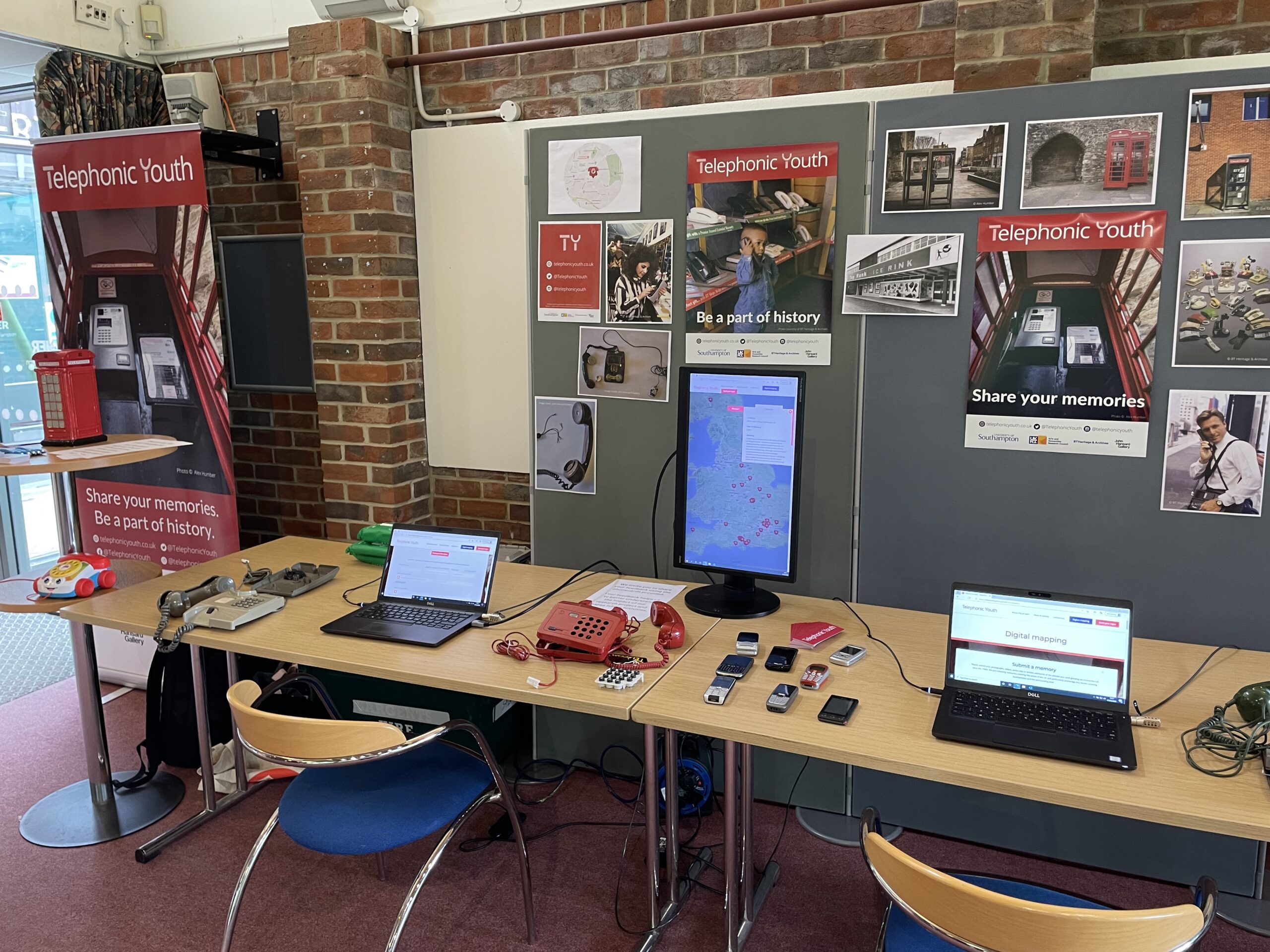
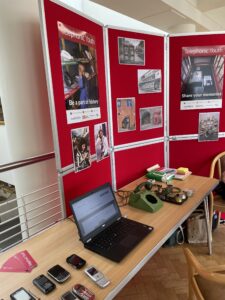
Two laptops, three disassembled landline telephones, and eight mobile phones laid out on two tables. In the background are various posters from BT or places Southampton

On 7 May, the Telephonic Youth team took part in our second SOTSEF 2022 event (after our Community Takeover at John Hansard Gallery), the University of Southampton’s Science and Engineering Day. Following on from our stand at Hands On Humanities Day in November 2021 and pop-ups at libraries throughout Southampton in February and March 2022, we once  again set up shop with our old, disassembled telephones and laptops to gather visitors’ memories.

Although, this time we had even more phones:  a set of mobile phones from the 2000s (liberated from a family member’s garage) and a Fisher Price rotary telephone toy. We were also supported, once again, by two wonderful University of Southampton History students, who gave up their Saturday to help us out and (we hope) get a chance to see community history in action.

A rotary telephone toy with eyes, a mouth and wheels.

Our toy phone

We knew that the old, disassembled telephones would be interesting objects for younger visitors. Many do not have landline telephones at home, let alone rotary phones, and enjoyed working out how to put them back together and – had we had the means to plug them in – make a phone call. What I, in particular, was less prepared for was how alien some of the older mobile phones would be.

Some of them had black and white only screens and no cameras while others didn’t have the ability to connect to the internet. The basic hallmarks of design were also fundamentally different: much smaller screens and many more buttons; one of them flipped shut while the other slid to conceal the buttons. The way that phones have changed over time was brought home by a comment from one young visitor who picked up a phone that I (a 31-year-old man) had owned brand-new as a teenager: ‘this must be 100 years old!’

But this post isn’t about me. Throughout the day, the team had lots of conversations with visitors about their memories of using the phone while growing up. Visitors kindly submitted these to our online map and we’ll also continue to share their stories via our social media. The sheer variety of memories which are shared with us is always heartening and really illustrates the many different ways in which children and young people acted as telephone users during our period of study.

Some people remembered vividly their parents and grandparents using bakelite phones and being made to answer calls in a certain way, whether listing the telephone number or the family name. Others remembered calling friends and ‘hoping that no-one picked up the other phone and listened in’ (Bishopstoke, Eastleigh, 1988).

SOTSEF was a wonderful opportunity to speak to people living in and around Southampton about their memories, and the team would like to thank our colleagues in PERu for all their hard work in organising the event. We’re still collecting memories of using the telephone while growing up anywhere in the UK from the 1980s onwards. We’d love it if you could share your memories too through our website.

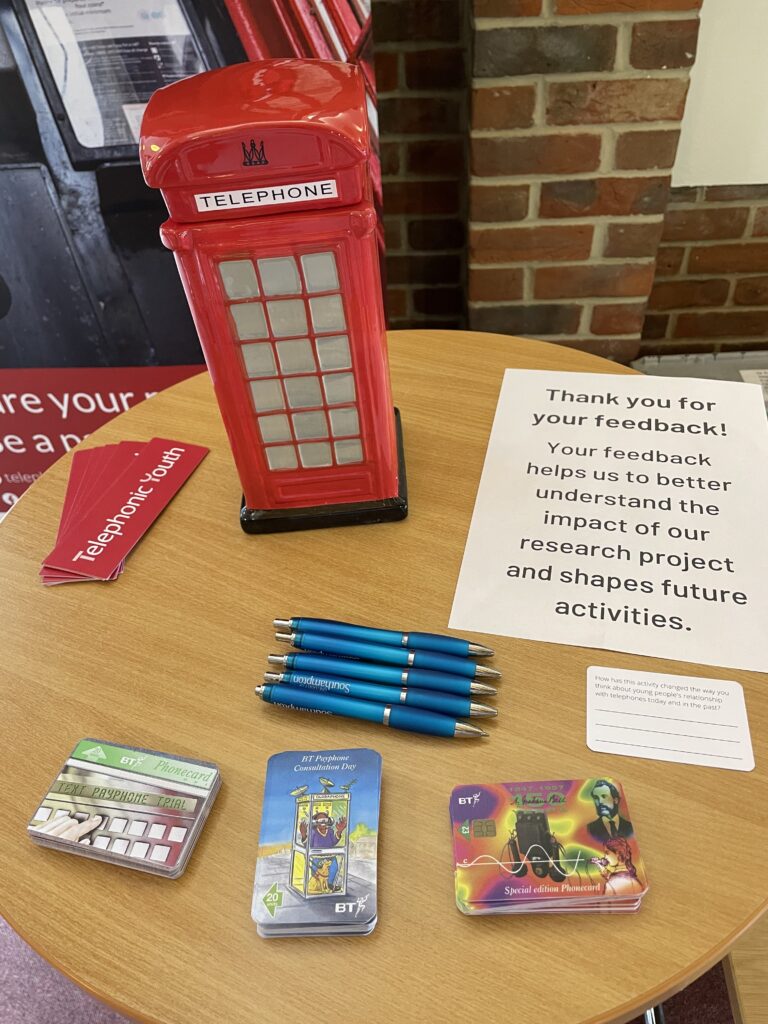
A red phone box-shaped cookie jar and set of replica phonecards on a circular table with a sign requesting feedback

The replica BT phonecards (courtesy of BT Heritage & Archives) and cookie jar we used to collect feedback

Community art exhibition foregrounds new youth voices in research

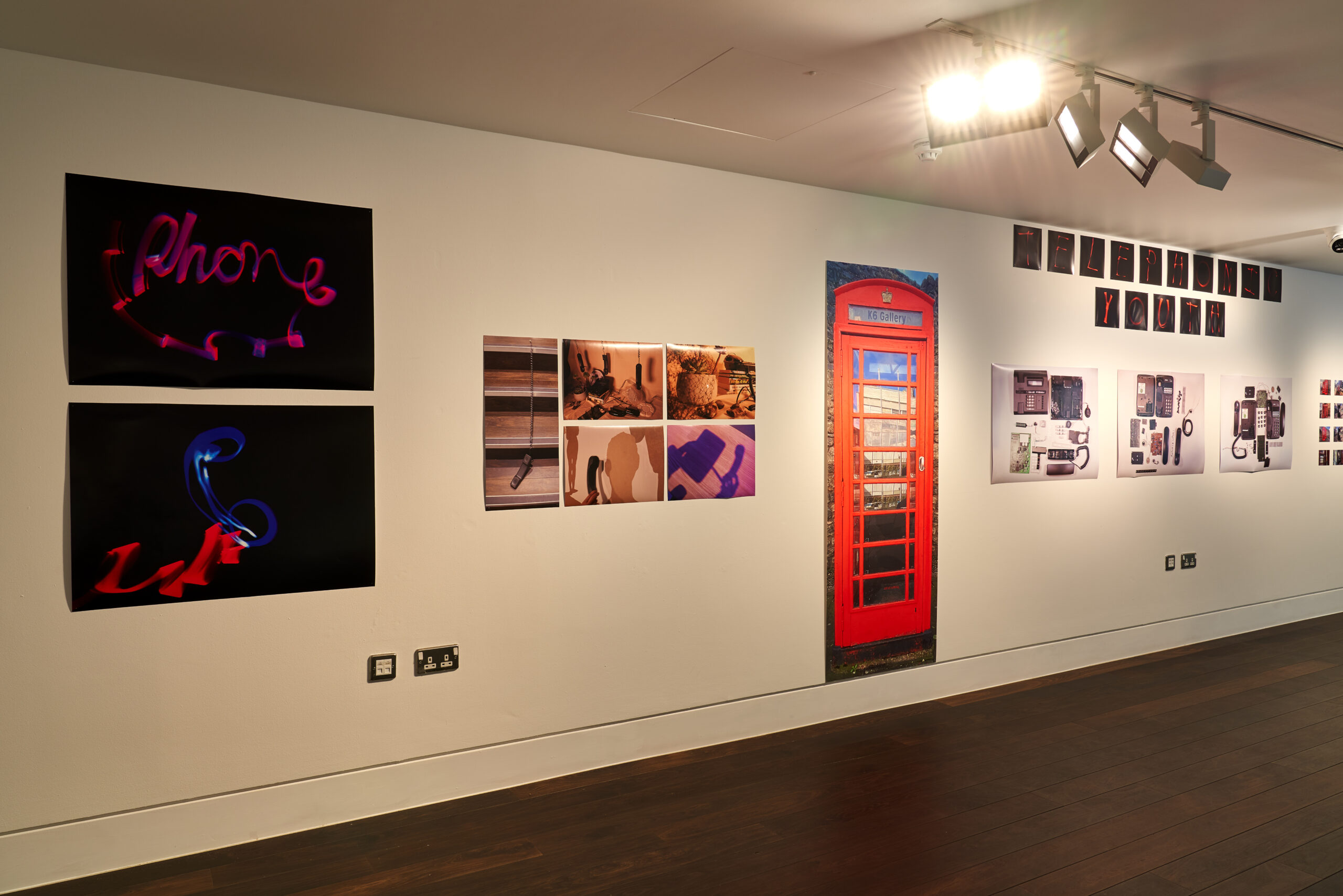
A series of photographs on a white gallery wall. The photos include the word 'phone' created using light, a large portrait image of a red telephone box, and a series of photos of disassembled telephones.

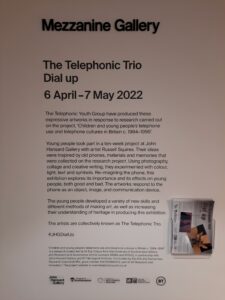
We were incredibly proud to see the first of our two community art exhibitions launched in Southampton at the start of April 2022. Dial up featured the artwork of a group of young people based in Southampton and reimagined the phone as an object, image and communication device and its effects on young people.

Image of text describing the exhibition at John Hansard Gallery. Underneath the text are the logos of the gallery, Southampton university, the AHRC, Arts Council England, and BT.

Description of the exhibition and accompanying materials.

The exhibition was the result of interpretative work undertaken by the group as part of Telephonic Youth’s collaboration with John Hansard Gallery. Beginning in November 2021, the young people worked with artist Russell Squires in a series of workshops over five months in which they responded to materials and themes from our research.

The young artists, known as The Telephonic Trio, experimented with a range of photographic styles. Inspired by Todd McLellan’s Things Come Apart series, they took photographs of the parts of disassembled landline telephones. They also drew on the traditions of vanitas still life artworks which used symbolic objects to remind the viewer of their mortality. Playing with this genre, The Telephonic Trio created atmospheric photographs that centred the phone.

The Telephonic Trio’s work spoke to the iconography of the 1980s and 1990s – our historical era – in playful ways. In their light painting photographs, the artists created colourful representations of the telephone number pad that were inspired by the neon colours in advertisements for phone chat lines found in teenage magazines of the late 1980s. In a nod to the zine culture of the 1990s, they created zines reflecting on varied associations of young people’s phone use, drawing on materials from BT Heritage & Archives’ collection, ephemera and creative writing.

Dial up has made a wonderful contribution to our research project and the questions we are asking. Moving between the imagery and the language of the telephone, it explores shifts and connections between young people’s phone use past and present. There are ways in which this is a distinctively Southampton show: all of the artworks were created in the city’s John Hansard Gallery or city centre by young Sotonians. But the show also points to the scales of connection and influence far beyond the city itself. Notably, The Telephonic Trio referenced the influence of Jamaican patois on the way young people from different cultural backgrounds in Britain speak on the phone today. Through this, Dial up presented a global story of contemporary youth culture.

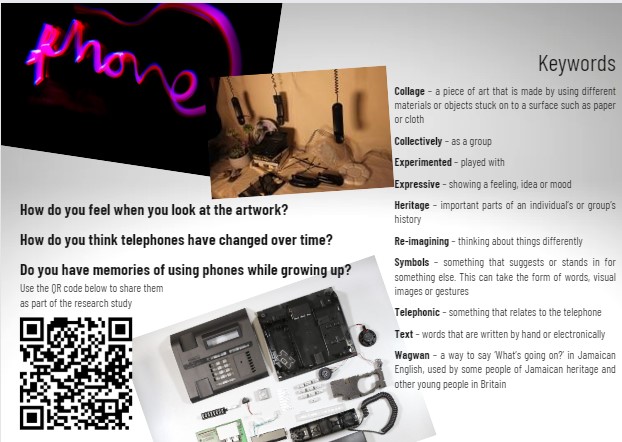
Part of the exhibition guide. Includes some photos from the exhibition, questions, a QR code to contribute to the research project, and a list of keywords.

Exhibition keywords.

Dial up was on display in John Hansard Gallery from 6 April until 7 May 2022. Some of The Telephonic Trio’s photography is also reproduced in our second community exhibition, Thinking inside the box, in K6 Gallery (located in the two red telephone boxes on Castle Way, Southampton), which is on show from 6 April until 10 July 2022.

Featured image: Photograph of Dial up at John Hansard Gallery by Reece Straw.

Community Takeover: Thinking about phones past, present and future

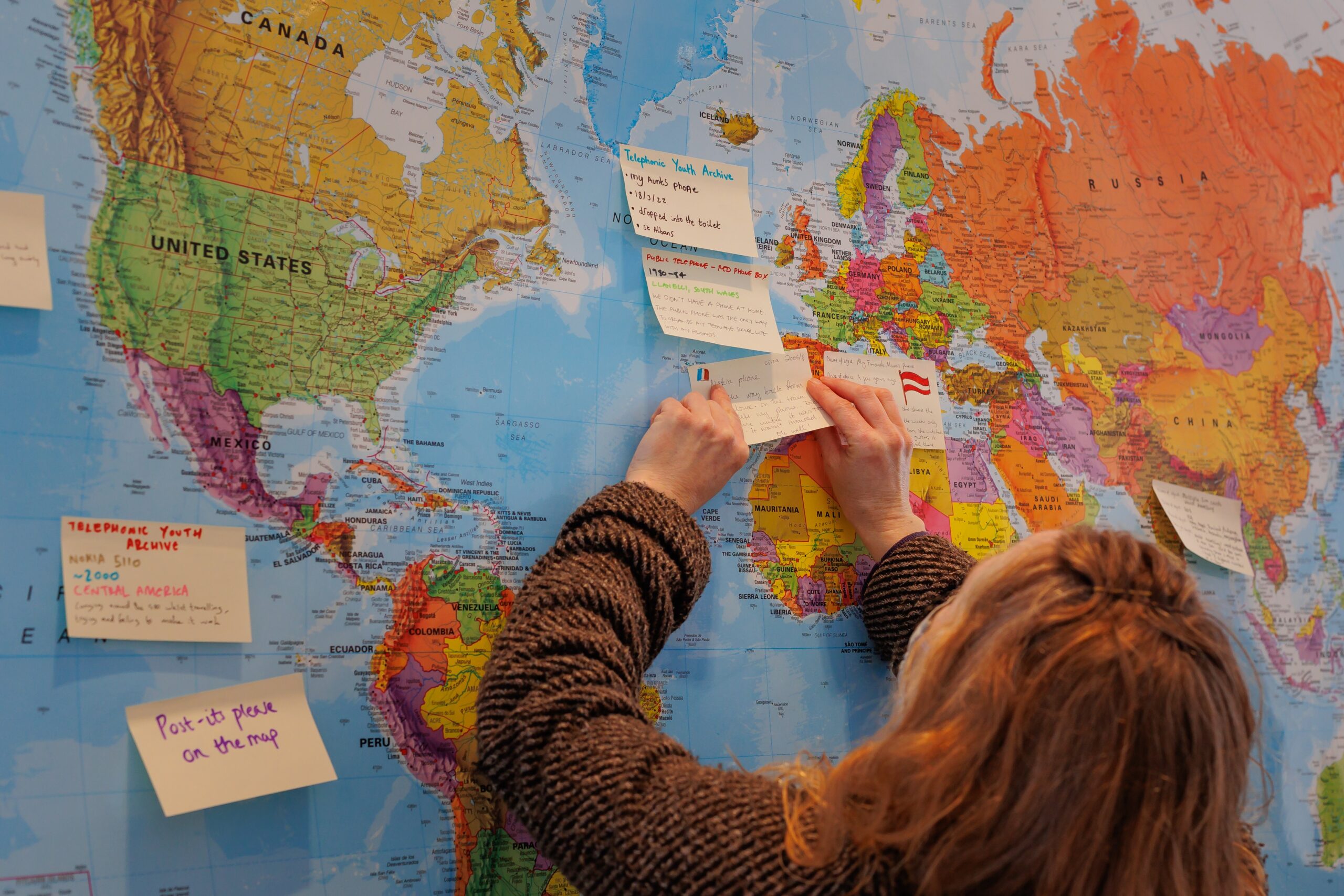
A white woman with medium length, red-ish hair and wearing a brown coat and blue disposable face mask is putting a post-it note on a map of the world. There are a number of post-its on the map, each with a memory relating to a telephone. The post-its have 'Telephonic Youth Archive' written at the top. The woman's memory appears to be related to a place in France and has a small French flag drawn in pen in the corner.

Throughout March and April, our friends at Southampton’s John Hansard Gallery have been running their 2022 Community Takeover events. Exploring the themes of environment, sustainability and wellbeing, the Gallery has worked with schools, local charities, artists, community leaders, and us to explore big questions about how we can help our planet and health.

The Telephonic Youth team was very excited to be part of Community Takeover on the first day of its programme. Joined by two History undergraduate students from the University of Southampton, we set up an activity in the Gallery  to turn old phones into community art. Where phones have become disposable items for many, we encouraged people to remember the stories that are attached to our old phones, and to think in different ways about how phone use and production impacts the environment.

We invited people to create an archive tag for one of their old phones. The tags asked people to describe an object, add the date of their memory and a description. The names people gave to their old phones pointed to intimate and personal connections that people have with their phones: ‘My old nokia’, ‘First telephone ever’, ‘The phone under the stairs’. Data left behind on sim cards were a reminder that phones themselves are made of many objects and are themselves miniature archives, holding memories of their owners’ everyday lives. As people stuck their archive tags onto a large 1980s map of Southampton and an even larger map of the world (on loan to the project), the community artwork began to take shape.

Professor Ian Williams, from the University of Southampton’s Engineering Faculty, also joined us on the day and spoke to people about e-waste. We learned about the amounts of carbon dioxide emissions that are caused during the manufacture of a digital device, but also what we can do to try to reduce the impact of e-waste. For example, if you keep your smartphone for 5 instead of 2 years, you can halve its carbon dioxide and water impacts. Community Takeover provided an opportunity to make a very small contribution to reducing e-waste, as some people also left behind old, unused mobile phones to be recycled or re-used.

The archive tags created during Community Takeover told stories about phone boxes and old landline phones, but memories about mobile phones featured prominently.  We shouldn’t be surprised at this: the heritage of mobile phones is now explored in dedicated museums, such as the Mobile Phone Museum. As mobile phones become museum exhibitions, consumers increasingly turn back to ‘dumb phones’, and the climate crisis and resource finiteness threaten consumer habits, there has never been a more important time to re-think the mobile phone’s past, present, and future.

Featured image by Nosa Malcolm.

‘Having fun isn’t hard when you have a library card’

Image shows the front of Southampton Central Library, located in the Southampton Civic Centre. The building is light stone neo-classical, the sun is shining but the sky is slightly cloudy.

The Telephonic Youth team have been spending a lot of time in libraries recently—though we weren’t there to borrow books (even if there were more than a few which caught our eye!)

The team at Southampton City Council Libraries kindly allowed us to stage a series of pop-ups across Southampton throughout February and March. It was a bit bumpy—and we had to re-schedule our last one because of covid—but it was also an enriching experience. In the process, we’ve added more stories to our interactive map. We’ve also learned a lot about how we can and should work in public spaces to gather memories (we spoke about this recently at the Institute of Historical Research’s Britain at Home and Abroad seminar). So, what did we learn?

Librarians are your best friends. We already knew this, but it was good to have it reinforced. At all of the libraries we visited, the librarians were there to offer us support, advice, and cups of tea. They directed visitors to our pop-up and even shared their own memories.

Local stories are also global stories. We talked a lot about this in our seminar paper, but visiting libraries across Southampton once again showed the diversity of the city. It was really striking how similar the memories people shared of growing up in Southampton were to those of growing up in other countries—the telephone is definitely something which can unite us all!

The best laid plans of mice and [historians] often go awry. Expect the unexpected is easier said than done, but it was especially true of our pop-ups. We began this research project during a pandemic, and even as restrictions have eased and we were finally able to go out and meet people (masked) in person, covid is still with us and so we’re especially grateful to the library teams for allowing us to reschedule when needed.

More than anything, we were reminded that public libraries are really important spaces which need to be available. Not just to loan out books, DVDs, board games, and puzzles, but also to provide a place for people to meet for a chat, to study, take part in family-friendly activities, or just spend the day learning about people’s experiences of growing up and using the phone in the 1980s and 1990s.

Do you remember using the phone when you were growing up? Share your memories here!

Six months of Telephonic Youth Space to Create!

Image shows arts materials laid out on a hexagonal table. Materials include post-its, some silver pots/cans, keys, wooden sticks, A4 sheets of paper with a colour-coded alphabet, an ipad, and some other pieces of paper. Around the table are four red/orange chairs. An individual in black clothing can be seen holding a stick.

Colourful heads, beautiful prints, drums and memory maps. Perhaps not your first thoughts when someone asks you about telephones. But with the artistic inspiration encouraged at John Hansard Gallery, families have been exploring all of these themes as part of Telephonic Youth’s Southampton-based activities.

Over the last few months, artist Joey Walters has led a series of workshops suitable for ages 4+ as part of the Gallery’s weekly, free Space to Create! programme. And it’s been wonderful to see what creative thinking telephones have sparked in those who have taken part.

Joey took inspiration from  the research we are doing at Telephonic Youth in a number of ways. The first workshop asked visitors to think about the journeys they make with their phones across the city.

A second workshop used binary coding to get families thinking about the words they associate with telephones. Once people had thought of their word, they were able to collage it onto the shape of a human head using tissue paper matching a colour-coded alphabet designed by Joey. The shape of the head encouraged families to think about how they communicate when they use a telephone. Using binary code meant that people could keep their chosen word secret – an added bonus, if you didn’t want to reveal all!

Image shows a set of coloured paper collaged over an outline of a human head. On A4 white paper, atop a light-coloured table.

One of the colour-coded collages produced at a Space to Create.

Inspired by how different it feels to hold a rotary dial telephone to a mobile phone, in a third workshop visitors created cyanotype prints. In this workshop, children and adults had fun taking apart old telephones and using disassembled telephone parts to create their prints. The results were beautiful, atmospheric prints in striking blue and white colours.

Telephones, of course, also make sounds, and in the fourth workshop, Joey was inspired by the sound of the phone ringing in a public phone box, and asked visitors to design their own ringtones. With the kind loan of tongue drums from Soco Music, everyday objects, and iPads, visitors got to compose, record and and take away their very own ringtones.

The final workshop linked to our Hands on Humanities Day where we had collected memories of young people’s telephone use. Joey asked visitors to think about what pictures they create when they map their memories of using phones. The prompt inspired people to draw and collage their phone stories in wonderfully creative ways. Joey’s customised ‘polaroid frames’, meant visitors captured their memory as a moment in time.

We want to say a really big thank you to everyone who created such amazing art at these workshops, to Joey for designing such brilliant activities, and to John Hansard Gallery for hosting us.

Telephonic Youth at Hands-On Humanities Day 2021

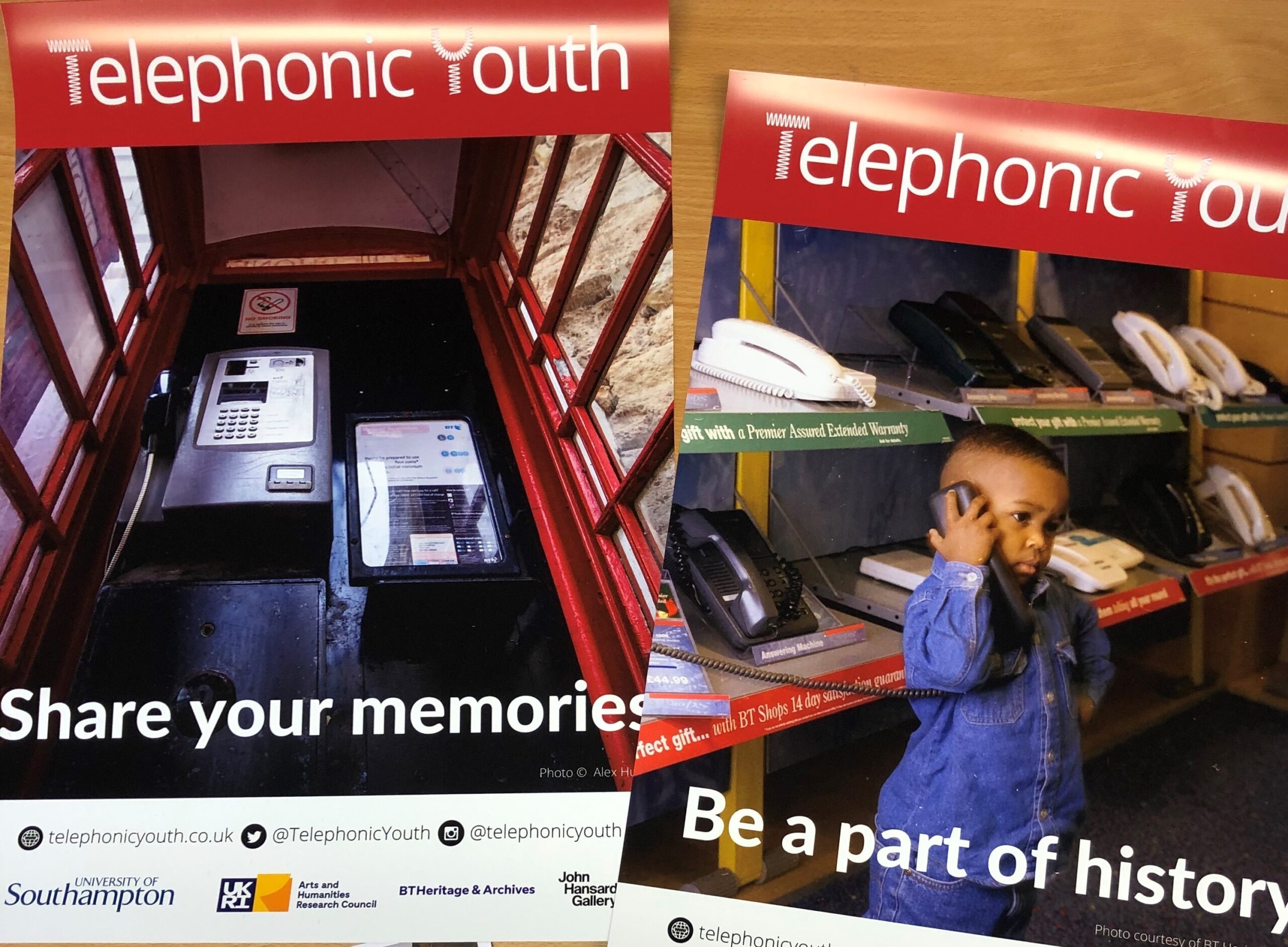
Image shows Telephonic Youth branded posters laid out on a table. The posters include the phrases 'Share your memories' and 'Be a part of history'. One has an image of the interior of a red telephone box; the second has an image of a young boy playing with a telephone in a shop.

Saturday 20 November was a great day for the Telephonic Youth team! With the help of two of Southampton university’s fantastic History undergraduate students, we spent the day speaking to members of the public in person about their memories of using the phone while growing up in Britain from the 1980s to the present. You can read their stories on our map.

Hands-On Humanities Day

Hands-On Humanities Day is an annual event organised by the Public Engagement with Research unit here at the University of Southampton. Part of the national Being Human Festival and the university’s own Southampton Arts and Humanities Festival, it is a celebration of research and a great opportunity to meet members of the public (masked)face-to-(masked)face.

As a project which puts your stories at the heart of our research, we are incredibly grateful to Silvia, Emma, Lou, Jo, Steve, Bethany and Connie for everything they did to make the day possible—and to all of the student ambassadors for their hard work throughout.

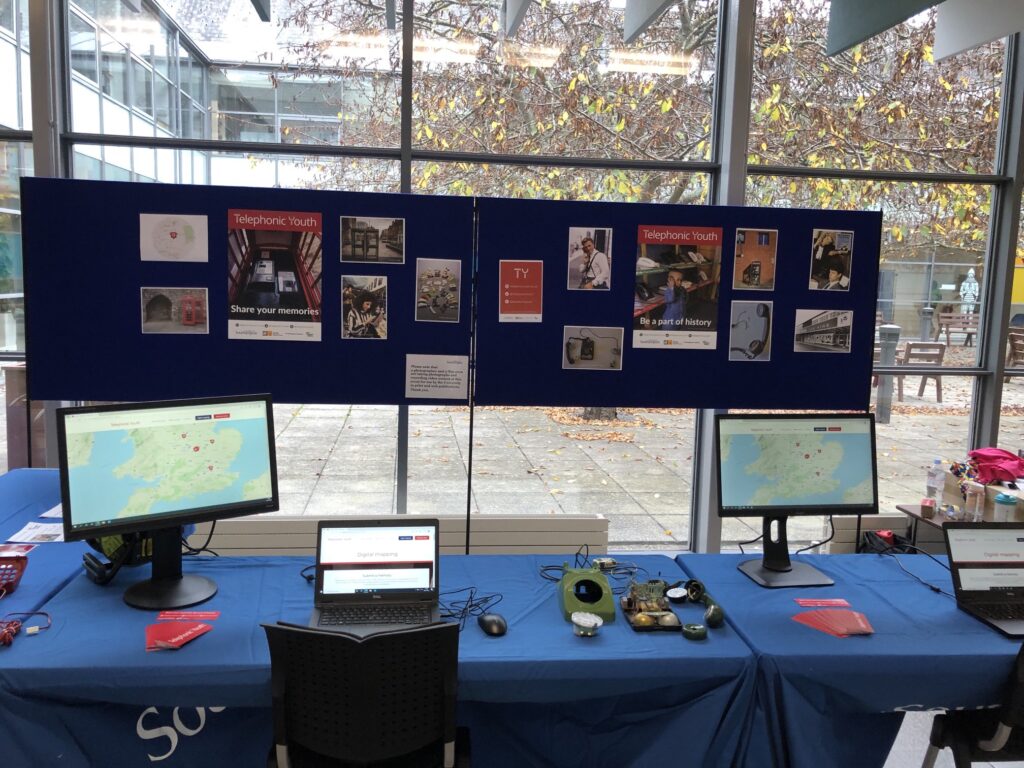
Image shows three tables in an 'L' formation with blue Southampton university-branded table cloths. On top of the tables are two laptops, two computer screens, and three disassembled phones. Behind the tables are two large poster boards with a number of posters featuring images of telephone users from the 1980s and 1990s. The stall is in front of a set of windows which look out onto a courtyard at the University of Southampton.

The Telephonic Youth stall at Hands-On Humanities Day 2021

The Telephonic Youth team spent the day at our stall, speaking to passers-by about their memories. And it was certainly hands-on. While we were speaking to adults about their memories (all of our participants need to be over the age of 16), a raft of budding engineers—and, hopefully, more than a few future historians—set about trying to reconstruct some old telephones kindly lent to us by our friends at BT Heritage & Archives, and which have frequently featured in our Space To Create events at John Hansard Gallery.

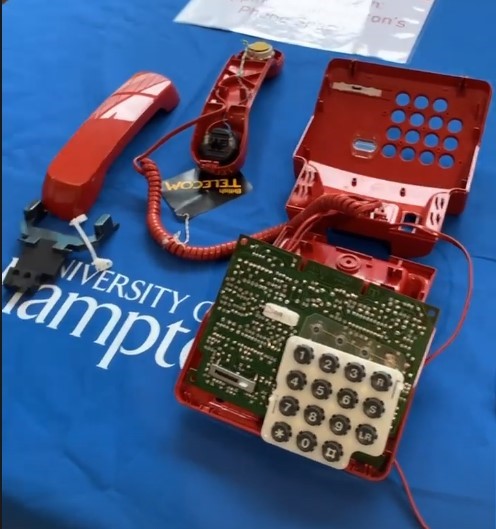
Image shows a disassembled red telephone on a blue Southampton university-branded tablecloth.

One of our disassembled telephones

It was amazing to see both how much the technology changed during the 1980s and 1990s, as rotary dials increasingly gave way to buttons and phones began to integrate digital technologies, but also the speed at which our young visitors were able to re-assemble them—no mean feat when the pieces are designed to fit together snugly and there are no instructions.

Your memories

The memories shared with us during the day showcased the many different ways that phones are integrated into our daily lives—and how important they were to us when growing up.

There were many memories of shared telephones—whether these were with family, friends, or neighbours in the form of a party line.

I lived with a family’s friend flat and she had a phone that was located very near her TV. Whenever the phone rang (dring dring dring) would she be upstairs, she will run down the stairs at speed and lift up the handset as quick as she could so she didn’t miss the caller.
(Barking, London, 2004)

Phone calls were expensive—especially for young people who didn’t always have change for a pay phone.

I remember using telephone boxes, these were used to tell my parents what time I’d be home. You could to do a return call where you would be connected to the other line. Just before you were connected, the operator would say to your parent, you have a call from ….. would you like me to connect you. The parent would be charged, but I’d say, “mum call me back”, and put the phone down. My mum would call back and it would not cost me or my mum anything. I had no money so it was only method I had to contact my mum if I was out and about.
(Lewisham, London, 1994)

As a team of historians, we’re interested in hearing your stories about growing up, using the phone, and what these can tell us about the histories of childhood and youth culture in late twentieth-century Britain. But another one of the memories shared with us also highlights the importance of technology as a means of staying in touch with loved ones—even under the most difficult of circumstances.

Over the pandemic our reliance on phones and telecommunications sky rocketed as they became our only bridge to our friends, family and outside world while being isolated. Before the lockdown I never really used my phone or appreciated how much smaller it makes the world and the ability to talk with different people no matter their world locations or the time.
(Highcliffe, Dorset, 2020)

There are many more stories which you can explore on our digital map—and don’t forget to add your own!

Collecting your memories on social media

Here at Telephonic Youth, we’re looking to collect as many memories as we can about young people’s telephone use in 1980s and 90s Britain. We’re now collecting memories on our Twitter and Instagram accounts, and we’d love it if you shared your story with us.

If you post a memory on one of our social media sites, we’ll get in touch to ask if you’re happy for us to use your memory and save it as part of our research. We would also like to be able to quote your memory in our research outcomes, but we would only do this if you give us your permission.

We want to be clear about what data we would collect: as well as your memory, we’ll collect your username (but only if that is required by the social media platform) and the date and time of your message. We’ll also keep a record of your permission to use this data. All of your data will be held in accordance with data protection legislation and saved securely by the University of Southampton, and it will be accessed only by the research team and responsible members of the University of Southampton or individuals from regulatory authorities who may be given access to the data for monitoring purposes.

If you’d prefer us not to save your memory or quote from it, then we would only record the theme of your memory for our research, and we would not save your post or any of your details.

Taking part in this research is voluntary. If you do take part we hope you won’t experience any anxieties or concerns. However, if participating in this study raises any issues for you, we recommend that you contact one of the following resources: Childline (free phone number 0800 1111) or MIND (MIND Infoline is 0300 123 3393).

If you have contributed a memory to our research project on Twitter or Instagram, you can contact the research team on our social media platforms to ask to see the research outcomes. If you change your mind later and decide that you want to withdraw your post/memory from our research, you can also contact us on our social media platforms to let us know, and we will delete the data we had saved about your post from our research.

The Telephonic Youth Project is led by Dr Eve Colpus and based at the University of Southampton. The project has ethics approvals from the University of Southampton ERGO numbers 56966 and 67005. If you have any questions about your rights as a participant in this research, or if you feel that you have been placed at risk, you may contact the Head of Research Integrity and Governance at the University of Southampton: rgoinfo@soton.ac.uk.

Data Protection Privacy Notice
The University of Southampton conducts research to the highest standards of research integrity. As a publicly-funded organisation, the University has to ensure that it is in the public interest when we use personally-identifiable information about people who have agreed to take part in research. This means that when you agree to take part in a research study, we will use information about you in the ways needed, and for the purposes specified, to conduct and complete the research project. Under data protection law, ‘Personal data’ means any information that relates to and is capable of identifying a living individual. The University’s data protection policy governing the use of personal data by the University can be found on its website (https://www.southampton.ac.uk/legalservices/what-we-do/data-protection-and-foi.page).

Our privacy notice for research participants provides more information on how the University of Southampton collects and uses your personal data when you take part in one of our research projects and can be found at http://www.southampton.ac.uk/assets/sharepoint/intranet/ls/Public/Research%20and%20Integrity%20Privacy%20Notice/Privacy%20Notice%20for%20Research%20Participants.pdf

If you have any questions about how your personal data is used, or wish to exercise any of your rights, please consult the University’s data protection webpage (https://www.southampton.ac.uk/legalservices/what-we-do/data-protection-and-foi.page) where you can make a request using our online form. If you need further assistance, please contact the University’s Data Protection Officer (data.protection@soton.ac.uk).

Mapping Southampton’s Phone Spaces

A map of Southampton overlaid with a red rotary telephone icon as a map 'pin'.

If you’ve been following the project, you’ll know that we’re creating a map of people’s memories of using phones as children and teenagers from the 1980s onwards. So far, we’ve been sent some wonderful memories from across England which we’ll be uploading soon, but we’re especially interested in collecting stories from people who grew up in Southampton.

Why Southampton? The obvious answer is that it’s the city where we’re based, so we’re always eager to learn and share more about its history. I’m especially excited to learn about the city, having only joined the History Department at the University of Southampton as a Research Fellow in the Summer. But we also think that mapping Southampton’s phone spaces can tell us a lot about the history of other places.

Southampton is a provincial city. Though some may claim otherwise, Britain has no archetypal town or city which can be held up as representative of the entire country. But Southampton makes for a fascinating local case study—not too big, not too small, and not a capital city—through which we can examine the spatial history of young people’s telephone use in the home and in other places. How did growing up in the inner city compare to the suburbs? Or, taking the area surrounding the city into consideration, how did growing up in the city compare to nearby villages or towns? While each story shared with us will be individualised and special in its own right, mapping Southampton’s phone spaces can help us to better understand some similarities in people’s experiences, and how they might have changed over time.

Southampton is a diverse city. As a port city, Southampton has a long history of migration. We hope that the diversity of the city will be reflected in the diversity of the stories we are able to collect and therefore tell. And though Southampton ‘does not automatically evoke an association with the LGBT community’, as historian Sebastian Buckle argues, focusing on the local history allows us to explore in more depth the ways in which telephones could provide a means of connecting with communities beyond the city limits—potentially becoming a lifeline for gay men in the 1980s.

Southampton is a city with a lot going on. True, this can be said of many cities, but Southampton really does: exciting historical research into the history and heritage of hip hop; arts venues and galleries (including one in a re-purposed K6 Telephone Box!) which are helping us to reach out to communities; and a City of Culture bid. It truly is an exciting time to be working on and in Southampton. We have a lot of plans for the coming year—so watch this space (and follow us on Twitter and Instagram) to find out more.

In the meantime, you can help us to research this important and over-looked history of a bustling city by sharing your stories. If you live in or grew up in Southampton and the surrounding area from the 1980s onwards, please do share your memories with us. Become part of this previously untold history.