Digital mapping one year in: our research methods; or what we did
In August 2021, the Telephonic Youth team began to collect memories through our social media channels and at in-person public events in Southampton. Over the next twelve months, dozens of people came forward to share their stories, most of which are available on our digital map. Our aim was to uncover aspects of the largely ‘untold’ history of children and young people’s telephone use and telephone cultures in 1980s and 1990s Britain.
This research is still ongoing—if you haven’t already, please do share your memories. But, one year in, we want to think about some of the things that the memories we’ve received so far might tell us about the history of children and young people’s telephone use and the wider histories of childhood and youth. Our digital mapping work is part of the engaged research strand on our project, and we are also reflecting on the practice of engaged research.[1] In this post, we will briefly outline the methodology we have adopted in this part of our research by explaining what we did and why. In two follow-up posts, we will examine some of the key themes discussed in many of the submissions to our map, and the spaces and places in which children and young people used the telephone.
In order to better understand the stories we have gathered, it is important to begin with how we collected them. Well before the August 2021 launch, Dr Eve Colpus worked with a web development team at boxChilli to design our website and the University of Southampton Research Ethics and Research Integrity and Governance teams to ensure that appropriate guidelines, participant choices and data storage mechanisms were in place (ERGO 56966). This allowed us to collect memories through the website and publicise this using our social media channels. After the launch of the website, we began to collect stories and started the process to gain University research ethics approvals also to collect data using social media (which was approved in ERGO 67005).
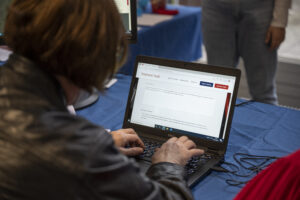
A participant submitting a memory to Telephonic Youth’s digital map at the University of Southampton’s Hands-on Humanities Day, November 2021.
Our online and in-person memory-collection has taken place alongside more established forms of historical research, notably archival research in collections including those of our partner BT Group Archives, and oral history interviews. Clips from these interviews have formed part of our exhibition at K6 Gallery in Southampton, with others soon to be available on this site. Archival and oral history research will help us to contextualise the memories we have received through our digital mapping research. This is especially important as many of the submissions to our map are, to a certain extent, decontextualised. We do not know any more details about our contributors’ lives beyond that which they chose to share with us. Although we are aware of instances where contributors shared more than one memory, the great majority submitted one. As a result, our mapping gives us a fascinating series of snapshots into people’s experiences and memories of growing up.
Of the 61 published memories which were submitted through our website —there were more which, for various reasons, we have not been able to publish on the map at the time of writing—30 of them came through our online engagement. The remaining 31 came through a series of in-person events in Southampton, including Hands-on Humanities Day, Science and Engineering Day, and pop-up stalls at local libraries across the city. Of the memories published on our digital map, 58 have been included in our analysis owing to the permissions granted by the contributors. Publishing people’s memories on a map has enabled them to be accessible and interactive, but as we explain in a follow-up post, also provides an insight into the way that geography might shape people’s experiences of growing up, as told through their memories of using the telephone.
Throughout our online and in-person public engagement work we have endeavoured to be led by the individual contributor, using as few prompts as possible to ensure that the memories we collected were those which our respondents most wanted to share at that moment in time. There have, of course, been exceptions to this, especially in the way that our social media engagement has been framed. The nature of social media-based engagement, for example, requires closer attention to themed posts during events such as LGBT+ History Month, Black History Month, and Disability History Month, or relating to specific materials we have collected in the archives. Nevertheless, these have been our guiding principles and will form the basis of our practice and thinking as we go forward.
The memories we have received may also have been affected by the other stories already published on our digital map. Rather than extracting knowledge from people, we have looked to create a community of contributors through our social media channels and by encouraging people to read other people’s memories on our website. On social media, we have frequently shared screenshots of published memories (with permission from the contributor) to publicise the project, share our findings, and encourage additional submissions. As engaged researchers, we are acutely aware that some people may have been guided in their submissions by having first read other people’s memories.
Officially, our period of research dates from 1984 to 1999, encompassing the economic and cultural shifts of the marketization of UK telecommunications and the growth of the global mobile phone market, which, by the end of the 1990s, was targeting young people as phone owners in their own right. However, in our digital mapping research, people have shared memories dating from the mid-1970s up to c.2020. That we received six memories from the 1970s, and an additional one dated ‘1975-1985’, undoubtedly confirms the significance of these particular memories to the contributors. It also shows the agency that members of the public have in this research in sharing their own stories on their own terms, and the requirement that engaged researchers work to shape their research practice in order to honour that engagement where possible. Our follow-up blogs will explain further how we have sought to do this and examine what the memories of telephone use we’ve received so far might tell us about the experience of growing up in Britain from the mid-1970s to the present.
[1] On engaged research in the discipline of History, see e.g. Jennifer Crane, ‘The NHS … Should not be Condemned to the History Books’: Public Engagement as a Method in Social Histories of Medicine’, Social History of Medicine, 34, 3 (2021), pp. 1005-27; Laura King and Gary Rivett, ‘Engaging People in Making History: Impact, Public Engagement and the World Beyond the Campus’, History Workshop Journal, 80, 1 (2015), pp.218–233.
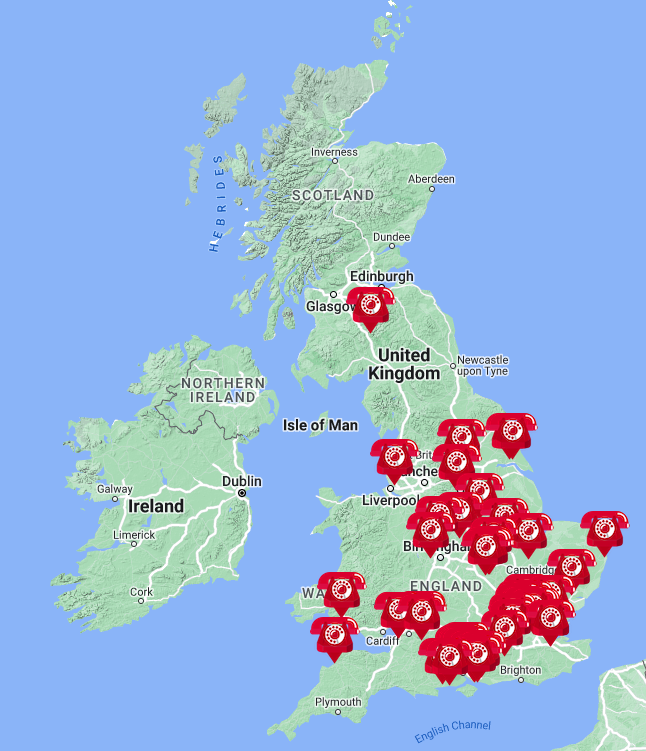
Main image: Screenshot of the map from telephonicyouth.co.uk/digital-mapping/ (as of 15 August 2022). The map shows the UK and Ireland (plus part of France and Belgium). The set of icons (red rotary telephones) indicate the locations of memories that have been submitted.