Telephone memories and the importance of place
Our research explores the changing nature of children and young people’s telephone use and telephone cultures in late-twentieth century Britain. Within this wider focus, we have been keenly aware of the importance of place in this history. In this post, we think further about the memories that people have shared with us in the first year of our work collecting stories on our digital map. We examine the importance of place to our research methods, how people articulate their memories, and in the experience of growing up (and using the telephone) over the last four and a half decades.
Place and our research
When people submitted their memories through our website, one of the things that we asked for was the ‘Address of Memory’. This information (as set out in the Privacy Notice) was required in order to create an interactive online map through which users could explore other people’s memories. In our in-person engagement, if asked about the address, we told people that they could be as detailed as they liked—many chose to give a street address including house number and postcode, but others chose to link their memories to particular neighbourhoods, towns or villages. This ensured that, as closely as possible, the pin on the map aligned with the contributor’s own geographical imagination.
As we have discussed previously in other posts on this site, our project focused initially on our home city of Southampton and the surrounding Hampshire area. We soon broadened out the scope of our research to avoid being too prescriptive about the location of memory submissions, especially as many of the people we spoke to in our public engagement work at locations around Southampton did not grow up in the city. Our use of social media also returned submissions from people from across England. We wanted to honour this engagement, and so adapted our geographical focus.
We did also receive memories from people who grew up in countries other than the UK. This again presented an important methodological and ethical challenge, and we adapted our practice to invite these contributors to submit a memory linked to a place in the UK. These submissions are a reminder that some people’s geographical imagination of their childhood and youth are global, and even if they spent their youth in the UK, the memories they most wanted to share were linked to other places.[1]
A geographical analysis of the submissions to our website did not reveal a substantial difference between memories linked to urban and rural locations. In part, this is a result of the small sample size, with the greatest differences evident over time. It is also a result of Britain’s heavily urbanised society and the massification of (youth) culture, of which the telephone was part, that there was a striking similarity in experiences.[2]
Place and people’s memories
Some of the memories we received provide forms of evidence of what geographers and social scientists call ‘sense of place’. Broadly speaking, sense of place is a term used to describe the links between people’s identities, the meanings they give to particular places, and their attachment (or lack of) to them.[3] The way that people talk about places and spaces in their memories might therefore be illustrative of their sense of place and how they, now as adults, have given meaning and developed attachments to the sites and spaces they frequented as children.[4]
One example, submitted by someone who lived in Southampton in 1996, gives an insight into how a ‘sense of place’ might work in some of the stories on our map:
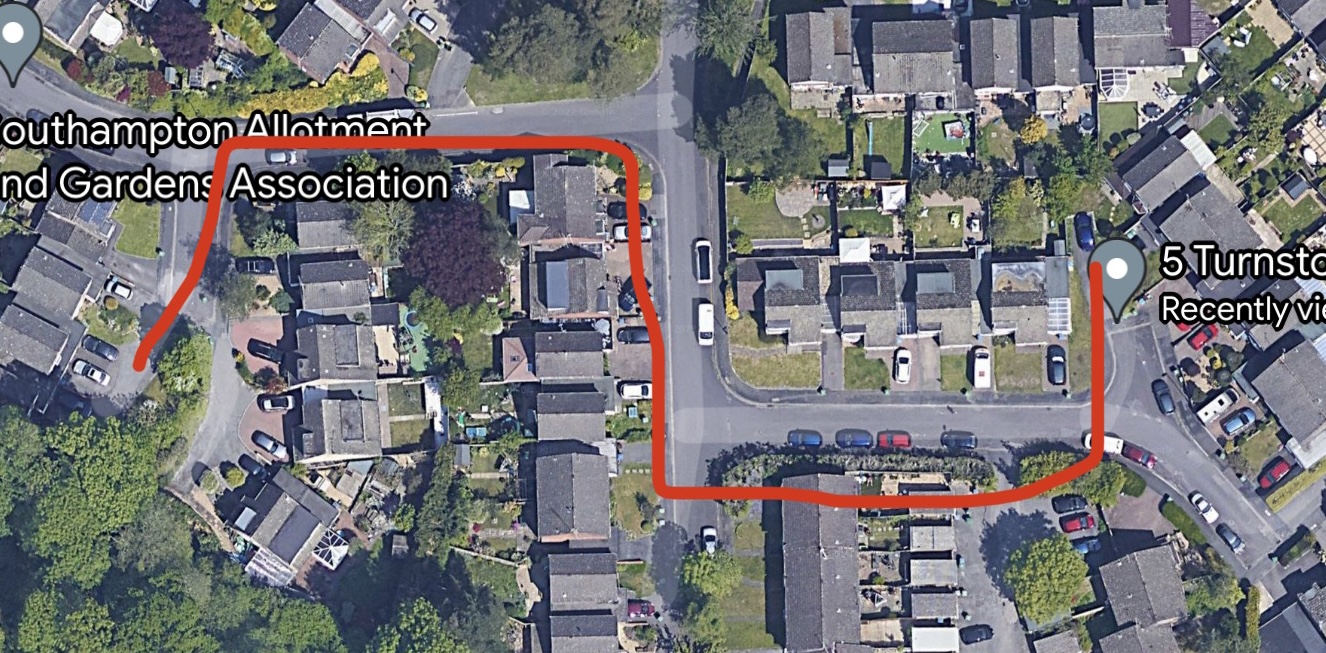
Growing up I lived at number 5 Turnstone Gardens, and my friend lived at number 40. It was probably a 2 minute stroll to her house. And yet, every time I went to her house or she came to mine, we had to call our house phone for two rings then hang up, so our parents knew we were there safely.
(5 Turnstone Gardens, Southampton, UK, 1996)
The individual also shared a map of the route from their house to their friend’s house (see the Main Image of this blog post) indicating the dissonant senses of place between the short, relatively safe route travelled by the contributor and the danger implied by the parents’ insistence on the then near-ubiquitous rule to give ‘two [or three] rings then hang up’ to let them know that they were safe.
Alongside the physical mapping by the contributor above, some memories suggested a process of mental mapping. Examples included measuring the distance to a phone box and inferred the theme of safety, which we discussed in our previous blog. Some submissions pointed to this usage within an emergency situation. One contributor, who recalled a memory linked to them being of an age when they were legally able to drive a car, submitted: ‘I can remember having to walk almost 8 miles to find a telephone box this was because I had broken down and had no clue where the next telephone box would be’.
Another contributor, who attended university in Hull, recalled that ‘one of the first things you learnt about Hull was it had its own telephone exchange and distinct white phone boxes’. In their memory, the colour and location of the phone boxes provided a vivid recollection of a significant aspect of their time as a student—calling home—with the distinct character of Hull’s street furniture adding to their sense of place in their university town.
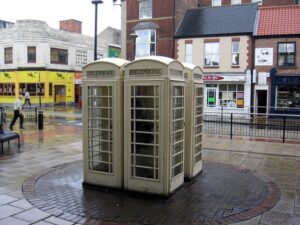
Photograph of four cream telephone kiosks in Hull. Photograph by David Wright (CC BY-SA 2.0) <https://www.geograph.org.uk/photo/244069> [Last accessed 4 October 2022]
Place, childhood, and youth
In the submissions we have collected in the first year of our digital mapping work, the most significant shift in terms of the places and spaces associated with children and young people’s telephone use have been the result of technological change. Of the 58 memories shared with permissions to use in publications, 19 (33 per cent) were of using a telephone kiosk (phone box); 34 (59 per cent) were memories of landline usage; and 13 (22 per cent) were related to mobile phones. The phone box memories were primarily from the 1970s and 1980s, with five dating from the 1990s and one from the 2000s. This should not be surprising. The number of BT phone boxes in the UK peaked in 1992, when there were 92,000 in operation, alongside those offered by other providers.[5] Since then, their numbers and usage have declined.
The continued increase in ownership of domestic landline phones and, from the late 1990s, mobile phones, meant that, over time, children and young people’s telephone use became disassociated from the phone box.[6] The significance of phone boxes as landmarks within young people’s everyday lives—as highlighted by the mental mapping discussed above—likely slowly diminished.
Within the home, the location of the landline—often in the living room or hallway—shaped children and young people’s experiences of telephone use. The fixedness of the landline meant that privacy was an issue, but it also situated emerging telephone cultures—whether this is understood as extended phone calls to friends and romantic partners or the burgeoning use of the telephone for other forms of entertainment, including television phone-ins—within a limited distance of the phone socket.
Portability and personalisation, in contrast, are defining features of mobile phone and smartphone use. Yet, childhood memories shared with us suggest there was a gradual uptake of the practice of using a mobile phone outside of children’s immediate local geographies. Submissions to our map have included two memories of mobile phone use dating from the late 1990s, one being a child’s first use of a mobile phone (using a parent’s work mobile phone in the kitchen of the family home), and the second, a recollection of using a friend’s mobile phone at school to play games during breaks. Although only two examples at the time of analysis, these submissions remind us of the value of looking at evidence of young people’s mobile phone use within family and peer settings, as much as ‘personalised’ modes of use.
Our reflections in this blog, as in our previous two blogs, are based on the submissions we had published on the Telephonic Youth Digital Map by 15 August 2022.[7] We are continuing to collect memories on our map, and you can add your own submissions here.
[1] We discussed our approach and some preliminary conclusions on this theme in a seminar paper we gave at the Britain at Home and Abroad seminar, at the Institute of Historical Research: Aaron Andrews and Eve Colpus, ‘Community histories and the challenge of scale: a global history of Britain’s telephonic youth, c. 1984-1999’ (10 March 2022).
[2] There is a great deal of writing on the massification of culture, but for a very influential theory see the essays in T. W. Adorno, The Culture Industry: Selected Essays on Mass Culture, edited by J. M. Bernstein (London, 1991).
[3] On sense of place, see Maria Lewicka, ‘Place attachment: How far have we come in the last 40 years?’, Journal of Environmental Psychology, 31, 3 (2011), pp. 207-30.
[4] On children’s sense of place, see Lucy Grimshaw and Lewis Mates, ‘“It’s Part of Our Community, Where We Live”: Urban Heritage and Children’s Sense of Place’, Urban Studies, 59, 7 (2022), pp. 1334–52.
[5] Nigel Linge and Andy Sutton, The British Phonebox (Stroud, 2017), p. 55.
[6] See statistics of the increase in domestic landline phone ownership cited in footnote 4 in ‘Tracing themes in our digital map’, Telephonic Youth website, 25 August 2022 <https://telephonicyouth.co.uk/tracing-themes-in-our-digital-map/> [accessed 4 October 2022]. The UK General Household Survey began publishing annual data on mobile phone ownership in 2000.
[7] Following the completion of the research project and the period that the website remains publicly available, the dataset of submissions to the Telephonic Youth Digital Map will be deposited and made accessible through a repository, in accordance with Arts and Humanities Research Council (AHRC) / UKRI policies.
Main Image: Map submitted by a contributor as part of the memory they shared to the Telephonic Youth Digital Map.